NEW TAIPEI CITY, Taiwan — China’s fourth aircraft carrier, a gigantic vessel known so far as just Type 004, will come out as early as next year bigger than its predecessors and with nuclear power that can launch planes faster than usual in case of any conflict, analysts say.
And it’s tipped to add pressure on countries, such as Japan and the United States, that already keep a high alert for the Chinese military.
The carrier being built now in the northern port city Dalian could accommodate 75 to 90 planes once deployed, the Asia program director at the think tank Defence Priorities has said.
As of October, the vessel’s hull measured about 322 meters in length from the unfinished bow to stern with a width of approximately 46 meters, according to the Center for Strategic and International Studies (CSIS), also a think tank.
CSIS called Type 004 “far larger than any other class of surface combatant” in China’s navy.
Aerial photos of the carrier show the “basic hull form” already built, auguring well for a 2027 launch, said Collin Koh, a senior fellow at Nanyang Technological University in Singapore. Deployment would take five to 10 years, he said.
 Related
China has ‘normalized’ naval presence near Japan since political spat of 2025
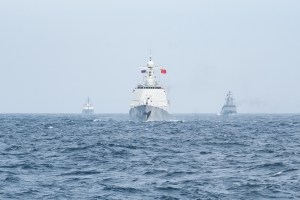
Given its scale, the massive Chinese flotilla that included coast guard vessels alongside navy warships may have had Taiwan’s maritime neighbor Japan in its sights, military experts say.
The specs would make Type 004 “slightly larger” than China’s Fujian aircraft carrier, currently the biggest one in its fleet, Koh said.
Information available today about the Type 004 – likely to be renamed after a Chinese province like the existing three – classify the vessel as a “supercarrier” in terms of electronics, tonnage and aircraft carrying capacity, said Alexander Huang, chairman of the Council of Strategic and Wargaming Studies in Taipei.
Nuclear power on board would offer the aircraft more propulsion than China’s existing electromagnetic aircraft launch system, Koh said. He said that would eliminate the need for power generators on board the carrier while allowing faster takeoffs – without payload compromises – and quick combat turnarounds for refueling.
“It seems to signal a certain strategic objective,” Koh said of the nuclear capability. “It’s not just going to move along your coast. It seems to signal a certain global ambition.”
Nuclear power will give the carrier “essentially unlimited endurance” and allow for global deployment without the kind of tanker support a conventionally powered carrier needs, said David Silbey, a Cornell University professor specializing in military history and defense policy.
The fourth carrier may get posted to northern China because the other three are in the south, Huang said. In that scenario, he said, China could “use one of the four to always operate somewhere.”
Type 004 may be used for training and maintenance as well as operations, Huang added.
China’s fourth carrier gets it closer to rivaling the U.S. navy, analysts said.
It will compare in size to the Nimitz and Ford class U.S. carriers, which means it can carry as many as 100 aircraft, Silbey said. “That gives it much more striking power than previous carriers, which could only carry around 50,” he said.
The U.S. navy has 11 carriers, all nuclear powered.
Even if smaller than the U.S. fleet, a Chinese navy with nuclear-powered carriers can mount a challenge to the United States, Koh said.
The U.S. navy maintains bases in Guam, Hawaii and Japan plus treaty alliances with Japan and the Philippines. The U.S. and China have long seen each other as rival superpowers.
Experts have said China sent an especially large number of its naval deployments near Japan’s southernmost islands and nearby waters since a political rift that erupted in November 2025 over a remark by Japanese Prime Minister Sanae Takaichi.
The Philippines is embroiled in a maritime sovereignty dispute with China.
China plans to build more carriers over the next decade for a “blue water capability that they’ve never really had before,” Silbey said. “In the Pacific, it means that they can go after American assets that are out of range of their other assets.”