The COP31 climate talks in Antalya, Turkey, failed to agree on a “pact” that – despite making no clear reference to fossil fuels or adaptation finance – had contained strong signals for oceans.
The “Antalya pact” took up much of the two weeks of negotiating time in Turkey, only to be rejected during the closing plenary by the EU, the UK and several climate-vulnerable countries.
Several countries expressed their regret during the plenary that significant work on advancing ocean-climate action would be lost.
The COP ran nearly 50 hours over time, but did not end with substantive outcomes on several key topics.
For the second year in a row, negotiations on agriculture and food security broke down and will now have to resume next year.
Food-systems advocates were, however, heartened by the explicit inclusion of “agroecology” in a decision within the “just transition work programme”.
Ocean-conservation groups noted an increased focus on ocean-climate links at this year’s COP, but said COP31 did not live up to its promise of being a “blue COP”.
There was also scant new funding for food systems and nature, with just a handful of small pledges to ocean initiatives and two newly announced contributions to the Tropical Forest Forever Facility.
Here, Carbon Brief analyses all of the key outcomes for food, forests, oceans and nature at COP31 – both inside and out of the negotiating rooms.
(See Carbon Brief’s coverage of food, forests, oceans and nature at COP30, COP29, COP28, COP27 and COP26.)
Article Contents Expand menu Close- Formal negotiations
- Cover decision
- Agriculture and food security
- Article 6
- Just transition work programme
- Adaptation
- Trade
- Climate and nature ‘synergies’
- Around the COP
- Action agenda
- Ocean
- Deforestation
- Food systems and water
- Methane
- Biofuels
- ‘Big ag’ influence
- Formal negotiations
- Cover decision
- Agriculture and food security
- Article 6
- Just transition work programme
- Adaptation
- Trade
- Climate and nature ‘synergies’
- Around the COP
- Action agenda
- Ocean
- Deforestation
- Food systems and water
- Methane
- Biofuels
- ‘Big ag’ influence
Formal negotiations
Cover decision
The final draft of a COP31 “cover decision” was rejected by at least 32 countries during a chaotic – and, at times, acrimonious – closing plenary in Antalya.
Other recent COPs have issued cover decisions, setting a firm precedent.
However, many parties remained unhappy about the existence of the cover decision, the process by which it was put together and the impact it had on time for other negotiations.
Ultimately, parties did not find consensus on the text, particularly around the removal of any reference to fossil fuels and the lack of concrete climate-finance targets.
The cover text was one of the places in the negotiations where ocean advocates were hoping to see ocean-climate linkages highlighted.
Marine Lecerf, head of international policy at Ocean & Climate Platform, told a press huddle:
“What we’re really asking for right now is to make sure we can recognise ocean-based interlinkages…We’re not asking for a new mandate. We are asking for acceleration of the work that is already undertaken.”
The first draft of the cover decision, published on 16 November, was a compilation of all the issues that parties had put forward for inclusion. It was accompanied by a short “presidency note” explaining that all elements were still in play, including whether or not they should appear in a final text.
This lengthy first draft had 21 references to the ocean, including recognising the impacts of climate change, support for ocean-observing systems, encouraging parties to strengthen ocean-climate action and a multi-year plan for the “ocean and climate change dialogue”, which occurs annually at the Bonn intersessional meetings in June.
Regarding that draft, Steven Guilbeault, former environment minister of Canada, told Carbon Brief:
“I don’t see why the elements that are in the cover decision right now on oceans should be controversial or problematic to any nations. If you’re serious about fighting climate change, there’s nothing in this text regarding oceans that should be problematic for you.”
(Earth Negotiations Bulletin reported that Russia opposed mentions of the ocean in the cover text during the ocean ministerial consultation.)
The next iteration of the text, on 19 November, retained many of the ocean elements, albeit with less detail than the first draft. The second text also removed references to post-2028 ocean work and a proposed high-level ministerial ocean dialogue.
In the end, oceans had 19 mentions in the rejected Antalya pact.
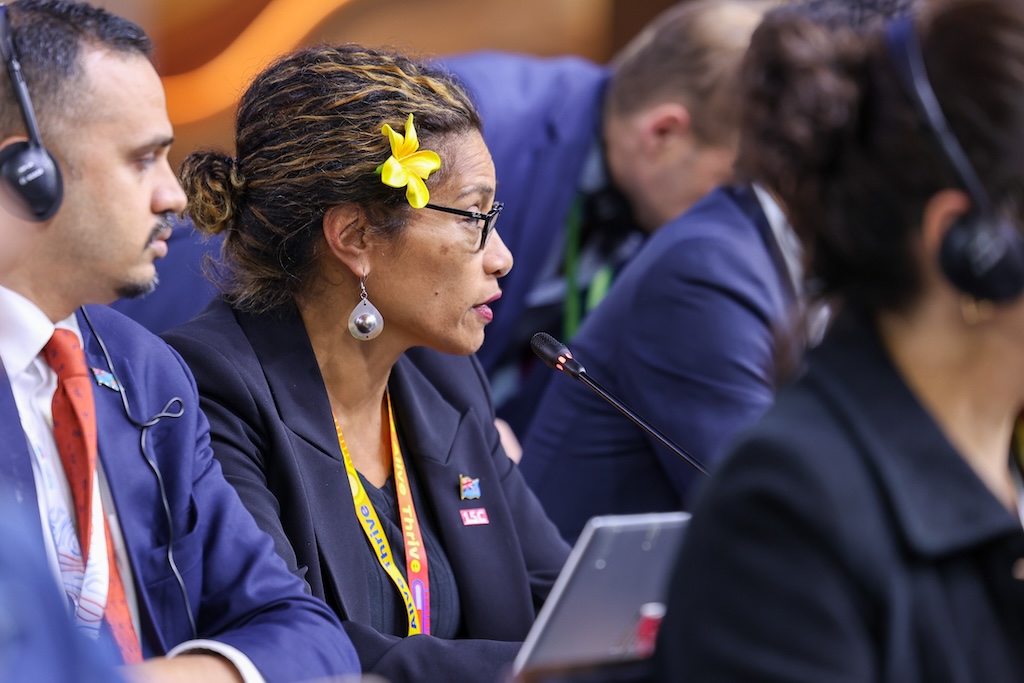 Lynda Tabuya, Fiji’s climate minister, at the closing COP31 plenary. Credit: IISD/ENB – Mike Muzurakis.
During the final plenary, Fiji’s Dr Sivendra Michael – co-chair of the ocean and climate change dialogue – appealed to the COP31 president to “humbly consolidate” the consensus on ocean as a “standalone ocean decision” and “directly submit” ten paragraphs with no objections in text as a “way to preserve” work done.
Lynda Tabuya, Fiji’s environment and climate change minister, said:
“The ocean-climate nexus is undeniable. We, the people of the Pacific, are deeply indebted, as the ocean is our home, our identity and it is what connects us. There is no climate action without ocean action. We hope this is not lost today and that parties will please consider keeping the ocean text alive.”
Other aspects of the natural world garnered significantly less attention in the cover text.
The final decision failed to mention the Brazil-led roadmap on deforestation, although it was “welcome[d]” in the initial draft. (See: Deforestation.)
Mentions of the “critical role” of forests in carbon storage, food security, biodiversity and community adaptation were also stripped from the text between the first and second iterations.
The final Antalya pact – that was rejected – did, however, retain wording on deforestation agreed by countries in the global stocktake at COP28 in Dubai.
 Language on deforestation included in the final, rejected draft of the COP31 cover decision. Source: UNFCCC.
The same draft also “recognises” the role of nature-based solutions and ecosystem-based approaches as “essential climate solutions” – although many experts reject the former term and warn that its vagueness leaves it open to deliberate misuse.
The final draft cover decision “emphasised the importance” of nature, forests, the ocean and other ecosystems as “natural infrastructure for resilience”, while “recogni[sing] that they play a critical role as sinks and reservoirs of greenhouse gases”.
Experts, however, were concerned that this language preceded a paragraph “welcoming” carbon dioxide removal, even if it “stressed” that these methods – that include tree planting – “should ensure environmental safeguards and respect the rights of Indigenous peoples”.
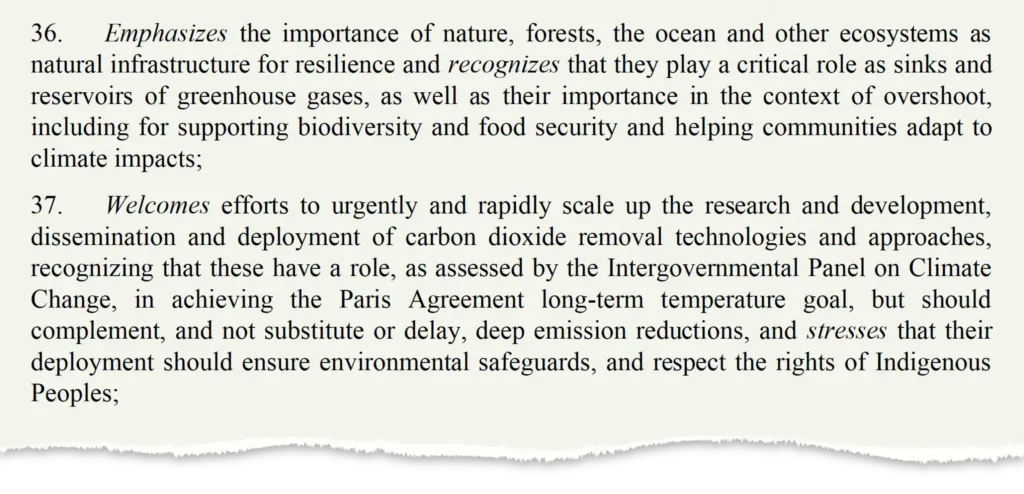 The final cover decision that was rejected had paragraphs on oceans and forests as sinks, as well as carbon dioxide removal. Source: UNFCCC.
None of the iterations of the rejected cover decision mentioned COP17, the biodiversity summit held in Armenia, which concluded just 10 days before COP31 started. Nor did they mention the Kunming-Montreal Global Biodiversity Framework (GBF), a landmark pact sealed in 2022 to reverse biodiversity loss by 2030.
When Carbon Brief pointed this out to Guilbeault – a key architect of the GBF – in an interview on 17 November, he vowed that he would try to make the case to ministers to get these aspects added in.
One observer told Carbon Brief that the “toxic” nature of discussions over the need for closer “synergies” between climate and biodiversity summits could explain the lack of mentions in the cover decision.
Despite this, they said the rejected pact did “underline” the “urgent need to address, in a comprehensive and synergetic manner, the interlinked global crises of climate change, biodiversity loss, desertification and land and ocean degradation”.
Adopting such language would have represented positive progress, the observer added.
Although the first draft of the cover decision referenced “food” twice – in the context of food security – both of these instances were removed in the subsequent draft. The rejected final cover decision draft mentioned “food security” four times.

Membership
Support award-winning climate journalism
Join CB+However, observers told Carbon Brief that a mention of “food” or “food systems” in the cover decision was not a priority for them. Teresa Anderson, global climate-justice lead at ActionAid, said:
“What we often find is that getting references or language to things in the cover decision doesn’t really play out as impacts on the ground and it’s more effective to push a meaningful agenda in a negotiation space.”
Agriculture and food security
For the second year in a row, negotiations on the Sharm el-Sheikh joint work on agriculture (SJWA) collapsed without parties reaching an agreement.
SJWA is where formal negotiations around climate change and agriculture take place under the UNFCCC.
Part of SJWA’s mandate is to synthesise information about work being done in the agricultural space – under both the UNFCCC and other international bodies – in an annual report.
SJWA also held two workshops – one on holistic approaches to agriculture and one on “means of implementation”, usually taken to mean finance – where countries and other partners could share their experiences, as captured in summary reports.
At COP31, parties were meant to discuss the conclusions of these reports and, time permitting, decide on the future of the agricultural workstream under the UNFCCC. (The four-year mandate of SJWA was set to end at COP31.)
Work “moved very slowly” in the first week, said Oliver Camp, senior policy and implementation specialist at the Global Alliance for Improved Nutrition. He added:
“It took a really long time to get into any substantive conversation.”
Ahead of the summit, many observers were hopeful of agreeing a text that recognised agroecology as beneficial for humans, climate and biodiversity.
However, in the first negotiating session, on 10 November, the Arab group expressed its view that fertilisers are vital for food security and fertiliser exports are being impacted by the EU’s carbon border adjustment mechanism (CBAM). Therefore, it said, the agriculture talks needed to discuss CBAM and other trade measures.
Teresa Anderson, global climate-justice lead at ActionAid, called this a “total curveball” in the negotiations. She told Carbon Brief:
“Everybody’s faces just dropped…Suddenly we knew that the chances of agroecology having a chance had been pretty elegantly spiked by putting in this really complicated political issue into the middle of the agriculture discussions.”
Other observers also expressed frustration to Carbon Brief that the group had brought CBAM into the negotiations, noting that trade measures are being discussed elsewhere in the COP. (In the end, trade measures were not included in any agreed elements of COP31.)
At the end of this session, parties were asked to submit their views in writing for consideration, with the like-minded developing countries (LMDCs) proposing an extension of SJWA to COP32.
Another major point of contention in the room was what, exactly, a draft text should cover.
The EU – along with Canada – said that the discussion should focus on the commonalities in countries’ positions, rather than the differences. Carbon Brief understands that opposition to this came from the G77 and China, along with the Arab group and the LMDCs, who said that areas of disagreement needed to be addressed through negotiation.
At the same time, said Camp, “there are a few fundamental rifts” around the scope of the work being done in SJWA itself. He told Carbon Brief: