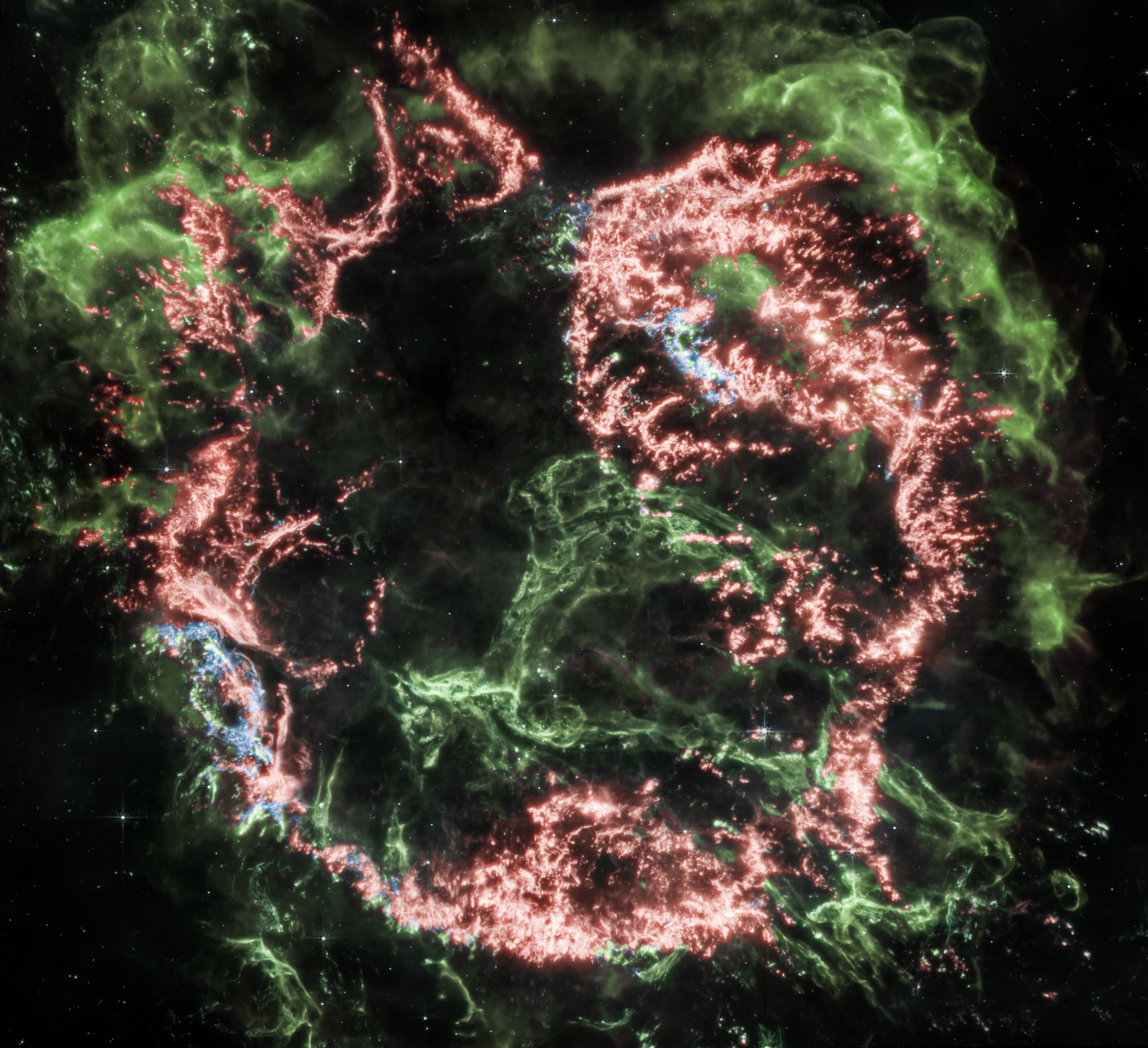
 NASA’s James Webb Space Telescope reveals the hot dust that makes up Cassiopeia A. The composition of its dust provides clues to the structure of Cassiopeia A’s original star.NASA, ESA, CSA, STScI, Tea Temim (Columbia University), Rick Arendt (UMBC), Dan Milisavljevic (Purdue University); Image Processing: Joseph DePasquale (STScI)
NASA’s James Webb Space Telescope reveals the hot dust that makes up Cassiopeia A (Cas A) in this high-resolution, mid-infrared image released on Nov. 23, 2026. Remnants like these are the clouds of gas and dust that remain following the explosion of a massive star and will eventually seed a new generation of stars and planets. The Webb data supports a scenario in which the interior of the star underwent a dramatic change, possibly just hours before its demise.
See what scientists have learned about Cas A from Webb’s observation.
Image credit: NASA, ESA, CSA, STScI, Tea Temim (Columbia University), Rick Arendt (UMBC), Dan Milisavljevic (Purdue University); Image Processing: Joseph DePasquale (STScI)