Science advocates react to Democrats’ historic midterm rout: ‘It’s a new day in Washington’
Researchers and advocates say they hope the “blue wave” could signal more accountability after two years of attacks on science
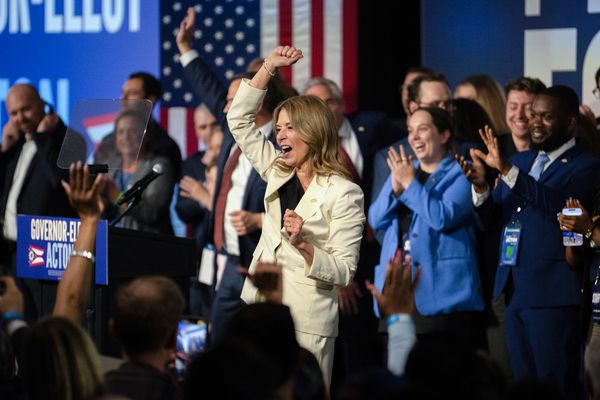
Amy Acton, former director of the Ohio Department of Health, then gubernatorial candidate and now Democratic governor-elect of Ohio, during an election night event with Ohio Democrats in Columbus on November 3, 2026.
Photographer: Jessica Phelps/Bloomberg
Amy Acton, former director of the Ohio Department of Health, then gubernatorial candidate and now Democratic governor-elect of Ohio, during an election night event with Ohio Democrats in Columbus on November 3, 2026.
Tuesday’s midterm election marked a sea change in the country’s political landscape, with Democrats sweeping control of Congress and making historic gains in many state legislatures. Now science advocates say they want answers for what has happened during the first two years of the Trump administration.
“It’s a new day in Washington,” says Gretchen Goldman, president and CEO of the Union of Concerned Scientists. “There’s huge opportunities for science, for democracy, for getting accountability for these attacks on science that we’ve seen. We are keen to get to work pushing back.”
Since taking office in 2025, the Trump administration has turned science into a battleground, slashing or outright canceling federal grants and research that was deemed too “woke.” Thousands of federal workers, including researchers, lost their jobs or decided to leave government. And the White House has pushed the country’s science funding to favor artificial intelligence and other technologies over other scientific fields, including medical research. At the same time, federal agencies have rolled back numerous anti-climate change measures in moves that critics say leave the country more vulnerable to warming and emissions.
On supporting science journalism
If you're enjoying this article, consider supporting our award-winning journalism by subscribing. By purchasing a subscription you are helping to ensure the future of impactful stories about the discoveries and ideas shaping our world today.
The sweeping defeat exacted by Democrats on Tuesday is a stinging rebuke to those efforts, says Colette Delawalla, founder and CEO of advocacy group Stand Up for Science.
“Thinking through how all of this could pan out, this outcome is better than any eventuality that we that we worked through,” she says.
Democrats seized control of a majority of governorships for the first time since 2010, flipping races in Georgia, Iowa, Texas, Ohio and Nevada. Julie Scofield, a member of the coordinating committee for Defend Public Health, an advocacy organization, noted that Ohio’s new governor-elect is physician Amy Acton. She led Ohio’s public health system during the start of the COVID pandemic and was “very vocal about public health issues and concerns during her campaign,” Scofield says.
Among the winners in the Senate were several others with science backgrounds, including Abdul El-Sayed, who holds a medical degree and PhD in public health, in Michigan and pediatrician Annie Andrews in South Carolina.
Both candidates were supported by 314 Action, a political action committee that backs candidates with scientific expertise.
"Last night, scientists fought back and and won," says Shaughnessy Naughton, the organization's president. "This was a romp. The candidates worked hard and it's well deserved."
The victories also mean Democrats will take over key congressional committees and subcommittees, empowering them to help set the country’s science and health agenda. Russ Paulsen, president and CEO of Research!America, observes that, even under Republican leadership, Congress had acted as a check on the executive branch, restoring some of the cut grants and preventing some of the most controversial efforts to politicize science funding.
“We think that this bipartisan support is going to continue,” he says. “We hope that it will stay the priority that has been for these members and that they’ll begin to roll back the damage that the Office of Management [and] Budget (OMB) has done.”
One proposal from the OMB in particular, a set of rule changes that would have granted political appointees—and not area experts—control over which grants were approved, was voted down by Congress in a stopgap funding bill that passed in September. That bill expires in December, before the new Congress is sworn in. Paulsen says he is optimistic that the proposed rule changes will not be included in any bills passed during the lame duck session.
“The Congress that was sitting before this election will come and sit again,” he says. “They voted against this OMB overreach. There’s no reason to think that they won’t vote against the OMB overreach again.”
Delawalla speculates, however, that once the new Congress is sworn in, there will be a more aggressive tone toward certain Trump officials, such as Secretary of Health and Human Services Robert F. Kennedy, Jr., who has pushed to overhaul the country’s vaccine policies in ways that public health experts have said endanger Americans.
"His administration of HHS has been a unbelievable disaster, and I do look forward to Congress holding him accountable and making him answer for the disastrous decisions that he has made and inflicted on the American people, whether it's to our public health system, or mRNA research that has clearly shown unbelievable potential for better health outcomes," says Naughton.
At the same time, Democrats gaining power to set federal budget priorities presents opportunities to “restore some of the things that have really devastated the public health system over the last several years,” Scofield adds.
For example, President Donald Trump’s signature One Big Beautiful Bill Act, passed in 2025, includes massive cuts to Medicaid spending, a measure that Scofield says she hopes could be reversed.
“I think we have to understand that state and local public health departments rely heavily on federal funding. We have to restore that funding stream,” she says.
Improving funding to Medicare and Medicaid, as well as reestablishing subsidies and funding for the Affordable Care Act, must be "the number one issue" for Democrats in the near future, says Naughton.
Editor’s Note (11/4/26): This is a developing story and may be updated.
Great science journalism requires human expertise, time, effort and creativity. And it costs money. That’s why I and the journalists here at Scientific American hope you’ll join our community.
When you subscribe, you are supporting staff and freelance journalists who are passionate about telling science stories that are true, important and compelling. Our editors and reporters are often experts in their fields, which means they understand the nuances of big discoveries and can untangle the breakthroughs from the hype. With a subscription, you are also supporting rigorous fact-checking to ensure the words we publish are precise and accurate. And you’re supporting original illustrations, graphics and photos that bring you closer to an advanced laboratory, an ice sheet in Antarctica or a space mission in orbit. You’re helping us craft other types of high-quality journalism as well: Our newsletters are carefully written, edited and curated by staffers you have or will come to know and love. Our Science Quickly podcast is based on original reporting, collaboration with editors and scientists and exacting production.
Subscriptions keep this engine running so we can continue to deliver thoughtful, rigorous and independent science journalism to you. In an era of viral misinformation, this work is crucial. If you value what we do, I hope you’ll consider joining us as a subscriber