Xgimi Elfin Flip 4K: One-minute review
The Xgimi Elfin Flip 4K brings a host of upgrades to the Elfin family. Its stand makes it all the easier to set up in different places, as does its modicum of optical zoom and quick automatic digital adjustment. It even has a lot more connection options than its predecessor, not to mention a more capable Google TV operating system.
The real prize is under the hood, where the Elfin Flip 4K upgrades to an RGB laser light source that’s fairly bright, offers good contrast, and delivers stunning color. That all channels into a 4K picture or a 1080p/120Hz VRR picture for gaming. This gives the Elfin Flip 4K some great chops for setups in dark and dim rooms, though it’s not enough to hold up in bright conditions.
(Image credit: Future)Packing all of this into a product that costs just $999 makes it a strong value option for the best projectors. Just plan on pairing it with some sort of speakers, as the built-in 7-watt speaker is just there for basic utility. Even a pair of cheaper Bluetooth speakers will be a huge upgrade to the sound quality.
While the Xgimi Elfin Flip 4K may not be a top-tier projector, it stands out as a great option for money.
Xgimi Elfin Flip 4K Review: Price and release date
- Release date: mid-2026
- MSRP: $999 / £869 / $1,995
The Xgimi Elfin Flip 4K launched in the middle 2026. It came alongside the Elfin Flip Laser, which offers many similar qualities but comes with a 1080p resolution instead. Though the Elfin Flip 4K doesn’t make it clear in the name, it also uses RGB laser projection.
The Elfin Flip 4K launched with a $999 / £869 / $1,995 price tag. It will likely see modest discounts during major sales events, and has even been $100 / £220 off during the course of testing.
Xgimi Elfin Flip 4K Review: Specs
Supported screen sizes
40 to 200 inches
Optical technology
3 Laser DLP
Brightness (specified)
1,600 Lumens
Audio
1x7-watt speaker
Ports
2x USB-A, 1x 3.5mm audio out, 2x HDMI 2.0 (1x eARC)
Smart TV
Google TV
Dimensions
10 x 9.65 x 3.07 inches / 254 x 245 x 78mm
Weight
3.42 pounds / 1.55kg
(Image credit: Future)Xgimi Elfin Flip 4K review: Design and features
- Integrated stand is good for vertical adjustments, but not rotation
- Optics offer minor zoom and quick digital correction
- More ports than before and Google TV built in
The original Elfin has received some considerable upgrades with the Elfin Flip 4K. The new design keeps a similar look for the actual projection hardware, situating everything into a flat box about the size you’d get a personal pan pizza in (10 x 9.65 x 3.07 inches / 254 x 245 x 78 mm). But this time, the projector is held captive in the middle of a square ring-shaped mount.
This mount is akin to the gimbal stands we’ve seen on many other mainstream projectors of late, except that it goes up above the projector as well, letting it protect the hardware but also preventing it from pointing directly up. The stand otherwise makes it easy to angle the projector as needed, though there’s no feet for rotation correction. (You can mount the stand on a tripod, but that may start to look really awkward.)
With the new stand and some extra internal hardware, the Elfin Flip 4K ends up a bit beefier than its predecessor, standing at 3.42 pounds / 1.55kg, but that’s still exceptionally light for a projector that’s doing what it does.
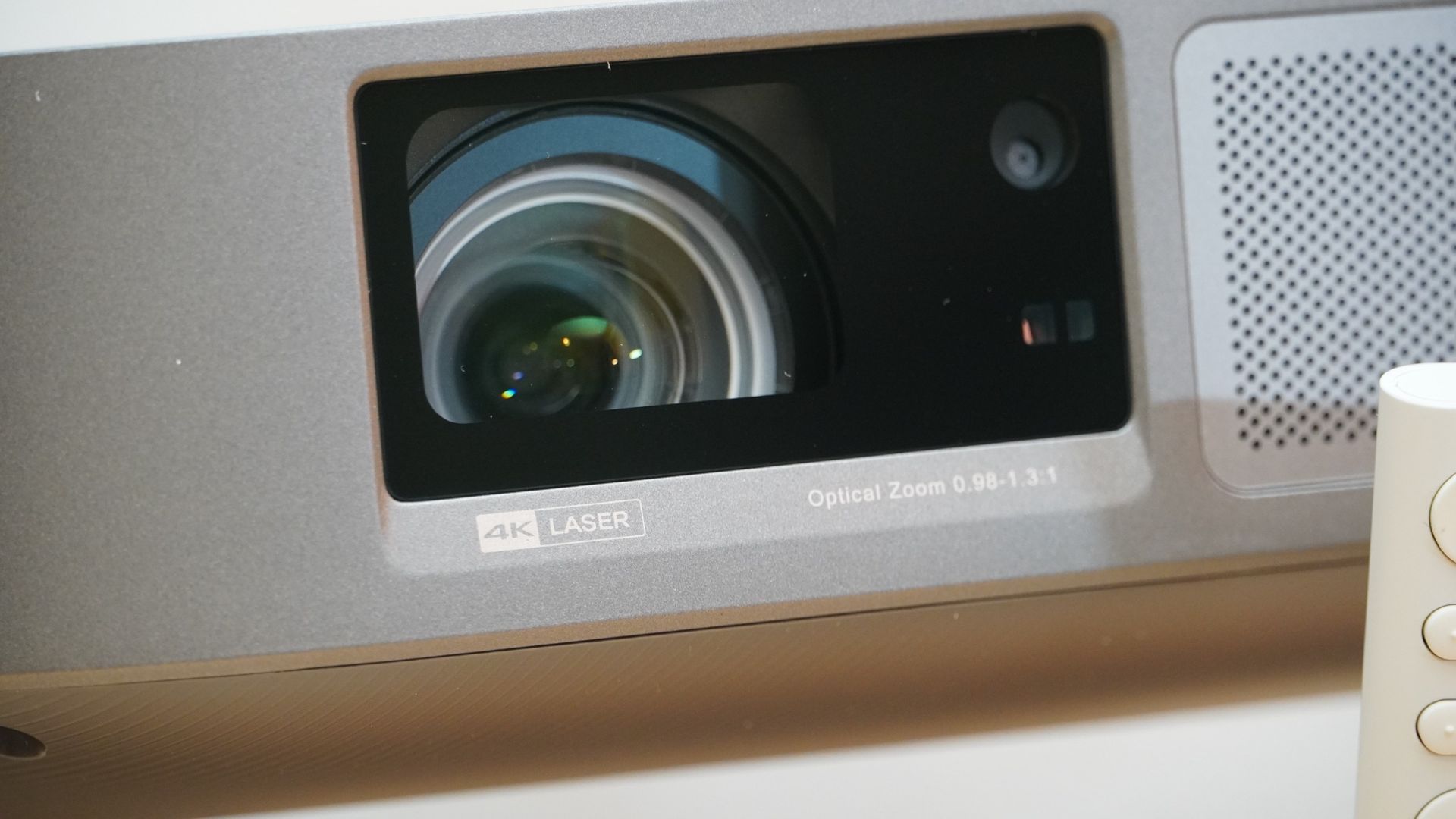
The Elfin Flip 4K fits in a 4K DLP chip and RGB laser projection system. It also squeezes in adjustable optics. They’re not the most flexible, offering no lens shift or a very wide zoom range, but they let you shift from a 0.98:1 throw ratio to as far as 1.3:1. This makes the Elfin Flip 4K better suited to shorter throw distances, such as from a coffee table in the middle of a room or from the ceiling, rather than a shelf or mantle at the back of the room. That consideration does make it a little awkward that the speaker fires out the front of the projector while the exhaust shoots out the back.
You’ll get more ports out of the Elfin Flip 4K as well. On the back, it has two HDMI ports (including one with eARC support), a 3.5mm audio connector, and two USB-A 2.0 ports. There’s a barrel jack as well for the 120W input to power the projector. Populating all of these ports does make the Elfin Flip 4K a little precarious, as it already can teeter a bit on its stand, and a bunch of cables coming out the back present new opportunities to tug and twist it.
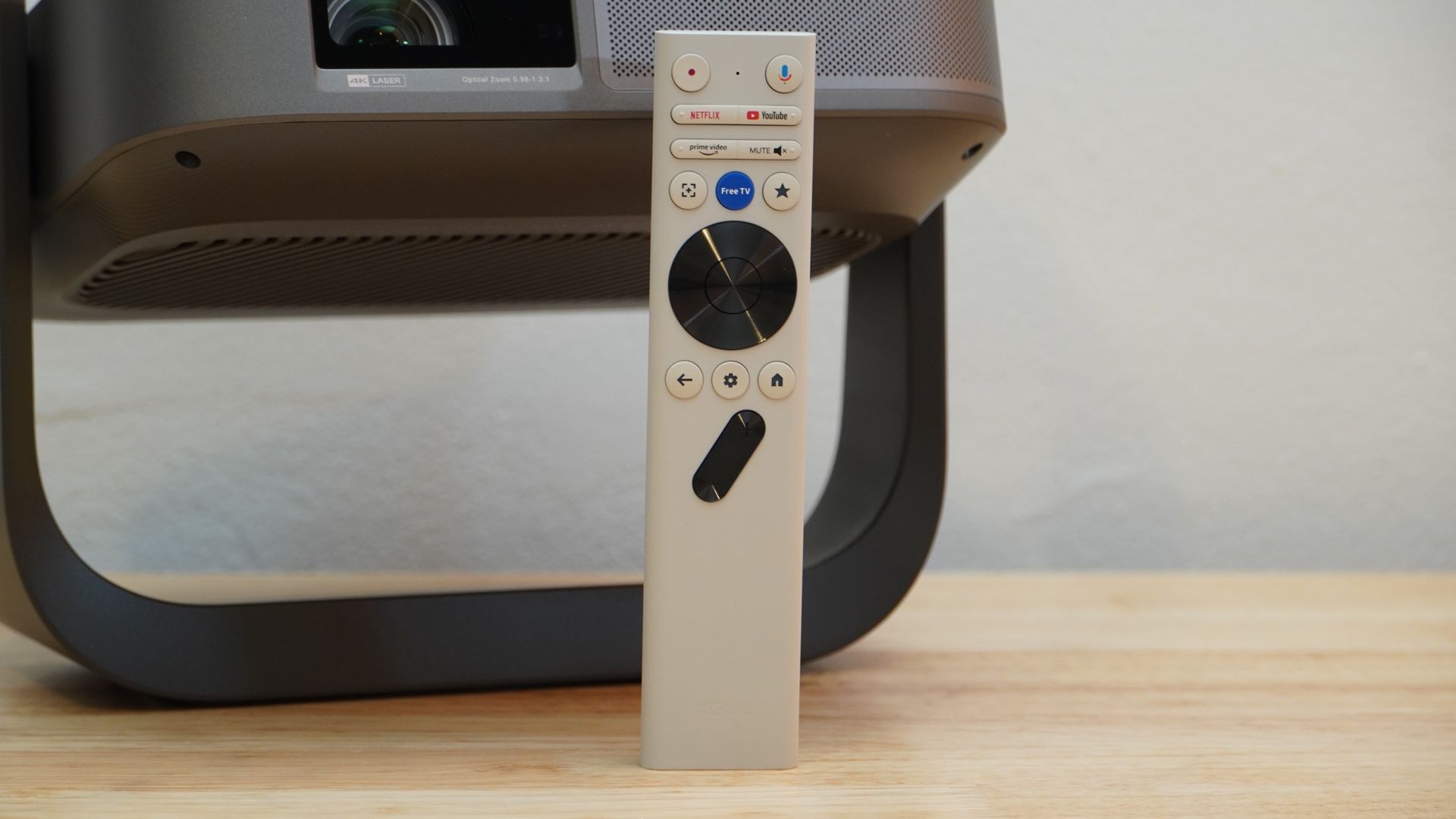
(Image credit: Future)You can get by with just the power cable, though, since the projector has Google TV built in with a healthy 64GB of storage for apps. This time around, Netflix is supported, which wasn’t the case on the original Elfin or many projectors at that time. The Elfin Flip 4K can connect over Wi-Fi 6 for fast and stable internet connections.
You probably will want to at least take advantage of the 3.5mm jack if not the eARC port, as the Elfin Flip 4K features a single 7W speaker that doesn’t even come close to matching the projection chops.
Initial setup of the projector is a little tedious, especially as it will only do basic focus and keystone calibration at first. The Google TV setup also requires scrolling through a list of seemingly every country in existence to find yours (Lucky for you, Australia). After Google TV is all set up, the projector offers a bit more capable automatic adaption, quickly focusing, zooming, keystoning, and cropping to fit the projection to a screen or available wall space. I found it quite accurate in testing, too.
While the projector is designed for 4K/60Hz video for home theater uses, it also supports gaming with the option to drop down to 1080p/120Hz with VRR. There are a few settings at play for enabling this, and it proved a small headache to get them right.
Certain setting toggles simply ignored me, others told me I needed to enable another setting first. Trying to get the display to run at 120Hz even after sending it a 120Hz signal required me to enable PC Mode and then Projector Super Frame. Trying to enable the latter without first doing the former would appear to enable the toggle, but actually wouldn’t, and returning to the menu later would show it still disabled. Without Projector Super Frame enabled, the projector will skip every other frame from a 120Hz source.
- Design & features score: 3.5 / 5
Xgimi Elfin Flip 4K review: Picture quality and performance
- Colorful 4K picture looks great in the dark
- Not bright enough for modestly lit room
- Single speaker is just serviceable
The Elfin Flip 4K has enough brightness to look great in a dark, home theater environment. In my testing, I measured it at just about 1,100 lumens. Xgimi’s higher rating is based on a performance mode that’s both noisy and hideous and clearly not intended for typical viewing. Even at 1,100 lumens, the Elfin Flip 4K is far too dim for a bright room, and can struggle in a dim room. It won’t look its best if there’s ambient light, but you’ll be able to see content just fine.
The projector has a feature called AIPQ, and combining that with a brighter gamma curve helps in brighter conditions, but it over-saturates colors and can make for some awkward color shifting. Some HDR details don’t sizzle as much as they should, such as the bright thrusters of the humans approaching and landing on Pandora in the opening of Avatar 2: Way of Water.
In dark scenes, the Elfin Flip 4K can struggle. The hedge maze fight scene near the end of The Gray Man is a dim sequence with a lot of shadow, and the projector doesn’t get its black levels very deep, leaving some areas appearing a hazy dark gray, and that makes fine detail in dark areas harder to make out. Dialing up the local contrast feature improved matters a bit, dropping black levels in some dark scenes enough to not look so washed out, although dark details weren’t any easier to make out.
With a bit more light in scenes, the Elfin Flip 4K hits its stride. The projector is wonderfully colorful, hitting 97% of the DCI-P3 color space and 92% of the BT.2020 color space by my measurements. For cartoons like X-Men ‘97, this looks marvelous. It offers surprisingly fair contrast as well. By measuring the white levels of two white boxes in each corner of an otherwise all black image and then blocking all but the middle of the middle of the projection with black velvet to see what the true black level is without any light reflected back onto the screen, I recorded a best-case contrast of 3,247:1.
 Future
 Future
 Future
 Future
Motion is generally decent on the Elfin Flip 4K. It uses a lot of smoothing by default, but it didn’t look awful for live action video. In Dark Winds, it smoothed out pans without introducing distracting artifacts. But in Ghost in the Shell, an animated show, it created unusual pacing in the animation that stilted it. Xgimi also has a Real Cinema settings for MEMC that can keep up with even dramatically panning drone shots without the unsightly artifacting.
The Elfin Flip 4K uses DLP projection, and one artifact this can result in is the DLP rainbow effect. Its effect here is not the most egregious I’ve seen, but I spot it from time to time in white areas of the screen, particularly subtitles.
You can also enjoy gaming fairly well on the Elfin Flip 4K. By default there's enough latency coming from the system to be a little annoying while trying to game. Even mousing around a PC desktop feels laggy. That drops to a more tolerable level with the projector’s gaming mode enabled, though the response still isn’t quite instantaneous. To get it really feeling locked in, the projector needs to switch over to its Boost mode, which disables all keystone and digital image adjustments. That may work out if you don’t need keystone adjustments, but it could be trouble if you do. However, at least in that boost mode, I didn’t feel the latency anymore.
Alternatively, the projector can drop down to 1080p/120Hz using its Projector Super Frame setting, which actually hurts clarity more than simply dropping to 1080p alone does. But with it, the projector feels very responsive and visuals are fluid in action. With those settings, I found I was readily able to plow through Hades 2 levels, handling Cerberus on my second attempt and taking Chronos within an inch of his first health bar on my first encounter with him. Eventually, I was even able to defeat him while playing in 4K.
The single 7-watt speaker on the Elfin Flip 4K is just good enough to get by. For an action movie like The Gray Man, it pushes decent volume for the explosions and gun shots while keeping clear mids that help ensure voices are clear. Of course, you’ll entirely miss out on stereo and surround sound as well as any real bass. But for casual viewing and a focus on dialogue, it’s not awful.
- Picture quality & performance score: 4 / 5
Xgimi Elfin Flip 4K review: Value
The Elfin Flip 4K is not without its shortcomings, but its value is remarkable. For $999 / £869 / $1,995, it provides smashing visuals that look lovely in the dark of a home theater. And it holds up modestly in lighter conditions for more casual content. The simple portability, ease of setting up in new locations, and extra flexibility with some optical zoom are really great to see at such a price.
Sure, you won’t get world-class sound, but even $4,000 projectors call for extra speakers to match their visuals. There’s more I’d love to see, like Dolby Vision support, optical lens shift, and an even faster 1080p mode, but the Elfin Flip 4K is already packing in an impressive array of capabilities for its $999 / £869 / $1,995 price tag. Looking at what it competes with, it’s a strong value.