8849 TANK 5 Pro: 30-second review
The Tank 5 Pro has but one purpose - it adds thermal imaging to the Tank 5 and changes almost nothing else from the prior design. 8849 admits as much on its own website - the only difference between the two phones, it states, is the thermal camera.
This design was already the most complete rugged projector phone on the market. It had a flagship chip, a gorgeous screen and a battery that recharges in about 90 minutes. The Pro keeps all those strengths and adds one more: thermal imaging.
You get a FLIR Lepton 3.1R sensor with a 95-degree field of view. 8849 claims that is a world first for a phone. Most thermal phones manage 50 or 57 degrees. A wider view means you see more of a room, a wall or a fuse board without having to move the device around.
The price of that view is resolution. The sensor delivers 160 x 120 native pixels. Software upscaling takes it to 480 x 360, and visible light edges are overlaid to help you read the image. It is useful, but it will not rival a dedicated high-end imager.
So who is it for? Electricians, builders, surveyors, solar installers and rescue teams spring to mind. Anyone who has ever wondered where the draught is coming from might also apply. If you will never point it at a hot pipe, save your money.
Would I consider this one of the best rugged smartphones? That depends on how much functionality you want in a single handset, but it deserves some recognition for its unique feature set.
(Image credit: Mark Pickavance)8849 TANK 5 Pro: price and availability
- How much does it cost? From $1150/£885/€809
- When is it out? Available by November 20 2026
- Where can you get it? Direct from the maker or via an online retailer
8849 has announced that this phone will be available from November 15, 2026 in the USA, with other regions from November 20, 2026, directly from the maker.
There are three SKUs: 16GB+512GB, 18GB+512GB and 18GB+1TB - US pricing for the three is $1149/ $1,199/$1,299, respectively. In the UK, that’s £885/£924/£1001, and in the EU those prices are €1.045,95/€1.091,95/€1.182,95.
Where is it cheapest? America obviously. It’s more than $20 per SKU in the EU and $45 more in the UK, making that location the most expensive place to buy.
Not sure why the UK gets the thin end of that wedge, but that’s the price 8849 decided.
I’ve noticed that 8849 has ditched the 16GB model of the original Tank 5, and it now only comes in the 18GB+512GB option for $999.99, £770 or €910,95 depending on your region.
That makes the inclusion of a Thermal camera an extra $200, £154 or €181 for each area.
But if it were my money, I’d buy the 16GB+512GB Tank 5 Pro model, as most people would never notice the difference, and it’s only $150 more than the 18GB+512GB Tank 5, and it has the thermal camera.
Competition is thin. Rugged phones with thermal cameras exist, but none that I know of also pack a projector that I’m aware of. The Oukitel WP70 Ultra offers thermal imaging and a 16,000mAh battery, but it’s not released, and no price has been confirmed.
The real comparison is with a standalone thermal imager, like those by ThermalMaster, but these typically start at around $250 for a USB-connected camera.
What these add-on cameras lack is the ability to merge the thermal data with conventional light camera data for image fusion, which makes for much better readability.
Obviously, this isn’t a cheap phone, but in terms of specifications and features, it seems like good value, especially if you live in America.
Unfortunately, the flip side of being in the USA is that the service providers are notoriously anti-consumer, and you will need to be on AT&T to use the Tank 5 or Tank 5 Pro. Curiously, other 8849 phones and tablets support Verizon and T-Mobile only.
In Canada, you can use Bell, Rogers, Videotron, Freedom, and Telus. In the UK, most will work, including EE, H3G, Sky, Telefonica(O2), Virgin, Vodafone and Gamma. Australians can use Optus, Telstra and VHA. Major carriers in other countries are supported, so you should be good if you check the supported frequencies before buying.
(Image credit: Mark Pickavance)- Value score: 4/5
8849 TANK 5 Pro: Specs
Item
Spec
Processor
MediaTek Dimensity 9400e, 4nm, octa-core (1x Cortex-X4 at 3.4GHz + 3x X4 at 2.85GHz + 4x A720 at 2.0GHz)
GPU
Immortalis-G720 MC12
RAM
18GB LPDDR5X (plus 18GB virtual)
Storage
512GB UFS 4.0, microSD expandable to 2TB
Display
6.73-inch AMOLED, 3200x1440px (3K), 120Hz, 3000 nits (local peak), Panda Glass
Thermal camera
FLIR Lepton 3.1R, 160 x 120 native, 480 x 360 with VividIR, 95 degree horizontal view, under 50mK sensitivity
Thermal ranges
High gain: minus 10°C to 140°C. Low gain: minus 10°C to 400°C
Main Camera
50MP Samsung ISOCELL GN1, PDAF, f/1.8, 4K30fps
Telephoto
50MP, 3x optical zoom, OIS
Night Vision
50MP with 4x 940nm infrared LEDs
Front Camera
32MP OmniVision OV32B40, f/1.7, 1080p video
Battery
17,600mAh dual-cell
Charging
120W wired (full charge approx. 90 min), 25W reverse charge
Projector
TI DLP, 2K resolution, 220 lumens, 0.5 to 4m laser autofocus, 4-point keystone correction
OS
Android 16
Connectivity
5G, WiFi 7, Bluetooth 6.0, NFC, dual frequency GPS (L1 + L5)
SIM
Dual Nano, Nano + eSIM, Nano + microSD, or Nano + eSIM + microSD
USB
USB-C 3.2 Gen 1 (DisplayPort 1.4 Alt Mode)
Rugged Rating
IP68 and IP69K
Dimensions
177.1 x 87 x 33.8mm
Weight
733g
Colours
Black
8849 TANK 5 Pro: Design
- Thick and heavy
- Vents for the projector on both sides
- Now with a thermal camera
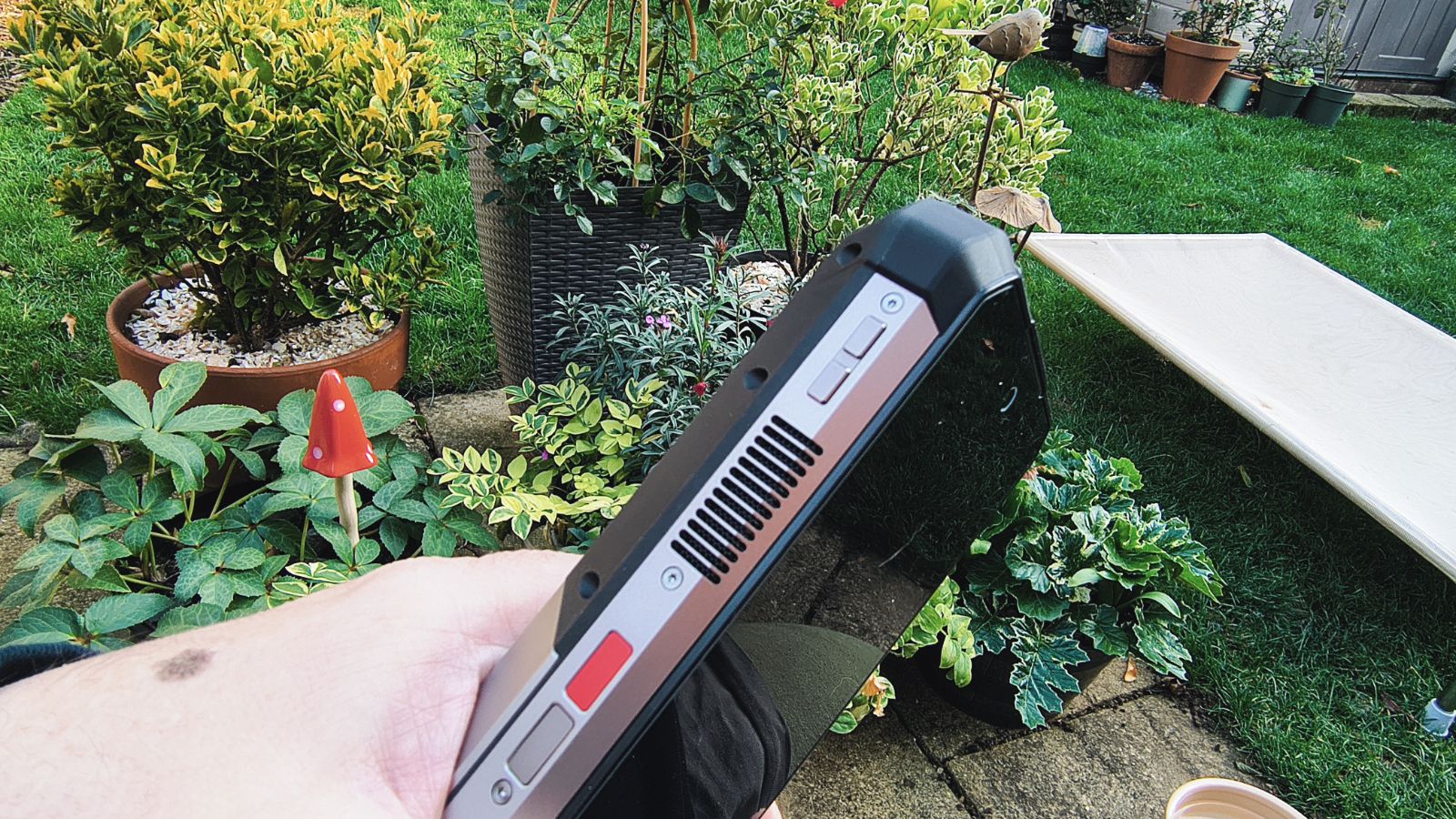
Hold the Tank 5 Pro, and it feels exactly like the Tank 5, which is good if you want something that feels built to double as a sledgehammer. The chassis blends brushed metal plates, rubberised corner armour and polycarbonate panels. It’s built for abuse, and if you drop it on your foot, you'll be the one giving, not the Tank 5 Pro.
The dimensions are identical to the Tank 5 at 177.1 x 87 x 33.8mm. So is the weight at 715g. That is surprising. A thermal module with its own shutter and optics has to go somewhere, and it must weigh something. Well, when I weighed it, the scales said 733g, so the thermal electronics don’t snub the laws of physics.
The thermal lens sits top right in the centrally positioned camera cluster, with the IR emitter below it. The visible light sensors are on the left. What’s great about this arrangement is that the primary sensor is physically close to the thermal camera, so when the two images are overlaid, there is almost no difference in the viewing angle between them, producing a good alignment when the data is merged.
(Image credit: Mark Pickavance)The camping light bar, night vision lens, and four infrared LEDs remain in a V-shape in the middle of the back, which prevents this phone from offering wireless charging. Given the battery size, that wasn’t a practical option, so it's not a real loss.
The projector vents still split the left frame in two, and the right frame still has its second grille and fingerprint power key.
My verdict about this phone design remains unchanged, because the form factor is almost identical, and it's slightly heavier.
To be precise, this isn't a pocket phone, but one better suited to a belt holster or vehicle mount. Those travelling on foot wouldn’t take long to conclude this wasn’t the best phone to carry any distance.
One new note on the Tank 5 I made related to the thermal camera. 8849 recommends an operating range of 0°C to 35°C for the phone. That is fine for a summer survey, but not being able to handle below-zero temperatures might be an issue. It is less helpful for a winter loft inspection, which is exactly when thermal imaging earns its keep. However, if you want to warm up the Tank 5 Pro, running the projector for a couple of minutes will noticeably raise the device's temperature. And the thermal sensor has a range of -10°C to 400°C.
Design score: 4/5
8849 TANK 5 Pro: Hardware
- MediaTek Dimensity 9400e
- AMOLED display
- 17600 mAh fast charge battery
The Dimensity 9400e remains the star of this show, as it was on the Tank 5. It is a 4nm flagship chip, and it sits far above the mid-range silicon found in most rugged phones. The Immortalis G720 MC12 GPU keeps games and sustained workloads moving.
As I’ve already mentioned, this phone comes in three flavours, matching 16GB or 18GB of RAM with 512GB or 1TB of storage. My review hardware has 18GB of RAM and 512GB of storage. And I noticed that the only Tank 5 SKU now comes with this much memory.
The 6.73-inch AMOLED display is also unchanged. It runs at 3200 x 1440 with a 120Hz refresh rate and 3000 nits peak. My only complaint about this screen is that it needs a reflection-reducing coating or screen protector, but it can still be seen outdoors, thankfully.
Thermal work often means bright roofs and sunlit walls, and this screen copes most of the time. Protection is still Panda Glass rather than Gorilla Glass Victus, which remains a disappointment, if you like the latter.
The battery is 17,600mAh, built as two 8800mAh cells. That is how 120W charging works. A full charge takes about 90 minutes, and reverse charging at 25W turns the Pro into a field power bank.
There is a small caveat, and I only noticed it with this phone, not its predecessor. After charging at 120W for 90 minutes, the charger gets hot to the touch. I suspect this also happened with the Tank 5, but for whatever reason I didn’t notice.
In my experience, electronics that get hot eventually fail, so keep your receipt.
(Image credit: Mark Pickavance)Another area worth mentioning is connectivity, since this platform supports WiFi 7 and Bluetooth 6.0, dual-frequency GPS, and eSIMs.
When I covered the Tank 5, the specs said Bluetooth 5.4, and now, magically, it's become version 6.0. Not sure what, if anything, changed there, but now both phones say the same BT 6.0 capability.
The eSIM shares the second SIM interface, so you can pair it with a Nano SIM and a microSD card, making a microSD less of a deal.
Overall, this is a terrific spec for a rugged phone.
- Hardware score: 4.5/5
8849 TANK 5 Pro: Cameras
- 50MP main + 50MP telephoto + 50MP night vision + Thermal camera
- 32MP on the front
- Five cameras in total
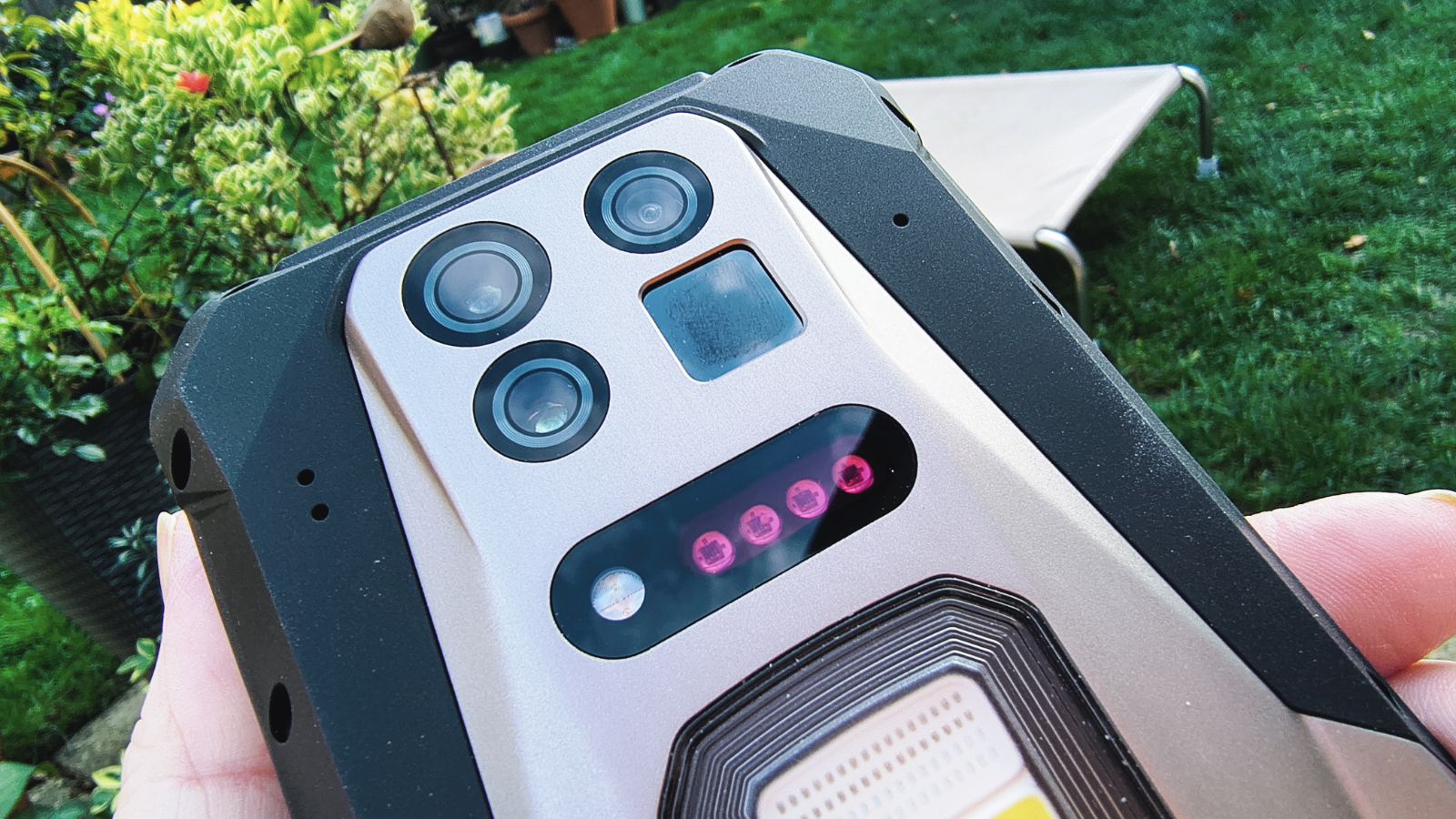
The 8849 Tank 5 has four cameras:
Rear camera: 50MP Samsung ISOCELL S5KGN1SP, 50MP OmniVision OV50C40, 50MP OmniVision OV50D40, FLIR Lepton 3.1R Thermal camera
Front camera: 32MP OV32B40
Here I’m going to focus exclusively on the Thermal sensor, because you can read my opinion of the other sensors in my Tank 5 review.
The Pro uses a FLIR Lepton 3.1R, which captures 160 x 120 native pixels, 19,200 calibrated temperature points. VividIR fuses frames in real time and upscales the image to 480 x 360. MSX overlays edges from the visible camera, making pipes, wires, and structures easier to read.
Those numbers sound modest, because they are. This is a compact sensor, not a professional handheld imager. Treat it as a very capable tool for finding problems, not for documenting them to survey grade.
Where it diverges from many phones that include a thermal sensor is the field of view, as 95 degrees is exceptionally wide. Typical thermal phones offer a 50 to 57-degree view, according to 8849, and that wider field is super-useful when you are working in a confined space. In a small room or a loft, that could be a big gain. You see more per frame, so you can scan faster and miss less, hopefully.
There is a trade-off, and it is simple maths. Spread 160 pixels across 95 degrees, and each pixel covers about 0.6 degrees. At 10 metres, one pixel spans roughly 10cm. That is my calculation from the stated field of view, not an 8849 figure. A small target at distance will be a handful of pixels, so that’s less of an issue.
I estimated that the nearest that this sensor will focus is about 15cm, which probably isn’t near enough to easily track problematic components on a circuit board unless they’re big.
Thermal sensitivity is under 50mK, or 0.05°C. That lets the Tank 5 Pro pick out subtle differences, such as damp patches or a warm pipe behind plaster.