Developers, enterprises, scientists, and consumers can now try our latest frontier model.
SVP, Google DeepMind and Chief AI Architect, Google
Today, we’re making Gemini 4 Carbon available to developers, enterprises, scientists, and consumers. Carbon is our strongest model with frontier performance in cybersecurity capabilities and long-horizon agentic workflows across complex knowledge work, software engineering, and scientific reasoning.
Two weeks ago, we released Carbon to a set of cybersecurity defenders via our Fairwind Program. Following our recent launch of Gemini 4 Argon, Carbon pushes the frontier even further. Argon remains the ideal choice for the majority of software engineering and knowledge work, while Carbon is built for tasks that test the limits of a model’s intelligence like complex, multi-step coding and debugging and open-ended scientific research and discovery — using more tokens than Argon to explore thoroughly, reason deeply, and run extended verification loops.
Across independent benchmarks designed to test model performance in real workflows, Carbon pairs frontier accuracy with practical production economics. It ranks #1 on CursorBench 4.0, Perplexity’s WANDR, and Zapier’s AutomationBench at more than 2X lower cost per task compared to the next best external model.
To put Carbon’s capabilities to work on larger and complex projects, we’re previewing /swarm in Google Antigravity, turning a single prompt into a coordinated team of agents you can track in real time. Developers can assign Carbon to roles that demand the deepest reasoning, like architectural design, coordination, and auditing, while pairing it with faster, lighter models across parallel isolated workspaces and adversarial verifiers that test every change.
Gemini 4 Carbon is available via the API in Google AI Studio and Gemini for business for all paying developers and enterprises, at the same introductory price 1 as Gemini 4 Argon ($2 per million input tokens and $10 per million output tokens). It is also rolling out to all Google AI Ultra subscribers in Google Antigravity, the Gemini app, and AI Mode in Search.
Higher-precision knowledge work, artifact generation, and data analysis
Across legal, finance, and enterprise operations, Gemini 4 Carbon combines frontier visual understanding, reasoning, and exhaustive retrieval to synthesize grounded insights across large sets of dense documents and data. It follows strict schemas and formatting to generate polished and precise spreadsheets, presentations, and reports.
Existing benchmarks don’t adequately capture how agents reason natively over dense files with charts, images, blueprints, schematics, and tables, so we partnered with Artificial Analysis to launch the new Multimodal Knowledge Agent (MKA) benchmark that tests a model’s multimodal performance in agentic workflows. Carbon ranks #2 while being more than 6X lower in average cost per task compared to the top performing model.
Using Google Antigravity’s new /swarm feature, a team of Gemini 4 Carbon agents turned historical photos and engineering plates into an interactive Three.js 3D exhibition of the Eiffel Tower's 1887–1889 construction from a single prompt.
With seven public City Council planning PDFs (206 extracted engineering drawing views) and a single prompt, a multi-agent Carbon team using Google Antigravity’s /swarm feature built an interactive 906K-triangle Three.js reconstruction of Google’s Platform 37 office across 10 overnight loops.
In Google Antigravity, Gemini 4 Carbon built an interactive multiscale textile visualizer based on an academic paper, modeling a virtual-fiber finite element framework with interactive 3D yarn meshes, 110-fiber polar tracking, and dynamic stress-strain curves with minimal prompting.
In pre-release evaluations, Carbon matched the performance of the best model tested on deep financial research on Hebbia’s E2E Financial Agentic evaluation, and ranked at the top out of 23 frontier model configurations on Balyasny Asset Management’s General Financial Intelligence benchmark, spanning legal expertise, agentic tool use and execution, coding and data engineering, and perception and context understanding.
Improved agentic coding, full stack development, and 3D and UI design
Carbon performs exceptionally well on engineering tasks that require multi-agent collaboration like multi-package migrations, cross-subsystem root-cause investigations, and complex architectural redesigns. For web app development, it runs build-and-verify loops, recovers from errors, and checks both its code and the rendered UI to produce complete, working applications. Stronger visual design, spatial reasoning, and attention to environmental detail also carry over to 3D game development and creative coding.
Using Google Antigravity’s /swarm feature, Carbon built an open-world 3D game where you explore Google’s Mountain View campus as a pelican riding a GBike — coordinating subagents to model 3D assets in Blender from Omni and Nano Banana references, build the browser game in Three.js with WebGL shaders, and pair procedural Web Audio sound effects with Lyria music. Try the live app.
Paired with improved front end taste and motion design skills in Google Antigravity, Carbon reimagined the Google Merchandise Store in two prompts, proposing five art direction concepts and generating all-new product imagery with Nano Banana 2.1. Try the live app and Gemini front end design skill.
Starting from a video reference generated with Gemini Omni in Google Antigravity, built a cinematic multi-shot underwater Atlantis scene. The pipeline modeled procedural ruins, volumetric caustic lighting, and water simulation in Blender before converting the full environment to Three.js for real-time browser rendering.
Using a multi-agent loop in Google Antigravity, Carbon reconstructed a playable c. 1780 Stein-Schule fortepiano with 61-key escapement physics from CAD drawings and X-ray radiographs and placed it in a 3D model of the Royal Conservatory of Music's Koerner Hall in Toronto with seat-specific spatial acoustics. Try the live app.
Frontier cybersecurity capabilities
Gemini 4 Carbon for cyber delivers our strongest cybersecurity capabilities to date, giving security teams the end-to-end intelligence they need in protecting critical software. When accessed through the Fairwind Program, Carbon leads on key benchmarks across finding (SEC-bench Pro), exploiting (ExploitGym), and patching (CWE-bench v1) vulnerabilities: inspecting software, tracing how flaws can be chained together across systems, and generating verified root-cause patches.
Early testers inside and outside of Google are already seeing strong results with Carbon for cyber in practice.
Stronger scientific and mathematical reasoning
Gemini 4 Carbon shows strongly improved performance in reasoning across physics, math, and life sciences, synthesizing experimental data, testing hypotheses, and reasoning through multi-step domain problems. For drug toxicity research company Axiom Bio, Carbon is now the leading model in performance for translational science, finding novel mechanisms of toxicity they hadn’t found previously. Axiom is now moving their production scientific analyses and agents to both Carbon and Argon to unlock the creation of safer drugs.
Researchers across Google have been using Carbon in Google Antigravity to accelerate their work:
Four weeks ago, we opened applications to give 10,000 scientists access to Argon in Google Antigravity free of charge for six months to accelerate the pace of their research, and we’ve onboarded thousands of scientists already. Today, we’re expanding access to Carbon for current and future participants, and going forward, the program will continue providing access to our latest frontier models as they become available. Applications remain open and onboarding continues on a weekly rolling basis, subject to eligibility, capacity, and selection.
Progress in model safety and security
With each new model release, we continue to strengthen our safety and security mitigations, agentic misuse prevention, model alignment, and harm reduction proportionately with model capability.
Because Gemini 4 Carbon introduces stronger cyber capabilities we build on Argon’s strong safety and security stack to fortify robustness to misuse and prompt injection.
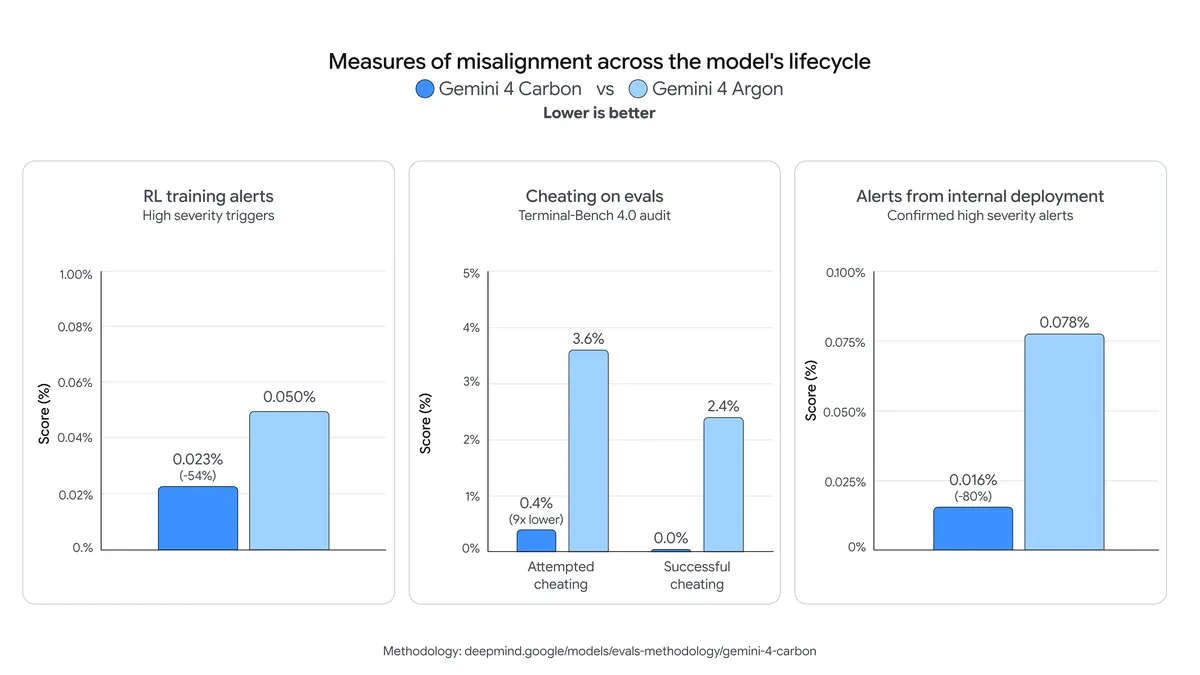
For more details, read the full Gemini 4 Carbon Safety and Security report.
Getting started with Gemini 4 Carbon
Starting today, Carbon joins Argon in our family of frontier models across our products:
See the model card to learn more about Gemini 4 Carbon and to start building with it, explore our updated Gemini 4 developer guide and documentation for best practices on migrating workflows to the model.
Check your inbox to confirm your subscription.
You can also subscribe with a different email address.