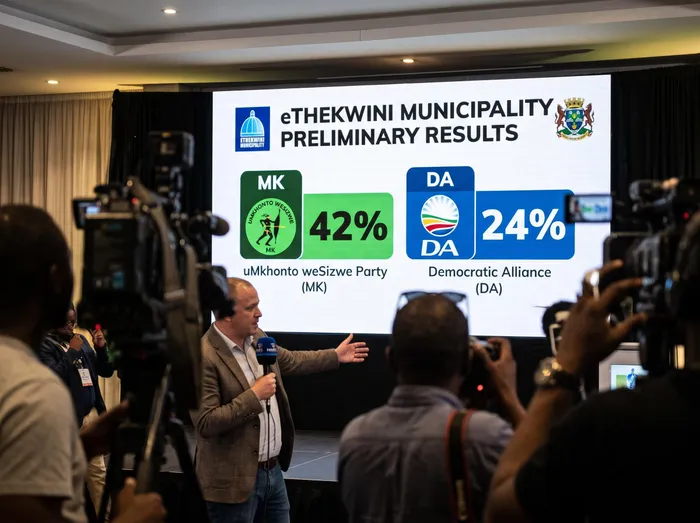
Preliminary results for the eThekwini on Thursday night.
Governance in the eThekwini Municipality looks set to shift dramatically, with the uMkhonto weSizwe Party (MK Party) and the Democratic Alliance (DA) emerging as the two biggest parties, according to preliminary results.
The DA said the preliminary results showed that it would become the biggest party, while the MK Party said it had secured close to 75 wards in eThekwini.
Yesterday, the Electoral Commission of South Africa (IEC) was still auditing some of the results before publishing them. By the afternoon, less than 35% of the results had been released, but most parties already had unaudited results from their structures in different wards.
The preliminary results showed that the ANC had retained key strongholds, including KwaXimba, but had suffered severe electoral losses in many other areas, with both the DA and the MK Party taking wards from the party.
An MK Party spokesperson in KwaZulu-Natal, Mkhuseli Mlengane, said the party had performed well in eThekwini.
“The preliminary results show that we have won about 75 wards in eThekwini. We have taken wards from the ANC and almost every other party that was previously represented in the council.
“We are pleased with what we have achieved. In fact, we expect to do even better as the results continue to come in. Many people have voted for and trusted the party to lead.”
Speaking about the possibility of forming a government, he said the party currently wanted to govern alone. However, should that not materialise, discussions on the way forward and on forming a government would be referred to the party’s national leadership.
He committed to providing eThekwini residents with services as soon as the party led the council.
“One of the issues we are going to tackle is the water crisis. We are also going to deal decisively with the issue of the water mafia,” he said.
The DA, however, indicated that it was unlikely to work with the MK Party in governing any municipality and discouraged other parties from doing so.
DA provincial leader Sithembiso Ngema said any party that worked with the MK Party would be inviting disaster.
“We would like to caution any party against working with the MK Party. They will infect themselves with the problems affecting the MK Party as we speak. They will be engulfed by chaos and leadership changes, as has happened in the party,” he said.
The DA said it appeared likely to become the second-biggest party in the province and the municipality. The party’s provincial chairperson, Dean Macpherson, said it was pleased with its performance.
“We are likely to be the second-biggest party in this council. We have won wards from the ANC, including one that was previously held by the MK Party. We also won a ward that was held by ActionSA,” he said.
Macpherson said that should the DA gain enough support to lead the council, it would also prioritise the water crisis. He said its first priority would be to reallocate funds from the municipal budget and invest about R10 billion in municipal infrastructure, particularly to address water challenges.
In a statement, the ANC thanked those who had led the party’s campaigns. “As the custodian of our liberation heritage and democratic state, the ANC is profoundly humbled by the millions of voters who reposed their confidence in the Mass Democratic Movement. We regard this mandate not as a privilege, but as a sacred trust. We will deploy this confidence directly to fix local government, accelerate fundamental service delivery, restore critical infrastructure and drive inclusive economic development across all communities.”
Political analyst Professor Musa Xulu said early results showed a contest between the ANC and the MK Party.
“It would seem that the ANC is stronger in proportional representation councillor results, while the MK Party is stronger in ward councillor results. The MK Party wave has yet to show up. The ANC performs well among the black middle class and upwardly progressive youth, while the MK Party seems to do well among the township working class and people living in informal settlements.”
Xulu said there was still a way back for the ANC. “Elections are always a process rather than an event. Those were ANC wards, and the MK Party consists of angry people who left the ANC.
It will take time for the ANC to recover. In 2011, the IFP was left with only two municipalities in KwaZulu-Natal. Fifteen years later, it is attractive again.”