From the Salvador Pass to the Mediterranean, Libya’s divided authority leaves it vulnerable to conflicts it did not choose.
An expanding European war, an African security dilemma
On 22 November 2026, reports of attacks on Russian vessels in and off Benghazi brought the Russia–Ukraine war into Libya’s security environment. The following day, President Volodymyr Zelensky acknowledged the operation, claiming that Ukraine had sunk a Russian naval vessel and struck a cargo ship allegedly carrying military equipment. The full extent of the damage and the cargo ship’s reported military function still require independent verification.
For Libya, the significance of Benghazi extends beyond the losses Kyiv claims. The incident raises the question of who determines the security risks that foreign military partnerships create on Libyan territory. A European conflict need not become a sustained African front to affect African societies. Where national authority is divided, foreign military relationships can expose a country to conflicts that its institutions have not collectively chosen to enter.
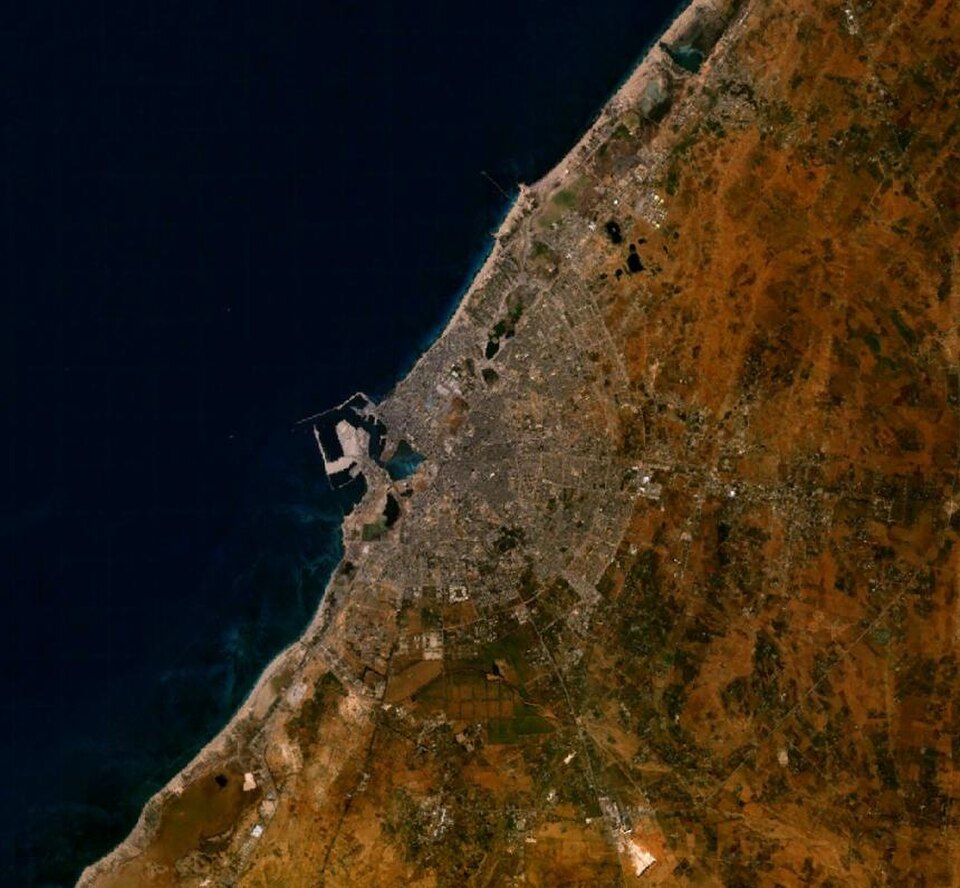
Aerial image of Benghazi. Wikicommons.
When local partnerships become national liabilities
Libya’s vulnerability cannot be explained by military technology alone; its institutional fragmentation has deeper political roots. The October 2020 ceasefire agreement, negotiated by the UN-facilitated 5+5 Joint Military Commission, set a framework for ending nationwide hostilities but did not restore unified national authority. The Tripoli-based Government of National Unity, established in 2021 through an UN-facilitated political process, operates alongside competing eastern institutions, while Khalifa Haftar and his military establishment exercise considerable influence over eastern and southern Libya. Libya retains international legal sovereignty, but its capacity to exercise that sovereignty remains uneven.
Russia’s relationship with Haftar shows what this division implies. After the Benghazi incident, eastern Libyan authorities acknowledged the presence of a Russian naval vessel and said it had stopped for supplies under a cooperation arrangement, the terms of which remain independently unverified. Such partnerships can bring local authorities military assistance, economic opportunities and political support, but their costs can extend well beyond those who negotiated them. A faction’s capacity to secure foreign assistance may grow while the state’s ability to manage its consequences declines.
Libyan actors should not be reduced to instruments of foreign powers: they pursue their own interests and exercise real agency in negotiating international partnerships. The institutional difficulty arises when separate arrangements reinforce competing centres of authority rather than contributing to a coherent national security policy.
Self-defence and the sovereignty of third states
On 24 November, Ukrainian Foreign Minister Andrii Sybiha reportedly defended the operation by invoking Article 51 of the United Nations Charter. Tripoli, meanwhile, rejected Libya’s involvement in the conflict and objected to foreign military activity within its sovereign territory.
The dispute raises two distinct legal questions: whether the vessels qualified as military objectives, and whether force could lawfully be used within another state’s territory. Article 51 recognises the inherent right of individual and collective self-defence in response to an armed attack, but it must be read alongside Article 2(4), which establishes the general prohibition on the use of force against the territorial integrity or political independence of states. International humanitarian law adds a separate test. Under Article 52(2) of Additional Protocol I to the Geneva Conventions, the classification of an object as a military objective depends on its contribution to military action and the definite military advantage anticipated from attacking it. Establishing an object’s military character does not, by itself, settle the legality of using force within a third country.
Ukraine’s right to defend itself against Russian aggression must therefore be distinguished from the legal assessment of operations abroad, and Russia’s foreign military partnerships must likewise be examined in light of their consequences for host states. For African governments, the underlying concern is whether external security arrangements expose national territory and civilian populations to international confrontation without adequate public accountability or effective national oversight.
From the Salvador Pass to Benghazi
My October 2026 analysis for African Arguments, The Salvador Pass: How a Nameless Desert Gap Became a Battleground for Libya’s Warlords, examined competition over Libya’s southern borderlands and the strategic significance of trans-Saharan mobility. Located near the point where Libya, Niger and Algeria meet, the pass illustrates how difficult it is to govern cross-border networks amid competing political and security interests. Benghazi brings a related institutional problem to Libya’s northern coastline.
The two cases are not equivalent. The Salvador Pass involves territorial border security, trans-Saharan networks and regional influence; Benghazi concerns maritime security, foreign military partnerships and the geographical extension of an international armed conflict. Their analytical connection lies in the difficulty of exercising coherent national authority over strategically important territory. Libya occupies a position linking the Mediterranean, North Africa and the Sahel. The available evidence does not establish that the Benghazi incident has triggered wider regional military escalation, but further external confrontation could complicate security relationships and efforts towards reconciliation. The northern coastline and southern borderlands therefore deserve attention within a common analysis of Libya’s institutional vulnerabilities.
From geographical protection to institutional protection
Distance from a battlefield can provide a degree of protection, but it cannot guarantee security when military, political and economic networks extend across national borders. Benghazi offers a case through which to examine this limitation, not definitive proof that geography has lost its protective value.
The United Nations Support Mission in Libya (UNSMIL), established in 2011 under Security Council Resolution 2009, has long supported political dialogue, national reconciliation and institutional development. Following the reported Benghazi attacks, it called on 23 November for an independent investigation and restraint, linking the crisis to the need for institutional reunification. That reunification is a security priority as well as a prerequisite for elections and reconciliation: diplomatic recognition alone cannot enable a government to regulate foreign military activity in areas beyond its effective authority. African regional institutions could complement UN-led mediation by encouraging transparency in security agreements, cooperation between North African and Sahelian states, and the protection of civilian infrastructure. The objective would not be to eliminate foreign partnerships but to make their terms and consequences accountable to legitimate national authority.
African ownership of security
The Benghazi incident may reinforce competing security arrangements or strengthen the case for common national rules governing foreign military activity. Much depends on whether Libyan political actors can reconcile their separate arrangements with shared national interests. For African states, strategic autonomy does not require isolation from international affairs. It requires the institutional capacity to choose partners, negotiate the conditions of cooperation and preserve independent decision-making.
Geographical distance cannot compensate indefinitely for fragmented national authority, nor can international recognition substitute for institutions capable of regulating the external relationships through which foreign conflicts enter domestic security environments. For Libya, rebuilding effective sovereignty is more than an unfinished political project. It is a means of protecting the country from conflicts it did not choose.
The post When Europe’s Wars Reach Africa’s Shores: Benghazi and the Limits of Libyan Sovereignty appeared first on African Arguments.