
In brief: Ukraine has shot down a Russian jet-powered Shahed drone for the first time with a combat laser, presidential adviser Serhii “Flash” Beskrestnov said on Wednesday, Nov. 25. The Blysk system, developed by Carmine Sky under the state Private Air Defense program, is protecting critical infrastructure, though tests are ongoing and serial production remains premature.
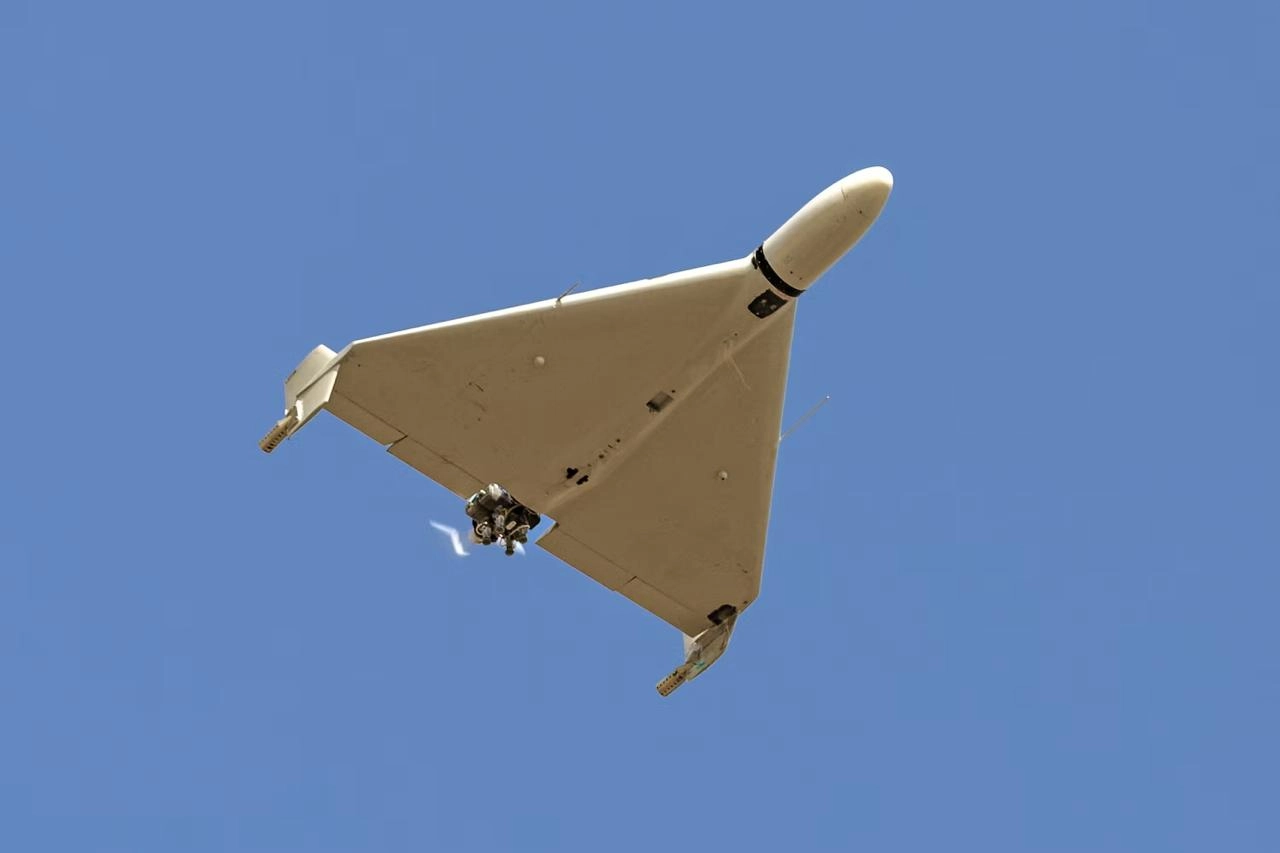
Ukraine has successfully downed a Russian jet-powered Geran drone, the Russian-made version of Iran’s Shahed, for the first time, using a combat laser.
According to presidential adviser Serhii “Flash” Beskrestnov, who shared video of the interception on Wednesday, Nov. 25, the Blysk laser system was developed by Ukrainian company Carmine Sky under the state-run Private Air Defense program, with backing from Brave1, the government’s defense technology cluster.
Follow our coverage of the war on the @Kyivpost_official.
“Recently, a combat laser installed to protect a critical infrastructure facility shot down a jet-powered Geran drone for the first time in the world,” Beskrestnov wrote in a statement on social media. “Laser technologies are very complex and costly, so it is nice when someone has good news.”
Beskrestnov noted that several Ukrainian companies are working to adapt lasers for air defense, but cautioned that it was too early to discuss mass production.
For now, he said, the lasers are being tested while defending critical infrastructure sites.
BBC Ukraine reported on Nov. 19 that Blysk had entered service in early November, describing the laser as a low-power system with a range of roughly one kilometer (0.6 miles).
According to the news outlet, a small first-person-view drone can be disabled almost instantly by the system, while a larger target, such as a Shahed, needs to stay in the beam for several seconds.

Countering jet-powered drones
Over the past several months, Russia has changed its warfare tactics, increasingly relying on jet-powered drones that are significantly harder to intercept due to their speed, which can reach up to 400-600 kph (250-370 mph).
Russian forces launched more than 3,000 such drones at Ukraine in September alone, up from around 350 in June, according to Ukraine’s Air Force. As of the same month, Ukrainian forces were intercepting only about 60% of them, compared with 90–95% of slower, propeller-driven models.
Speaking to Radio Liberty in Brussels on Nov. 16, Prime Minister Serhii Koretskyi said the number of jet-powered drones Russia could launch at Ukraine in November might be 12 times higher than in August.
Kyiv has since been racing to find cost-effective ways to stop such drones.
On Sept. 3, President Volodymyr Zelensky ordered the development of high-speed interceptor drones to be fast-tracked, and on Sept. 19 he announced that Ukraine had deployed a newly developed interceptor capable of destroying jet-powered Shaheds, following a briefing by the Security Service of Ukraine (SBU).
Escalation amid diplomacy
Beskrestnov’s announcement comes as Ukraine braces for its fifth winter of full-scale war, during which Russia is expected to intensify its attacks on civilian and critical infrastructure, including the power grid and water supplies.
Meanwhile, Moscow continues to escalate its attacks even as diplomatic efforts to end the war have been revived, with Ukraine, Russia and the US holding their first trilateral talks since February in Abu Dhabi on Nov. 10-11.
As of 10 p.m. local time, the General Staff of the Armed Forces of Ukraine (AFU) had recorded 151 clashes along the frontline since the beginning of Wednesday, Nov. 25.
During that period, Russian forces carried out 47 airstrikes involving 156 guided aerial bombs, deployed 3,870 kamikaze drones and fired on Ukrainian positions and populated areas 1,647 times.
Kyiv Post is Ukraine’s first and oldest English news organization, reporting since 1995. Its international reach – 90% of readers are outside of Ukraine – make it truly Ukraine’s global voice.