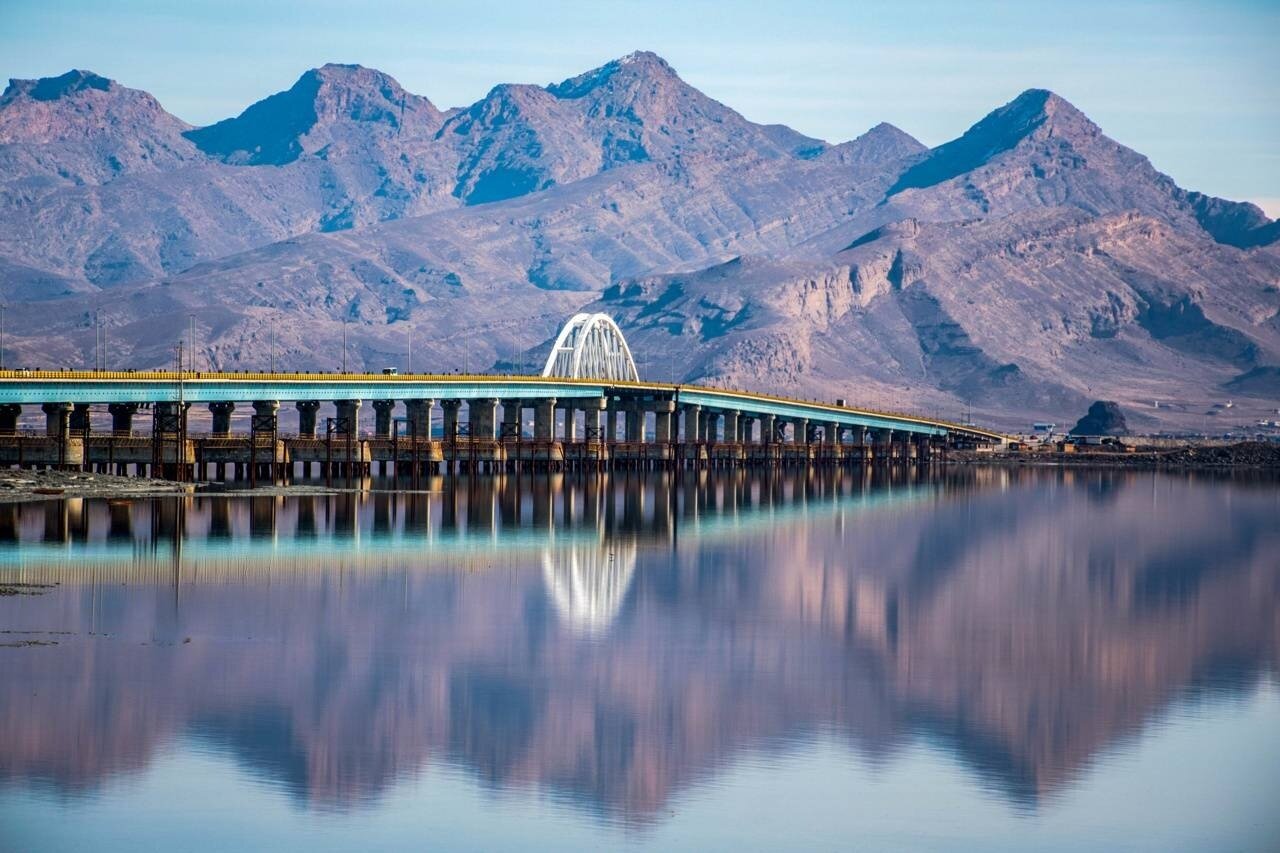
TEHRAN – The water level of Lake Urmia has reached 1,270.60 meters, marking a 110-centimeter increase compared with the same period last year.
Despite the improvement, the lake's current level remains 3.5 meters below its ecological level, IRNA quoted Arezou Ashrafizadeh, an official with the Department of Environment (DOE), as saying.
Lake Urmia in northwestern West Azarbaijan province started to dry up in the 2000s. The lake was once the largest in West Asia and the sixth-largest salt lake in the world, with a water surface area of 5,000 to 6,000 square kilometers. The lake’s basin plays a critical role in ensuring Iran’s food security and agricultural productivity. However, in recent years, the Basin’s water resources have significantly declined due to rising temperatures, changing precipitation patterns, and unsustainable water use.
Currently, the lake has about 2.5 billion cubic meters of water, and the area of the lake has reached 2,000 square kilometers.
Temporal increase in water levels over a certain period does not constitute the ecological restoration of the lake; true restoration is achieved only when a balance between water supply and water consumption is established within the basin, and the water flow required by the lake is provided on a continuous and sustainable basis, Ashrafizadeh added.
The restoration of the lake requires the implementation of effective strategies for runoff collection, the revision of water resource management within the basin, and the prevention of new water use allocations, alongside the adoption of sustainable agricultural practices to facilitate the lake’s recovery, the official further noted.
In December 2025, the Food and Agriculture Organization (FAO), in cooperation with the Governorate of West Azarbaijan Province, held a workshop on a project titled ‘Enhancing Restoration Activities in Lake Urmia through the Effective Use of Agricultural Water’, marking the official launch of the project’s second phase, which was signed in October 2025.
Funded by the Government of Japan, the FAO of the United Nations and the United Nations Development Programme (UNDP), the initiative aims to promote sustainable agriculture and support the restoration of one of the country’s most vital ecosystems — Lake Urmia.
The project also aims to help revive the lake, promote sustainable agriculture and support the restoration of one of the country’s most vital ecosystems — Lake Urmia.
The signing ceremony of the project was held during President Masoud Pezeshkian’s visit to West Azarbaijan.
The document was signed by Reza Rahmani, the Secretary of the Urmia Lake Rescue National Committee, and Ali Nazaridoust, Officer-in-Charge (on behalf of the FAO Representative to the Islamic Republic of Iran).
The Lake Urmia Basin plays a critical role in ensuring Iran’s food security and agricultural productivity. However, in recent years, the Basin’s water resources have significantly declined due to rising temperatures, changing precipitation patterns, and unsustainable water use.
Recognizing the urgency of these challenges, FAO is implementing this project to promote integrated water resource management and climate-smart agricultural practices across the Basin.
The Lake Urmia component of the project will be jointly implemented by FAO and the Urmia Lake Rescue National Committee (ULRNC). It aims to scale up and operationalize improvements in agricultural water efficiency and productivity, safeguarding livelihoods and reducing pressure on water resources.
Through capacity development, the introduction of efficient irrigation technologies, and the promotion of sustainable farming methods, the project will help farmers and rural communities build resilience to water scarcity while contributing to the restoration of the lake’s ecological balance.
The project represents a strong example of collaboration between the Government of the Islamic Republic of Iran, FAO, UNDP, and the Government of Japan in supporting national efforts toward sustainable agriculture, water management, and environmental conservation.