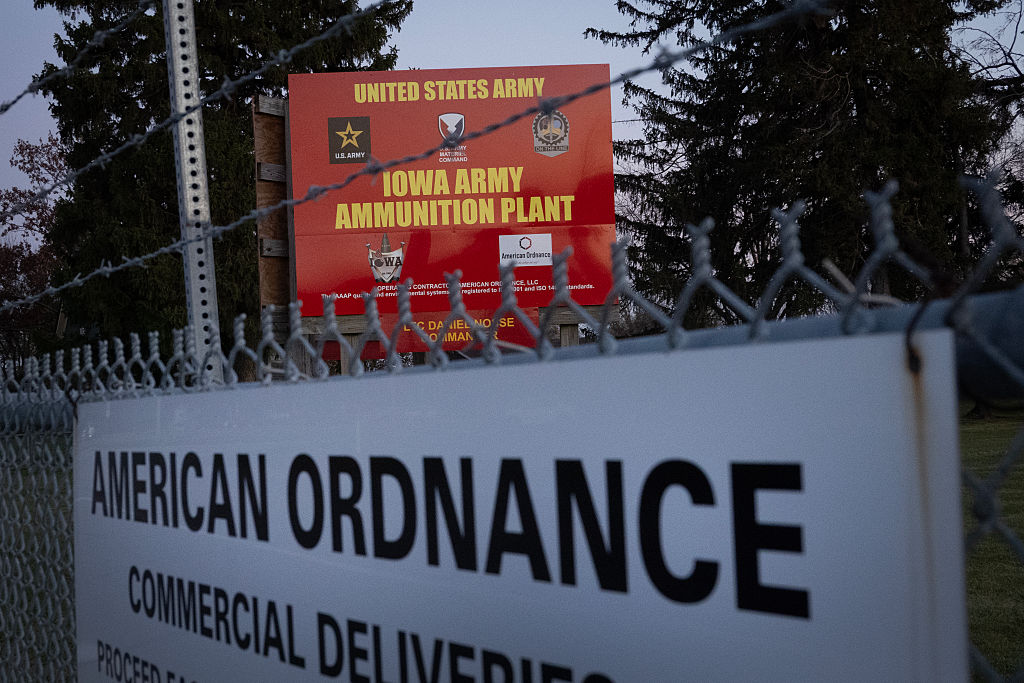
 A sign identifying the facility sits inside a fence surrounding the Iowa Army Ammunition Plant in Middletown, Iowa, on Nov. 19, 2026.
The U.S. Army said it is pushing through with the controlled detonation of more than five dozen barrels of a toxic explosive chemical in an Iowa munitions plant on Wednesday, despite public outcry over the potential health impacts on neighboring communities and an ongoing legal battle.
Nearly five tons of degraded lead azide, a chemical compound used as a detonator in cartridges and shells, are set to be detonated at the Iowa Army Ammunition Plant in Middletown, a city in Des Moines County of nearly 400 people some 13 km away from the Mississippi River separating the state from Illinois.
On Nov. 19, Acting Army Secretary Adam Telle posted on social media that discussions with environmental officials and the local community determined a controlled detonation of the lead azide stockpile “posed the lowest risk to the public in the immediate and surrounding area,” but he announced that the detonation would be postponed from Nov. 20 to Nov. 23.
Also on Nov. 19, environmental groups sued the Environmental Protection Agency, which granted the permit to the U.S. Army to carry out the detonation, and a federal appeals court ordered a temporary freeze on the permit.
Then, on Nov. 21, the Justice Department said it plans to use emergency powers to avoid the permit requirement for detonation. On Nov. 22, the Army rescheduled the blast for Nov. 25, saying that the new time would “allow for more optimal weather conditions and all mitigation measures to be emplaced.”
Environmental groups have argued that the U.S. Army is “sidestepping” the judicial process. They claim that the EPA approved the detonation plan without enough public notice and without thoroughly studying alternatives.
The detonation risks community exposure to lead, a neurotoxin health officials have long documented to cause a variety of health problems in pregnant women and children. There is no safe exposure level to lead: exposed children can suffer damage to the brain and nervous system, learning and behavioral issues, speech and hearing impairments, while pregnant women face increased risks of premature births and miscarriages.
The Federal Aviation Administration has restricted flights around Middletown from Monday through Wednesday. Iowa Gov. Kim Reynolds activated a state emergency operations center on Nov. 20.
In neighboring Illinois, officials argued that they are similarly at risk from airborne lead-containing particles the detonation will produce. On Sunday, Illinois Gov. JB Pritzker said he spoke with the Army, the EPA, and other agencies about the planned detonation, adding that he was “continuing to press for the release of more public information to help keep Illinoisans safe.”
“The Army has clearly mishandled this situation, and Iowans and residents in our neighboring states deserve a full review of all of the missteps that led us to this point,” said Wally Taylor, attorney for the environmental organization Sierra Club’s Iowa chapter, one of the petitioners against the EPA. “However, if detonation is now the only option, it is imperative that everyone impacted has access to the full range of testing, mitigation, and remediation resources.”
Why is the Army choosing to detonate the stockpile?
In March, during what the Army said was a “routine stockpile surveillance operation” at the 19,000-acre plant, technicians discovered 68 drums of degraded lead azide in underground concrete bunkers, which it said had potentially become unstable. The barrels have languished underground for nearly two decades, and the Army said moving the chemical off-site for disposal would risk accidental detonation.
Between April and September 2026, the EPA issued three emergency storage permits so the Army could continue storing the stockpile safely while the Army assessed how to treat it.
In its environmental assessment, the Army concluded that doing nothing would create “a constant threat of an accidental, unmitigated detonation,” which would have “significant, uncontrolled adverse impacts.” But while detonating the stockpile on-site would “produce severe, instantaneous physical effects” such as blast overpressure and noise and would locally release hazardous materials such as lead particulates and combustion gases in the short term, the Army says these impacts are “heavily mitigated.”
Justine Barati, a public affairs specialist for the Army Sustainment Command, told a local news station on Nov. 18 that the Army’s window to safely dispose of the stockpiles was narrowing as winter is arriving. Barati said colder weather or disturbances could cause the stockpiles to detonate spontaneously.
“We’re trying to do a controlled detonation to minimize the impact to the community and the environment,” Barati said. “This is not something that we take lightly. We know that this is a disruption to people and that is not our intent, but we’re trying to do this in the safest manner possible.”
On Nov. 21, the New York Times reported that, in late March, the Army had initially awarded a contract to MuniRem Environmental, a Georgia-based company that would neutralize the stockpile using chemicals. But two months later, it canceled the deal over purported safety concerns.
The EPA granted an emergency permit to detonate the stockpiles between Nov. 13, 2026 and Feb. 11, 2027. The permit for the on-site detonation echoed the risk linked with alternative means of disposal, saying that “recrystallization of the lead azide during long-term storage has increased the material’s sensitivity to friction and shock, creating a highly unstable and dangerous situation.”
In the Army’s public notice issued just days before the initial blast schedule, it said the lead azide barrels will be detonated in two, rapid-fire shots inside concrete, earth-covered magazines surrounded by Hesco barriers filled with sand about two stories high. Before and during the detonation, the soil above the magazines will be saturated with water, and water misters will be spraying, all in an attempt to control the amount of lead that could travel through the air beyond the plant.
The notice added that models projected the level of lead particles in the air after the detonation “may be elevated but well below the level at which EPA would require protective actions be taken.”
What’s the legal battle about?
Iowa Environmental Council and the Sierra Club, both nonprofit environmental advocacy organizations, sought to suspend the EPA permit. In a suit filed before the U.S. Court of Appeals for the 8th Circuit, the plaintiffs argued that the permit authorized the Army to detonate the lead azide “in the open,” adding that the blast would create “a plume of lead dust that will blanket homes and communities” possibly as far as 100 mi or more.
The petitioners argued that the Army did not promptly and accurately inform the public of the detonation and its impact. The Army said it had informed the local community ahead of the planned blast, including at an open house at the Army Reserve Center in mid-October, but the petitioners argued many residents and local officials claimed to only have learned of the planned detonation “through friends and social media.” The petitioners also emphasized how there’s no safe level of exposure to lead.
The court sided with the petitioners and granted the emergency stay on Nov. 19 pending the ruling. But in its Nov. 21 filing to the court, the Justice Department said it would use emergency powers allowing the Army to continue with the blast without an environmental permit, citing federal exemptions. The department emphasized the “immediate risk” posed by the stockpile, while saying that the Army “intends to act consistent with the terms of the Emergency Permit and its mitigation measures even if not in effect.”
Thien Chau, an attorney for Earthjustice, which helped sue the EPA, said in a statement that “despite claiming public safety is its top priority and public communication is essential to trust, the Army seemed more concerned over the weekend with finding a way to sidestep the judicial process than on meeting the public’s demands for greater transparency, notice to affected communities, and far stronger protection of people, property, and the environment from serious harm.”
What’s the anticipated impact of the detonation?
While safety measures will be fully enforced, the Army said in its public notice that during the detonation, it anticipates ground vibration and a dust plume that spreads “some lead-containing particles” in the air, which will deposit on the ground. The notice said Middletown residents can expect the plume to linger for no more than an hour, depending on wind speed.
The Army advised residents to evacuate and avoid the affected area in Iowa, and urged those who could not leave to stay indoors, close windows and doors, and turn off heating and cooling systems that could bring in outside air. It also said residents should wet-clean surfaces to remove lead dust.
Precautionary measures were not limited to Iowa: In Illinois, agriculture officials recommended ways to protect livestock and pets, including keeping animals indoors until the plume passes, and their rigorous washing afterward.
Amid this, several politicians continued to express concern over the risks ahead of the continued detonation. U.S. Senator-elect Josh Turek of Iowa posted on social media Sunday that he believes that a full investigation is needed not only into the stockpile’s prolonged unsafe treatment and why safer methods of disposal are needed, but also into “what other potentially dangerous materials are being stored at [the plant] and their condition, and what procedures are needed to ensure this never happens again.”
Turek as well as a group of Illinois Democrats—U.S. Senators Dick Durbin and Tammy Duckworth; Lieutenant Governor and U.S. Senator-elect Juliana Stratton; U.S. Rep. Eric Sorensen; and Gov. Pritzker—and two Illinois Republicans, Representatives Darin LaHood and Mary Miller, sent a letter to acting Army Secretary Telle and EPA Administrator Lee Zeldin on Nov. 19 expressing their grave concerns over the planned detonation, calling to postpone it.
The potential health risk caused by the detonation threatens Iowa, which is already suffering from having one of the highest cancer incidences in the U.S.
“Because of the decisions that have already been made over the course of months, if not years, no good options exist and the situation is more dangerous and unpredictable than it ever should have been,” Rob Sand, who’s set to take office as Iowa’s new governor in January, posted Sunday. “Iowans deserve transparency over how we got here, then answers and accountability to stop this from ever happening again.”