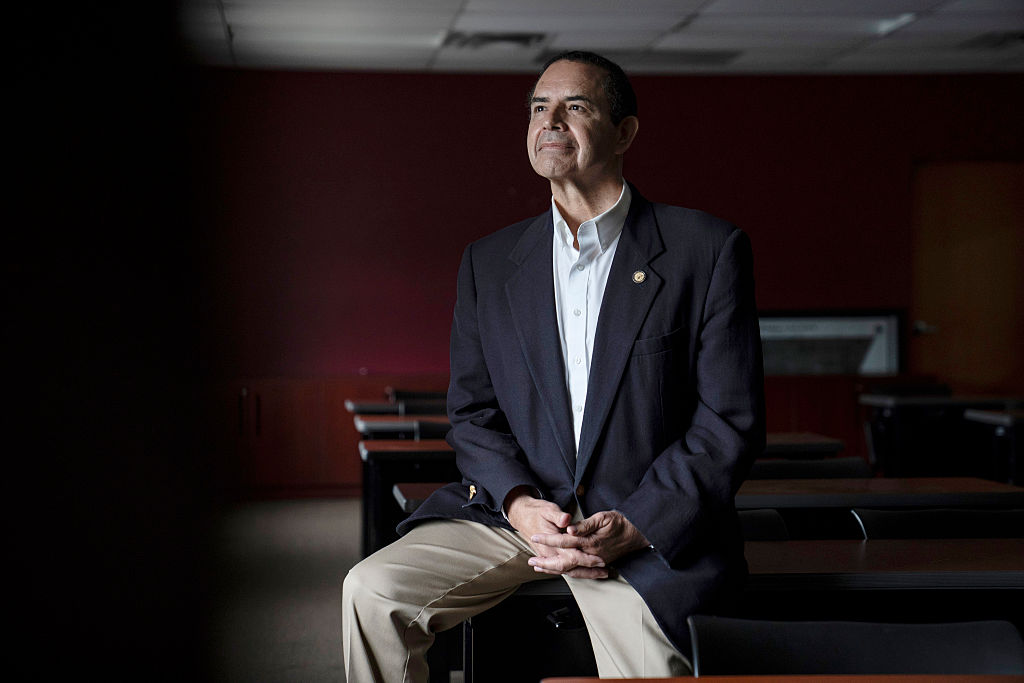
 U.S. Rep. Henry Cuellar, D-Texas, poses for a photo at the Starr County Courthouse Annex Building on October 2, 2026 in Rio Grande City, Texas. —Gabriel V. Cárdenas–The Washington Post via Getty Images
Representative Henry Cuellar has been in Congress for more than 20 years, representing a South Texas district that includes a big chunk of Texas' border with Mexico. Over the years, he has fended off pressures from both parties: Democrats have tried and failed to replace him with someone more liberal; Republicans have tried and failed to convince him to join the GOP.
Now he's about to start a new term as part of the largest Democratic majority this century. While many of his colleagues want to battle the Trump Administration to rein in ICE, Cuellar sees things differently. He thinks Washington may be on the verge of the perfect conditions to finally fix the country's immigration system for good.
“I told my Republican friends, the last time we had real immigration reform was [when] President Reagan was a Republican, and the House was controlled by Democrats," Cuellar tells TIME. "That's how you get the work done. It's got to be bipartisan.”
Cuellar says discussions are already underway behind the scenes on how to work with the White House to actually pass immigration reform, something Congress has repeatedly tried and failed to accomplish for decades. He points to Rep. Pete Aguilar of California, and Reps. Sylvia Garcia and Rep. Veronica Escobar, both from Texas, as other Democrats who are helping craft language for the measures. “A good number” of congressional Republicans willing to talk seriously about immigration reform are also involved in the discussions, he says.
Cuellar is set to chair the House subcommittee that oversees funding for the Department of Homeland Security. At the top of Cuellar’s wish list: put new guardrails on Immigration and Customs Enforcement, redirect billions of unspent funding allocated to immigration enforcement in the One Big Beautiful Bill, and streamline the visa process for millions of immigrant guest-workers.
“If the president is the one that calls the decisions, we will reach an agreement,” the Texas Democrat says.
Trump’s mixed signals
Cuellar’s optimism on immigration reform stems in part from how Trump softened his tone on immigration right after the election. During a “60 Minutes” interview, Trump acknowledged that some of the immigration policies pushed by hardline Republicans were “too tough” and that he was open to a pathway to permanent residency for undocumented immigrants who have been staying in the U.S. for more than a decade.
But around the same time, Trump also promoted Stephen Miller as the White House Chief of Staff, elevating the architect of the mass deportation agenda to the most powerful unelected position in Washington.
Any potential immigration deal is further complicated by Cuellar and Trump’s unusual history. In 2025, President Trump pardoned Cuellar and his wife after both were indicted for accepting thousands of dollars from the Azerbaijan government and a Mexican commercial bank. Following his pardon, Cuellar continued to run and won his reelection as a Democrat, which enraged Trump who expected Cuellar to switch parties. Last month, Trump slammed Cuellar in a Truth Social post, calling him “disloyal” and “ungrateful.”
While Cuellar saw signs of hope from Trump’s comments on “60 Minutes,” other Democratic lawmakers and some immigration policy experts were far more skeptical. Trump, after all, is behind the federal government’s most aggressive immigration enforcement operation in decades.
Read more: An Idaho ICE Raid Rounded Up Hundreds. The Fallout Could Change How ICE Operates
Trump’s comments also drew pushback from his closest allies, who interpreted the President’s comments as amnesty. Vice President JD Vance on Thursday criticized the idea of offering a legal pathway to undocumented immigrants, saying that any effort to “give amnesty to people who have broken our laws” is “morally and electorally disastrous.” But none of those comments dented Cuellar’s excitement.
“Other people are hardliners, but the President, I feel, will be willing to make an agreement,” Cuellar insists.
Jorge Loweree, the managing director of programs at the American Immigration Council, says that Trump has long floated the idea of offering undocumented immigrants a legal pathway to stay in the country, but previous efforts among congressional Republicans during Trump’s first term failed due to the GOP’s internal divisions. Trump has never been given an opportunity to sign or veto an immigration bill at the White House.
“If Congress managed to get it [a legalization bill] through both chambers and send it to the President and call his bluff, it's not clear what he would do,” Loweree says.
TIME has reached out to the White House for comments.
The power of the purse
Instead of passing a standalone bill, Democrats may find it easier to reshape the immigration system through the budget process. Cuellar is set to chair the House subcommittee that oversees funding for the Department of Homeland Security.
An American Immigration Council analysis estimates that ICE had roughly $91 billion remaining from two Republican reconciliation laws as of October, with another $45.6 billion available to Customs and Border Protection—guaranteeing both agencies the ability to carry out mass deportation operations for years without congressional oversight. Last week, House Democratic leader Hakeem Jeffries reiterated his interest in redirecting ICE funding.
“We believe that taxpayer dollars should actually be spent to make life affordable for the American people, not to brutalize or kill American citizens, or law-abiding immigrants,” Jeffries said during a press conference.
Democrats in both chambers have previously introduced bills either redirecting tens of billions of dollars to fund Medicaid or clawing back the funding altogether. Cuellar suggested that legislators are looking into whether that money could be redirected to other agencies inside DHS that have been impacted by the layoffs implemented by DOGE last year.
“Can it be moved from ICE into other items? You've got FEMA. You've got other agencies that certainly could use more assistance. We are looking at all the legalities as to what is possible and what is not,” he explains.
Detention centers and border security
Cuellar’s congressional district in South Texas is home to three ICE detention centers. He has also examined the conditions inside Dilley, the country’s largest family immigration detention facility, which is in Texas but not in his district, and has drawn a string of accusations of medical neglect.
And he’s been watching how ICE has been buying up properties around the country to drastically expand its network of detention facilities. The agency overpaid by at least 50% for nine of the 11 warehouses that it had intended to convert to detention centers, but is now trying to offload, according to a recent report from the Government Accountability Office. The report also estimated that ICE pays more than $13 million a month for detention beds that sit empty.
All of that is shaping his approach to trying to overhaul ICE, as is a ticking clock. There is likely little time to rein in ICE’s spending on detention centers before the agency signs more contracts with private prison companies. The One Big Beautiful Bill signed by Trump in 2025 granted ICE $45 billion for immigration detention centers and made the funds available through the 2029 fiscal year. The GAO report found that ICE’s current plans indicate that the agency expects to obligate the remaining detention funds by the end of the 2027 fiscal year.
Cuellar has a history of being a staunch supporter of border security. In January, he was one of just seven House Democrats to join Republicans in voting for an ICE funding bill. Among the broader party, support for pairing ICE reform with border security has been gaining more traction among Democrats since the end of the Biden administration. Texas Governor-elect Gina Hinojosa, the state’s first Democratic governor since 1990, said in a Fox News interview on Thursday that she wants to see the federal government shore up funds for border security.
“Texas has spent $20 billion on border security,” she says. “It is the responsibility of the federal government to keep our borders intact and secure, and Texas taxpayers should not be footing that bill to such an extent.”
Cuellar sees that growing sentiment within his party as key to the next Congress finding a way to make sweeping changes to immigration that Trump could support.
“Every immigration reform or full comprehensive immigration reform will have border security,” Cuellar says.