Worker groups say leaked names, addresses and phone numbers could make fake work permit and job messages harder to spot.
Fullerton Health said about 140,000 work pass holder records were compromised in a cybersecurity incident. (Photo: CNA/Raj Nadarajan)


SINGAPORE: Migrant workers whose personal details were exposed in the recent Fullerton Health data breach could face employment-related scams, impersonation attempts and phishing messages made more convincing by the information leaked, migrant worker groups said.
Fullerton Health on Nov 14 said about 140,000 work pass holder records were compromised in a cybersecurity incident involving a server supporting its Migrant Worker Primary Care Plan programme.
The incident has put existing vulnerabilities surrounding migrant workers into the spotlight, for whom employment-related scams are a particular concern, Transient Workers Count Too (TWC2) executive director Ethan Guo told CNA.
The Migrant Workers’ Centre (MWC), a bipartite initiative of the National Trades Union Congress (NTUC) and the Singapore National Employers Federation, warned of calls or messages posing as employers, healthcare providers, banks or government agencies.
Associate Professor Razwana Begum from the Singapore University of Social Sciences (SUSS) said many migrant workers rely on employers, healthcare providers or intermediaries for information about their employment, medical examinations and work permits.
This, she noted, could make messages appearing to come from such sources seem particularly credible.
"There may also be pressure to respond quickly if a message suggests that a worker's employment or work permit could be affected," she said.
CNA Games
 Guess Word
Crack the word, one row at a time
 Buzzword
Create words using the given letters
 Mini Sudoku
Tiny puzzle, mighty brain teaser
 Mini Crossword
Small grid, big challenge
 Word Search
Spot as many words as you can
Show More
Show Less
WHAT HAPPENED
Of the 140,000 records compromised in the data breach, about 43,000 belonged to people whose work passes were no longer valid, said Fullerton Health on Nov 14.
WHAT HAPPENED
The information that may have been affected included workers' full names, foreign identification numbers (FIN), dates of birth, mobile numbers, email addresses and residential addresses.
No health, medical or personal financial information was compromised, said the healthcare provider.
It became aware of the breach on Oct 31 and has since made two rounds of notifications to affected workers through their employers.
The Ministry of Manpower (MOM) has also notified affected workers through the FWMOMCare mobile app, with messages provided in workers' native languages.
EMPLOYMENT SCAMS, IMPERSONATION AMONG RISKS
Mr Guo said that even before the Fullerton Health breach, the main type of scam TWC2 had seen migrant workers fall victim to was employment-related.
He said rogue employment agents could use workers' personal particulars to apply for work permits without their knowledge, then demand hundreds or thousands of dollars to cancel the resulting In-Principle Approval (IPA).
This could be a particular problem for workers who have returned home and are looking for another job in Singapore, he said. Many continue using their Singapore WhatsApp numbers after leaving, leaving them contactable by scammers.
Workers can approach MOM to cancel unwanted IPAs, but Mr Guo said some may not know how to do so.
He also raised concerns that bad actors could approach migrant workers and ask to use their bank accounts for illicit purposes.
"Many of them would not be aware of the severe implications of allowing unknown transactions to flow through their bank accounts – because sometimes, even employers ask to use their bank accounts," said Mr Guo.
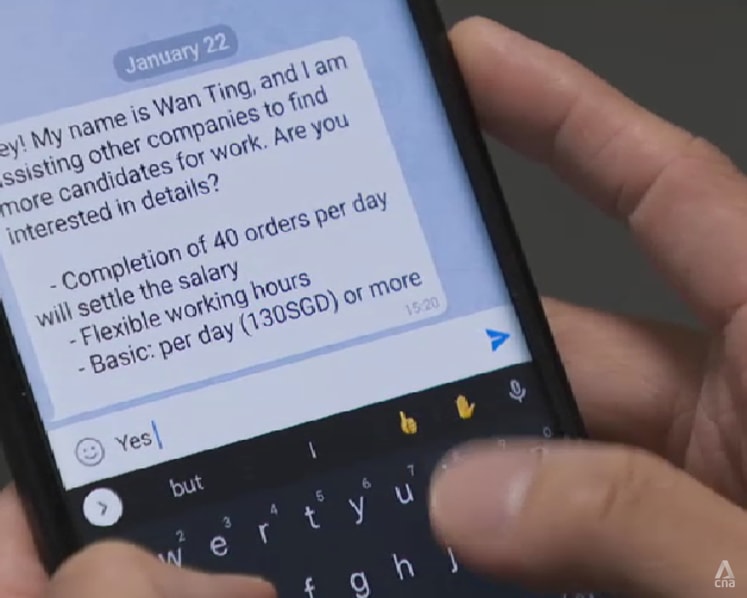
Mr Michael Lim, director of the Migrant Workers' Segment at NTUC, said MWC was particularly concerned about calls or messages posing as employers, healthcare providers, banks or government agencies.
These may ask workers for more personal information, money or verification codes, or urge them to click on links, he said.
Some migrant workers may find it harder to tell whether such calls or messages are genuine, especially when they come in unfamiliar language, added Mr Lim.
TWC2's Mr Guo noted that scams involving perpetrators who impersonate public officials such as police officers have been on the rise in Singapore, some of which targeted migrant workers as well.
SUSS' Assoc Prof Razwana, whose research interests include public safety and security, cautioned against assuming that migrant workers were inherently less digitally aware or more susceptible to scams.
"The concern is whether they have access to clear information, trusted sources of advice and practical ways to verify suspicious requests," she said.
She noted that migrant workers may also struggle to identify and verify suspicious communications because of limited familiarity with local administrative procedures.
However, the exposure of the information in itself does not mean someone could gain access to a worker's bank account or government services, she said.
"The key concern is how this information could be used to gain trust and facilitate further scams," she said.
The use of accurate personal information in such communications could make approaches by bad actors appear more legitimate, particularly in scam messages about medical examinations, work permits or employment matters, said Assoc Prof Razwana.
Personal details could also be used in phishing attempts to obtain more sensitive information, such as account credentials or one-time passwords, she added.