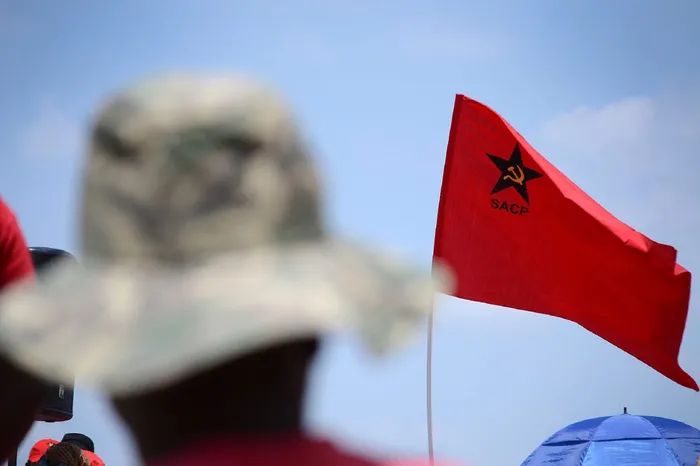
The SACP won 271 municipal seats and 2.38% of the national vote after contesting local elections independently for the first time, potentially giving it influence in some hung councils.
The SACP won 271 municipal seats and 2.38% of the national vote after contesting independently for the first time, positioning it to influence coalition negotiations in hung councils.
It contested the election independently for the first time in 76 years, after decades of strictly supporting its tripartite alliance partner, the African National Congress (ANC).
The SACP garnered 2.38% of the national vote, placing it eighth overall.
Operating on a zero-budget campaign driven purely by grassroots activism, the party outperformed better-funded organisations like the Patriotic Alliance (PA) and Rise Mzansi.
The party's most historic victory came in the Eastern Cape, traditionally an ANC stronghold, where the SACP finished third with 6.2% of the provincial vote (89 seats), including winning 5 seats in the Buffalo City Metro.
They secured substantial representation across other provinces, including 45 seats in Limpopo, 26 seats in Mpumalanga, and 20 seats in the North West.
In KZN the SACP fielded candidates to contest approximately 921 wards across almost all municipalities.
In eThekwini, out of the 112 available wards in the metro, the majority were swept by the uMkhonto weSizwe Party (MKP), which won 73 wards, followed by the DA with 33 wards, the IFP with 4, and the ANC with 2.
The SACP did not win any individual wards.
By successfully winning ward seats directly rather than just proportional representation (PR) seats nationally, the SACP has positioned itself as a critical player in upcoming coalition talks across South Africa's 127 hung municipalities.
Alex Mohebutswana, SACP spokesperson, said they were impressed by the party's support in the November 4 elections.
He said that the SACP performed fairly without the millions of rands that private capitalist donors have showered other parties with through party-political donations.
"The SACP relied on its structures, community members and supportive organisations. We are happy and honoured by the results we received in this year's elections. We salute all our supporters," said Mohebutswana.
He said the SACP's decision to break away on the ballot was sparked by growing frustrations over its lack of policy influence within the ANC and the formation of the Government of National Unity (GNU).
"The party reserved its hard-won right to contest elections independently since 1994 in favour of an ANC-led tripartite alliance campaign," he said.
However, Mohebutswana said the alliance was affected by internal policy tensions following the adoption in 1996 of the economic policy called Growth, Employment and Redistribution (Gear).
"The SACP studied the 'Washington Consensus,' which was extended to become a key part of the neoliberal economic policy regime, and opposed Gear because it represented a domestication of the shift to the neoliberal agenda," he said.
He highlighted that over the years, the SACP had been seeking a reconfiguration of the alliance to work according to consensus-seeking democratic consultation before all major policy decisions and votes in parliament, provincial legislatures and councils.
"The reconfiguration was rejected while policy choices that go against SACP policy positions were entrenched and expanded. In the end, the SACP contested elections independently," said Mohebutswana.
Zakhele Ndlovu, political analyst, said the SACP actually exceeded people's expectations in the 2026 elections.
"I did not expect it to get any votes. I guess it took votes that would have gone to the ANC," said Ndlovu.
Another political analyst Prof Purshottama Reddy of the University of KwaZulu-Natal (UKZN), confirmed that the SACP stood for elections independently for the first time in the recent elections.
"The SACP has always been in an alliance with the ANC and COSATU. This is indeed an interesting development. The SACP did not seem to push its agenda very strongly during the elections. However, it is quite clear where the party stands on bread and butter issues and the economy," he said.
Reddy pointed out it was interesting to see which political groupings it will join and vote for as part of broader coalition governance in South Africa post the November 4 local government elections.
"Will its participation in local governance be rooted in its basic values and principles, or will it be more practical and pragmatic in its decisions and modus operandi at the council level?" asked Reddy.