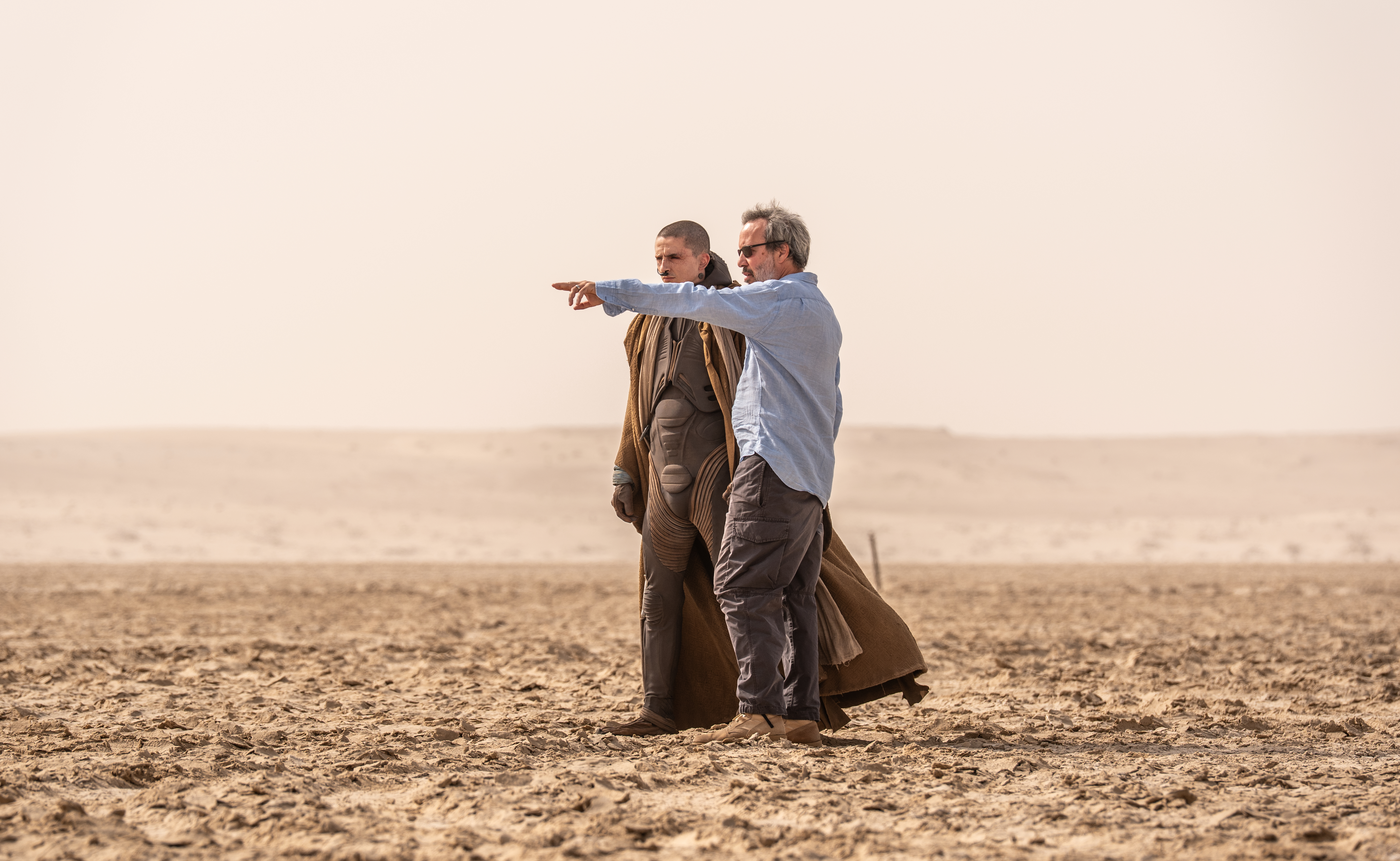
 Timothée Chalamet with director Denis Villeneuve on the set of Dune: Part Three —Courtesy of Warner Bros.
Denis Villeneuve is finally done wandering the desert. The writer-director has spent nearly a decade adapting Frank Herbert’s Dune and Dune Messiah, the saga of Paul Atreides (Timothée Chalamet), a young duke stranded on the desert planet of Arrakis, the only source of the universe’s most precious commodity, spice. Embraced as a messiah by the native Fremen thanks to the machinations of a religious order called the Bene Gesserit, Paul ends Dune: Part Two by avenging his father, seizing the throne, and launching a war. At the beginning of Dune: Part Three, which opens Dec. 18, billions have died in his name, and Paul faces a conspiracy that includes his wife, Princess Irulan (Florence Pugh), and Chani (Zendaya), the estranged Fremen mother of his children. The director of previous hits including Sicario, Arrival, and Blade Runner 2049 spoke with TIME about radical adaptation choices in his trilogy’s final chapter and his plans for his next project, a James Bond film, whose new star, Robert Pattinson, was announced a week after our conversation.
Fans of Dune Messiah have called the book unadaptable.
The book is a chamber piece. People are meeting in rooms talking. It’s a complex, paranoid book. It’s also a kind of depressing book that was not welcomed by Dune readers. The first book is more like an elegy of a hero. And Herbert felt that he was missing the mark because he wanted to create a warning against messianic figures. He felt he needed to correct the trajectory of the story. So yes, it was a big challenge to make this adaptation. The opening battle, which is about 15 minutes in the movie, is one sentence in the book. It’s such a free adaptation that I felt it would have been dishonest to call the movie Dune Messiah. That’s why it’s called Dune: Part Three.
The biggest departure is Paul’s love interest, Chani. In the books, she stays loyal to him even after he marries the emperor’s daughter and becomes this messianic figure. In your movie, Paul and Chani have children together, but she later fights against Paul’s regime. Why the change?
It all started with the adaptation for Dune: Part Two. I was facing the challenge of trying to embrace Herbert’s idea to create a story that would be a warning, not a celebration. At the end of the first book, Paul wins the battle, marries a princess, still gets Chani, and becomes emperor. When you read the book, you’re like, this is a celebration of a hero. I had the idea to make Chani more of a critic regarding the idea of religious colonization. It’s not in the book, the idea that the older generations are contaminated by the beliefs of the Bene Gesserit, by the colonialist religious poison. And the new generation doesn’t believe in the messiah. They want Fremen to be freed by the Fremen themselves. I thought it was a dynamic idea, Chani being the representation of this.
In the third movie, Chani is still a critic of the choices Paul has made. She believes the Fremen should free themselves. She doesn’t want to harm Paul, but she does want to harm his regime. I would have loved to have taken Frank Herbert for a coffee about these ideas because I think he could have liked them. In his book, Chani is there to give Paul foot massages. It’s a character that has not a lot of firepower.
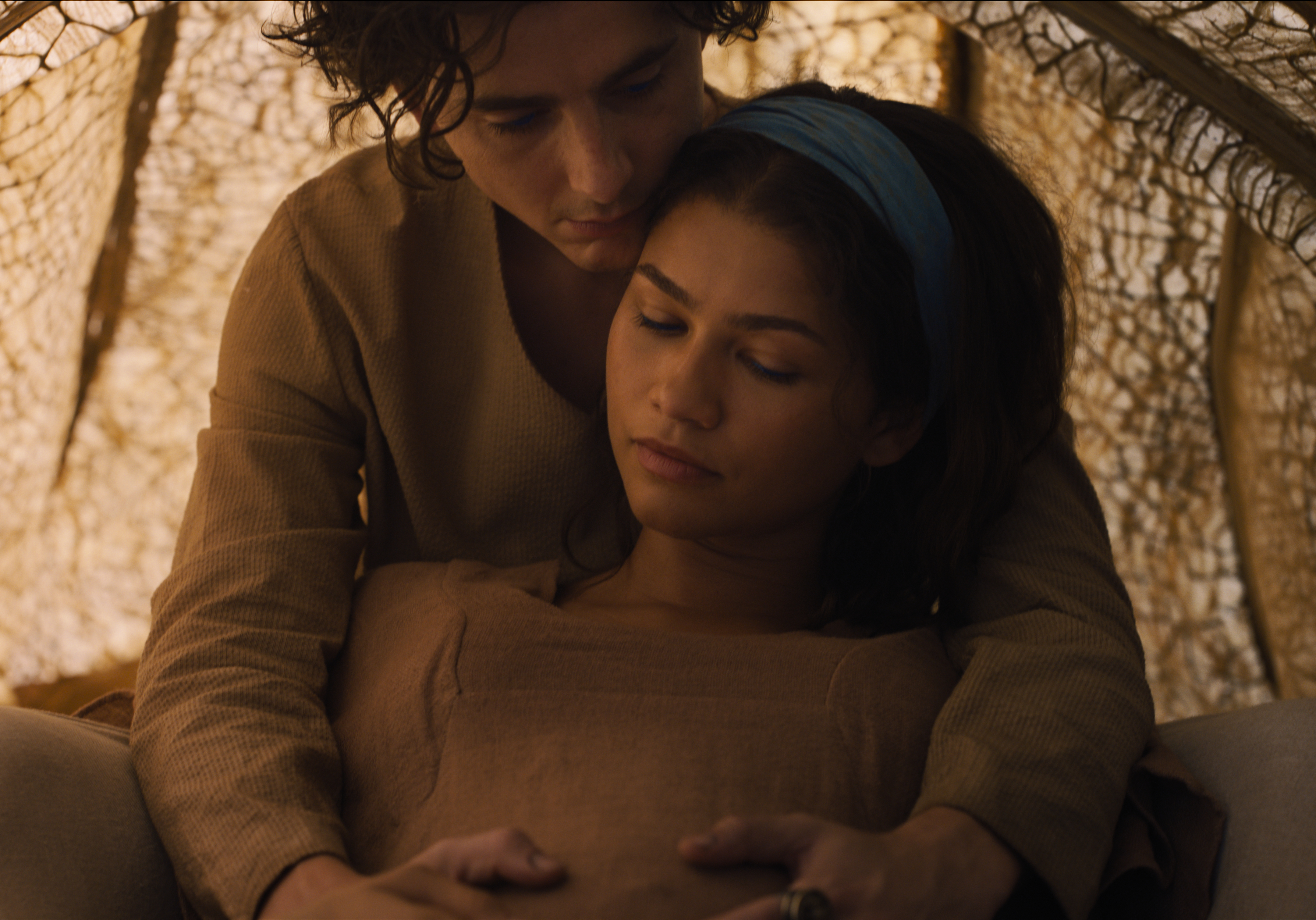 Chalamet and Zendaya in Dune: Part Three —Courtesy of Warner Bros.
Did you worry about upsetting book purists?
When you adapt, you kill. It is not the book. It is my movie inspired by the book, with tremendous respect. My three movies embrace the Bene Gesserit angle because that is what I thought was most inspiring, relevant, and cinematic. But you could make an entire Dune adaptation focused on the idea that humans have fought AI and banned machines. Those ideas aren’t in my movies because it’s too much. You have to make choices. That’s the beauty of adaptation.
There is a big time jump between Part Two and Part Three. Paul and Chani have teenage children now. You originally planned to take a long break between those films. What changed?
I did [Part One and Part Two] back to back, without a single day break between. They were not easy births. I’m not complaining. I’m just explaining that I said to myself while filming Part Two, the only way to get out of this alive is to take a break. I’m going to the forest to hide for many months. And I did. The problem is that after two weeks, I got bored. My wife asked me, “What are you doing?” And I said, “I’m writing Part Three.” I was waking up at night with cinematic images. I was working on another project, but every image coming to my mind was from Dune Messiah.
 —David Jon Photography
What images?
The final one of Paul. It’s a moment that haunted me all these years, and I think I did the trilogy to make that image.
One that has stuck with me from the movie is the opening battle. Was there a particular cinematic touchpoint?
It’s difficult to see men coming out of a troop transport being decimated without thinking of Saving Private Ryan. It’s obvious. I knew I was stepping into delicate territory because that is one of the most celebrated cinematic sequences of the past 30 years. But I felt it was what the scene needed. I have been dreaming about shooting a landing on the beaches of Normandy since I was a kid.
Another was Florence Pugh, covered in clay, walking through the maze to Paul. I don’t believe that was in the book. Where did that come from?
At the beginning of Part Three, Paul is unable to find a peaceful way out of the violence. He becomes more and more paranoid and isolated. We’re not sure if he’s lost contact with reality. How do you express that? Princess Irulan has to meet her own husband she hasn’t seen in years. How does he live? How can he protect himself from the assassination attempts? We created a space as if Irulan is walking into the subconscious space of Paul, like the Greek story of Theseus and the Minotaur, where Theseus walks into the labyrinth in order to kill the monster. Irulan won’t kill Paul, but this idea of her going into that maze to neutralize the source of evil was inspiring.
You’ve called this your most personal film in a long time. How so?
One of the ideas is what kind of world Paul and Chani are trying to leave their children. And what happens to this heritage when you are going through a divorce? That’s a question that anyone who has a broken family understands. It’s vivid and profound to me.
Dune: Part Three premieres the same weekend as Avengers: Doomsday. How are you feeling about that?
Listen, I will be honest. The first Dune came out at the end of the pandemic. We made a great box office in a very rough environment. But we had the winds against us. Then the second movie, same thing. We were meant to release in the fall, and we had to release at the end of winter because of the two Hollywood strikes. We had success, but it was not easy. The third time, I said to myself, “Finally, there is no pandemic, no strike in sight. We will have a normal release.” Then Disney put the biggest franchise of all time against us. I’m no fool. Those movies are a mammoth.
So I was deeply disappointed. But we had committed to this date, to IMAX. It was impossible to move. So I accepted my fate, praying to the gods of cinema. Dune is not a mammoth like the Avengers, but it’s a sexy little animal that has a lot of firepower, and I hope we will survive. It could be one of the biggest box-office weekends of all time because of both movies. Am I in competition with the Avengers? Absolutely not. It’s a T. rex. But I stand proud because I think the film delivers.
After living within Dune for so long, how difficult is it to transition to a different world for James Bond?
I don’t sleep a lot right now because it’s like I have electricity in my veins thinking about this new project. It is so different. I spent 10 years of my life in the sun talking about a specific color palette, thinking about ways to embrace natural light. I adore being on Arrakis, but I think it’s healthy to step away.
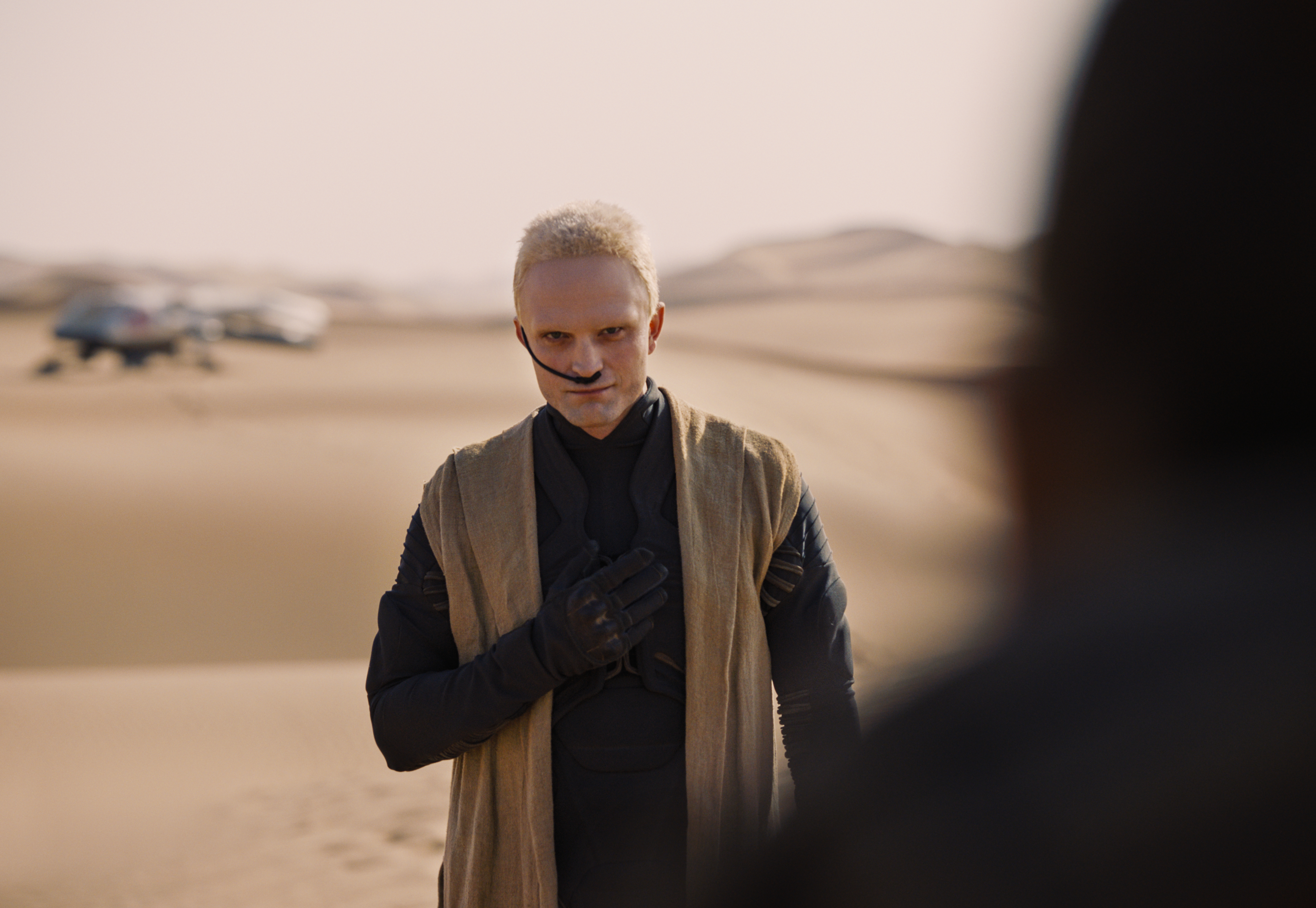 Robert Pattinson in Dune: Part Three —Courtesy of Warner Bros.
Are there things you feel are essential to Bond that need to be maintained?
I don’t want to talk too much about Bond because it’s still in the oven cooking. This stage of the process is my favorite part because everything is possible.
I will say: I love traditions. I love the unapologetic way the character behaves, the panache. I’m not here to change the DNA of James Bond. I’m here to embrace it, to bring it to the world of today. I’m a hardcore James Bond fan, and I want other fans to have fun watching my film. Of course, it will be tainted by my sensibility. But I wake up every morning with a stupid smile because it’s a world of pure cinematic pleasure.
We are speaking ahead of the much-anticipated casting announcement. Are you aware that people were placing bets on Polymarket?
I read nothing about that. My responsibility is to make the best casting and create the best story for that cast. I cannot listen to the rumors. No matter what we do, we will never please everybody.
When Daniel Craig was cast, it was a sh-tstorm. He was blond. He was short. He was not seen as an action hero. Yet when we talk about James Bond today it is because of Daniel Craig’s extraordinary interpretation. And that was a different environment in 2006 before social media. I expect a hurricane when we bring our choice to the world. Some people will be happy. Some will be mad. I can do nothing about that. At the end of the day, the truth will be on the screen. Then they will be able to judge.