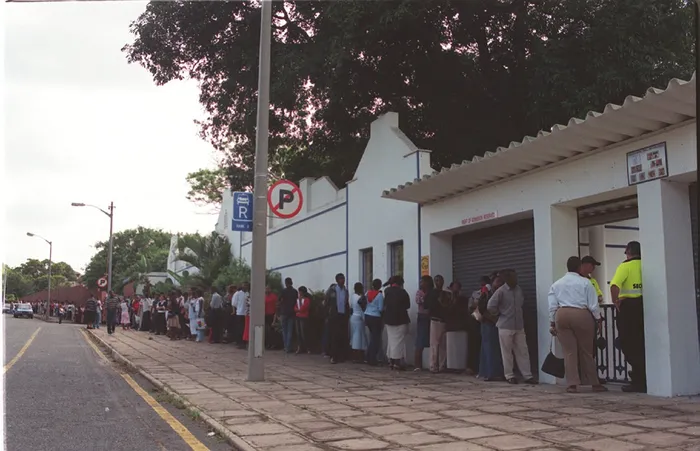
A group of unemployed people queue for job applications. Unemployed residents camped along Moore Road in Durban say that official claims of falling unemployment do not match their daily struggle to find work.
Unemployed residents camped at Moore Road in Durban have reacted to reports that unemployment in the city has fallen, saying local jobseekers are still not benefiting.
For the protesters, the improved figures do not match their experience on the ground. They say they have been waiting for work and are still unemployed.
Speaking in Durban on Tuesday, Felimntwini Gumede, who speaks for the group camped at Moore Road, said the protesters were there because they are unemployed, and argued that hiring should benefit local jobseekers who are already in Durban and actively seeking work.
He said local unemployed residents have been waiting for employment opportunities, and should be considered first when employers in the city are hiring.
What Stats SA data reveals about eThekwini’s falling unemployment rate
The reaction follows eThekwini Municipality's announcement on Tuesday that its official unemployment rate fell from 27,8% in the third quarter of 2025 to 22,2% in the third quarter of 2026, according to the Quarterly Labour Force Survey released by Statistics South Africa.
The City said the number of unemployed residents decreased by 101,000, from 464,000 to 363,000, while the number of employed residents grew by 66,000 to 1,27 million.
The metro also recorded an 18,2% increase in formal-sector employment, adding approximately 146,000 formal-sector jobs year-on-year.
eThekwini was the only metro to record a decline in unemployment year-on-year, and now sits alongside Cape Town with the lowest unemployment rate among the metros — well below the national rate of 33,7%.
Premier Ntuli welcomes metro progress but highlights rural-urban gap
KwaZulu-Natal Premier Thamsanqa Ntuli has welcomed the figures, describing them as an encouraging development for the province, particularly given eThekwini's strategic importance as the province's economic hub and one of the country's major centres of trade, manufacturing, logistics, tourism and investment.
"These are encouraging figures for KwaZulu-Natal, particularly for the people of eThekwini. We welcome the fact that Durban has recorded the largest annual decline in unemployment among the country's metropolitan municipalities and is the only metro to have registered a reduction over this period," Ntuli said.
"The reduction of 5,6 percentage points in the unemployment rate, accompanied by 101,000 fewer unemployed residents and an increase in employment, is a significant development that deserves recognition.
"As the provincial government, we recognise that eThekwini is central to the economic fortunes of KwaZulu-Natal. When Durban's economy performs well, the positive effects extend beyond the boundaries of the municipality into the surrounding districts and the broader provincial economy," he said.
Ntuli attributed the improvement to sustained collaboration between the three spheres of government, organised business, investors and other economic stakeholders in creating an environment conducive to investment, business growth and employment creation.
He said the provincial administration, under the Government of Provincial Unity, remains committed to strengthening KwaZulu-Natal's economic competitiveness through investment mobilisation, infrastructure development, support for businesses and the revitalisation of key economic sectors.
From investment pledges to real work
Ntuli also linked the jobs figures to the province's recent investment performance, particularly the R124,5 billion in investment pledges secured at the 2026 KwaZulu-Natal Investment Conference, surpassing the initial target of R95 billion.
"Investment is one of the most important drivers of economic growth and job creation. Our achievement of R124,5 billion in investment pledges demonstrates the opportunities that exist within KwaZulu-Natal and the confidence that investors continue to place in our province," he said.
"We are determined to ensure that these commitments translate into actual projects, expanded businesses and employment opportunities for our people. Our ambition remains to facilitate the creation of at least one million jobs by the end of this administration's term in 2029."
Premier cautions: Don't celebrate while rural KZN is left behind
Ntuli, however, cautioned that while eThekwini's performance is encouraging, the broader provincial unemployment challenge remains significant.
The latest QLFS indicates that KwaZulu-Natal's overall unemployment rate increased from 32,5% in the second quarter to 33,3% in the third quarter of 2026. The provincial economy recorded approximately 2,73 million employed people, while the number of unemployed people stood at 1,36 million.
The survey places unemployment in non-metropolitan KwaZulu-Natal at 40,6%, compared with 22,2% in eThekwini.
"We cannot celebrate the progress in eThekwini without acknowledging the millions of our people across KwaZulu-Natal who continue to struggle to find employment. The provincial unemployment figures remind us that much more work remains to be done, particularly in our rural communities and smaller towns," Ntuli said.
"Our responsibility is to ensure that the economic opportunities being generated in Durban and other economic centres also benefit communities in our districts. We must strengthen rural economies, support agriculture, expand tourism, promote township businesses and unlock investment in areas that have historically experienced limited economic opportunities."
"Our approach must be inclusive, ensuring that no district and no community is left behind in our pursuit of economic growth and job creation," he said.
Ntuli called on the private sector to continue partnering with government in expanding investment, supporting local enterprises and creating decent and sustainable employment opportunities.