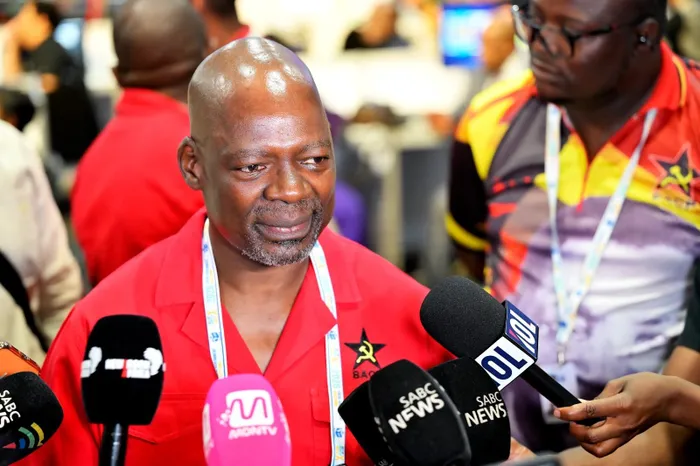
SACP general secretary Solly Mapaila says the party will not give the ANC automatic support in hung municipalities following its independent participation in the local government elections.
The South African Communist Party (SACP) has renewed its call for a reconfiguration of the Tripartite Alliance, insisting that its relationship with the ANC and Cosatu cannot return to the way it operated before the party contested the local government elections independently.
The party won 271 seats and 2.38% of the national vote in the 2026 local government elections, marking a significant shift after 32 years of supporting the ANC at the polls.
For 14 elections, SACP members and supporters voted for the ANC as part of the Tripartite Alliance.
However, that arrangement changed when the party decided to contest independently.
The SACP performed particularly well in parts of Nelson Mandela Bay, winning four seats.
It also attracted support in Limpopo and North West.
Its support was weaker in Gauteng, where some voters supported ActionSA and the Democratic Alliance (DA).
The SACP won more seats than the Patriotic Alliance, which secured 192.
Rise Mzansi won nine seats but no wards, while Build One South Africa (BOSA), led by former DA leader Mmusi Maimane, secured seven seats and no wards.
The ANC remains the largest party nationally, with just over 30% of the vote. It has 3,248 seats, controls 53 councils, and leads in 128.
No automatic coalition agreements
SACP Central Committee and Politburo member Dr Alex Mashilo said the party would not enter into automatic coalition agreements, stressing that its new electoral position had changed the terms of engagement.
“No, there cannot be automatic coalitions. You see, the terms under which we engage now have been reconfigured,” Mashilo said in an interview with the public broadcaster.
He said the SACP now had constituencies to which it was directly accountable, unlike previous engagements within the alliance when it did not contest elections independently.
Mashilo said the Politburo had reaffirmed a decision for provincial structures to convene meetings across the country, inviting both party members and members of the wider community who voted for the SACP.
He said the meetings would provide feedback and allow communities to express their views before decisions were made.
“We are not taking a decision without democracy and then imposing it outside there. Our process is thoroughly democratic because we have an experience of participating in processes where our voices were not taken into account,” he said.
SACP says alliance arrangement sidelined its voice
Asked whether the party would continue pushing for the reconfiguration of the Tripartite Alliance, Mashilo said the call remained firmly on the table.
“We have not dropped that particular call. You see, the way the alliance was configured just disadvantaged the SACP,” he said.
Mashilo argued that the alliance's participation in Parliament, provincial legislatures and municipal councils had failed to reflect the composition of its three partners, with the ANC dominating political representation.
He said the SACP had no direct voice in Parliament despite having representatives through the alliance.
“So that thing was burying the voice of the SACP, and it reached a point where it posed an existential threat to the SACP,” he said.
Mashilo said the party had effectively been forced to reintroduce itself to South Africans during its election campaign because its views were not being heard in political institutions.
He said the election had created an opportunity for SACP councillors to speak directly in municipalities, including Johannesburg, instead of relying on the ANC to communicate the party's positions.
“So there is no way we can go back to an arrangement we have been appealing [against]. It needed to be changed to reflect the composition of the alliance,” he said.
SACP rules out automatic support in hung councils
SACP general secretary Solly Mapaila also warned that the party's support could not be taken for granted during coalition negotiations in municipalities where no party secured an outright majority.
Speaking to the media at the National Results Operations Centre (NROC) in Midrand over the weekend, Mapaila said any cooperation would have to be based on shared priorities and a commitment to improving the lives of struggling communities.
“There is no automatic support for any single party,” Mapaila said.
He said the SACP would place the needs of working-class and impoverished communities at the centre of its decisions.
“We have been campaigning for them for 30 years. We're not coming to them only during elections. We are with them [all the time],” he said.
However, his remarks appeared to contradict those of ANC deputy secretary-general Nomvula Mokonyane, who said the ANC would naturally look to the SACP for support in forming stable municipal administrations.
SACP seeks to unite left-wing formations
Mapaila said the party would convene a summit with left-wing formations that contested the local government elections to discuss a common political programme and strategy.
The gathering followed the establishment of the Council of the Left, which gave the SACP a one-year mandate to lead and coordinate grassroots socialist formations.
“The left forces primarily represent the lowest in our communities, the poorest of the poor, those that have been neglected by the democratic transition, and those that are victims of the capitalist discourse in our country,” Mapaila said.
The SACP has also maintained its criticism of the national Government of National Unity (GNU), particularly the ANC's inclusion of the DA and Freedom Front Plus.
The party argues that the inclusion of the two parties do not represent the interests of black people and the working class.