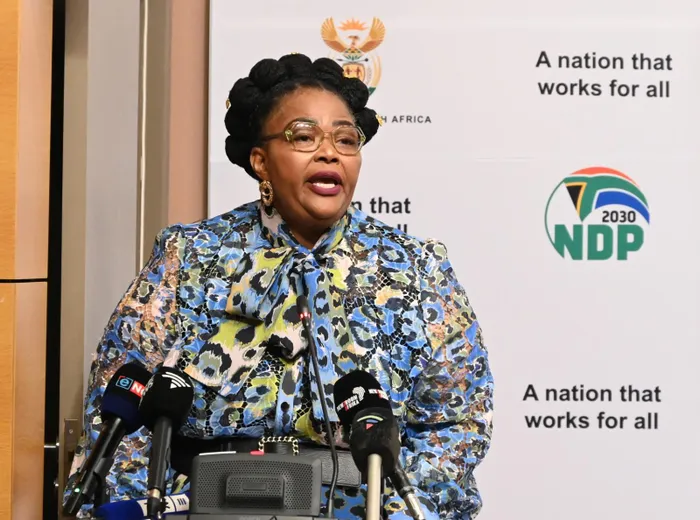
Water and Sanitation Minister Pemmy Majodina says water laws do not make provision for municipal managers to be held personally liable for municipal water service failures.
Water and Sanitation Minister Pemmy Majodina has confirmed that the law does not provide for the government to impose personal criminal liability on municipal managers who neglect their responsibility to supply water to communities.
President Cyril Ramaphosa announced during his State of the Nation Address (SONA) in February that criminal charges would be laid against municipal managers in their personal capacity for violating the National Water Act.
“Government has already laid criminal charges against 56 municipalities that have failed to meet their obligations. We will now move to lay charges against municipal managers in their personal capacity for violating the National Water Act,” said Ramaphosa at the time.
In response to DA MP Stephen Moore’s question on the number of criminal referrals that had been made to the police against municipal managers this week, Majodina said that nine criminal cases have been referred to the police since SONA, but these were against municipalities.
She said the majority of the matters remained under investigation and had not yet been referred to the National Prosecuting Authority (NPA) for a decision on whether to institute prosecution.
“If evidence indicates negligence or intent from an official, then this is added to the docket.
“It should be noted that the decision to institute criminal proceedings against municipal officials in their personal or representative capacities falls within the mandate of the NPA.”
Majodina said the National Water Act and the Water Services Act do not expressly allow for personal liability when an organisation is found guilty of an offence.
“The opened criminal cases are against municipalities as the institution and are represented by the municipal managers as accounting officers. Based on evidence collected by the departments’ environmental management inspectors, the NPA decides on additional charges to officials in their personal capacity,” she said.
Majodina said there were 106 active criminal cases that her department had opened against municipalities.
The cases primarily relate to alleged failures in the management and operation of wastewater treatment works, including the discharge of substandard effluent, overflowing sewer manholes, and the discharge of sewage into water resources. They also include incidents involving malfunctioning or non-functional pump stations, resulting in sewage overflows into water resources.
Of the 106 cases, 48 case dockets had been finalised and referred to the NPA for consideration for prosecution, she said.
To date, eight municipalities have been successfully prosecuted, with plea and sentence agreements concluded and fines imposed.
Majodina also clarified that the proposed National Water Amendment Bill and Water Services Amendment Bill seek to introduce direct personal criminal liability for municipal managers and company directors in respect of certain contraventions of the applicable legislation.
Majodina said that to date the NPA has decided to prosecute a former municipal manager of Lephalale Local Municipality in his personal capacity. It is not clear under which law the former municipal manager was charged.
Reacting to Majodina’s response, Moore said there were other avenues that the department could use to hold the municipal manager personally liable for wrongdoing.
While he acknowledged that neither the National Water Act nor the Water Services Act expressly allow for personal liability, there is liability to be found through other acts governing the local government sphere.
“What they're doing in the response, to make it look like they could not have done anything, is constraining the response to just the water Acts as opposed to all the Acts that govern local government,” he said.
“But that doesn't mean that the rules for local government don't apply and it doesn't mean that you couldn't consider those laws to pursue such actions.”
The South African Local Government Association (SALGA) previously warned that the move to amend the water acts to hold officials personally accountable for service failures and pollution could be short-sighted, arguing it overlooks systemic issues like historical backlogs, funding shortages, and ageing infrastructure.
“Municipal water infrastructure challenges frequently arise from historical infrastructure backlogs, funding constraints, skills shortages and ageing infrastructure inherited over decades. These challenges are often beyond the direct control of municipal managers,” said SALGA’s spokesperson Motalatale Modiba at the time.
The DWS amendment, among others, proposes the insertion of a section in the Water Services Amendment (WSA) Bill which provides the apportionment of liability and, where possible, holds directors of a firm or company personally liable.
Presidency spokesperson Vincent Magwenya said that while the National Water Act doesn't specifically make provision for personal liability currently, the NPA can still decide to lay personal charges in cases of gross personal negligence for an offence in terms of the Act by partnering it with provisions under the overarching National Environmental Management Act, which has extended liability.
Magwenya also noted that proposed changes to the two water Acts which are before Parliament include amendments to specifically make provision for personal liability.