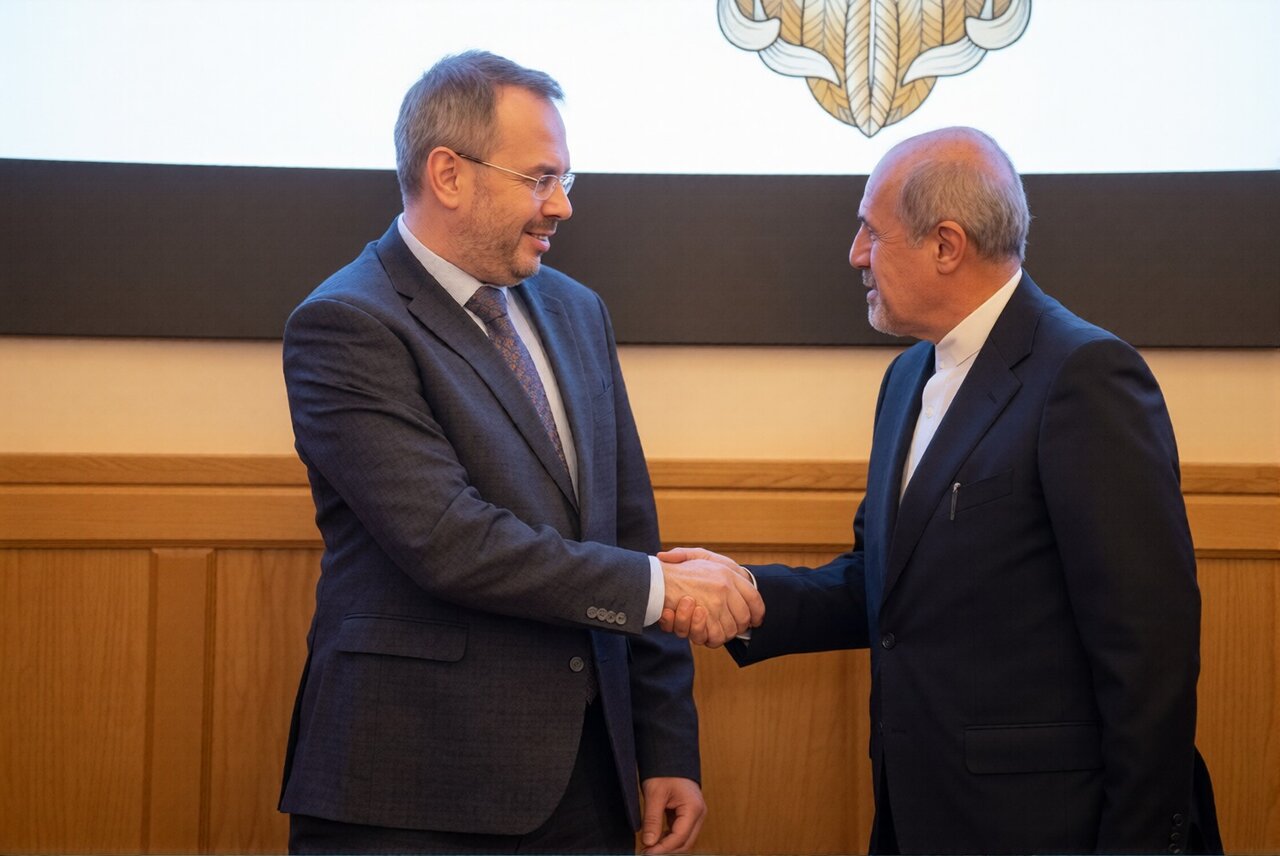
TEHRAN – The Russian Ministry of Science and Higher Education has agreed to allocate 100 additional scholarships to talented Iranian students, providing them with more opportunities to pursue higher education at Russian universities.
The issue was announced at a meeting on Sunday in Russia between Saeed Habiba, head of the Organization of Student Affairs, and Mogilevsky Konstantin Ilyich, Russian deputy Minister of Science and higher education, Mehr news agency reported.
During the meeting, the two sides discussed ways to enhance scientific, educational, and academic interactions between Tehran and Moscow.
Iran’s ministry of science, research, and technology will bestow scholarships to outstanding students.
Moreover, both parties agreed on establishing and implementing joint educational programs in fields such as modern sciences and emerging technologies, including artificial intelligence (AI) and quantum, as well as conducting joint research projects.
The officials also highlighted reviewing and updating the list of accredited higher education institutions and universities.
The Russian official welcomed the continuation of cooperation and urged the Iranian side to expedite the finalization of the nomination of members for the joint scientific and academic committee.
The two sides also discussed extending the deadline for Russian universities to submit and register their data with citation databases, including the Islamic World Science Citation Center (ISC), to encourage broader participation by Russian academic institutions in joint ranking and indexing initiatives.
Iran and Russia are preparing to establish a joint commission on science and technology, with a document on international scientific cooperation between the two countries set to be signed at a meeting of the commission.
In September, Ehsan Qaboul, head of the Ministry of Science, Research and Technology’s Center for International Scientific Cooperation, said Iran is firmly committed to expanding ties with Russia, outlining the next steps by Tehran and Moscow to strengthen bilateral cooperation, including the formation of the joint science and technology commission.
Qaboul added that the Minister of Science, Research and Technology is scheduled to travel to Moscow within the next three months to finalize the document on international scientific cooperation between Iran and Russia.
He also announced plans for 500 cooperation programs with Russian universities and scientific institutions.
The programs include holding 100 joint educational courses involving Russian professors, enabling 100 doctoral and master’s students to choose a second academic supervisor from among professors at
Russian universities, and organizing 100 technology events aimed at expanding bilateral cooperation from science and education into the technology sector.
Qaboul further said that 100 joint cultural events with Russian universities and academic and educational institutions, as well as 100 scholarships for Russian students, are also among the planned initiatives. The scholarships will give priority to students seeking to study Persian language and literature.
The official also stressed Iran’s support for Persian-language programs at Russian universities, saying Iranian professors are ready to teach Persian to Russian speakers either in person or online.
In June, Science, Research and Technology Minister, Hossein Simaei-Sarraf, and Russian Science and Higher Education Minister, Valery Falkov, reviewed strategies for developing scientific, educational, and academic cooperation between the two countries, with an emphasis on expanding professor and student exchanges, strengthening research cooperation, and facilitating academic interactions.
Simaei-Sarraf considered the development of Russian language chairs in Iranian universities and Persian language chairs in Russian universities as a sign of deepening scientific and cultural ties between the two countries.
Falkov, for his part, pointed out the beginning of a new university admission period in Russia and the welcoming of Iranian students to study at the country’s universities, emphasizing the importance of providing employment opportunities and utilizing the academic potential of graduates after their return to Iran.