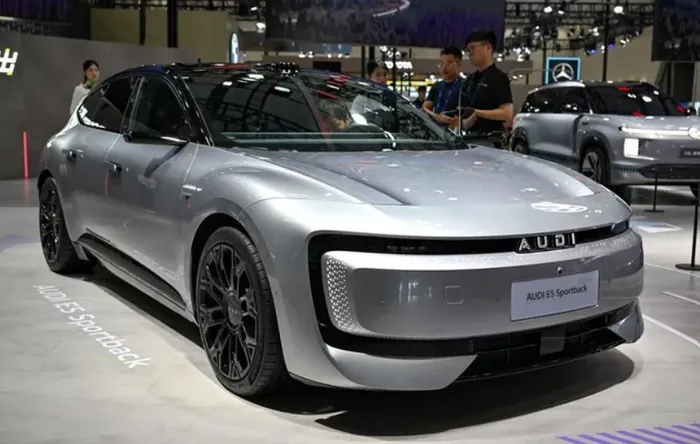
Visitors view a new energy vehicle of Audi during the 2025 World New Energy Vehicle Congress (WNEVC 2025) in Haikou, south China's Hainan Province, Sept. 27, 2025.
The US door was already closing
The practical damage predates the AGOA announcement. A 25% Section 232 tariff on vehicles, imposed in April 2025, and on components a month later, cancelled most of the preference the industry had enjoyed for 25 years. Vehicle exports to North America fell from 25,554 units to 6,530 in 2025, a drop of about 74% by my arithmetic. The Motor Industry Staff Association (MISA) puts the fall in exports to the US at 83%, so the two figures use different bases.
AGOA’s removal matters less for the economy than for particular sectors. AGOA-covered exports were about $1.7 billion in 2025, roughly 10% of South African exports to the US and 1% of total exports. But they are concentrated in vehicles, components and farm goods, so economist Raymond Parsons warns that thousands of jobs are at risk. Wandile Sihlobo estimates the exit adds about 3.4 percentage points to the 12.5% tariff already in force.
Africa’s small but fast-growing lane
Gqubule’s case rests on the numbers. South African vehicle exports to the rest of Africa rose 36.4% in 2025, from 26,200 units to 35,371. Africa is now the industry’s second-largest export region, worth R49.5 billion in automotive exports, mostly to Southern African Development Community countries.
That growth is real, but the base is small. Total vehicle exports hit 414,268 units in 2025, so Africa took only about 8.5% of them. Meanwhile 70.5% of locally built vehicles are exported, and 80% of those go to the EU and UK, which implies about 56% of production heads to Europe. South Africa’s overall export machine is huge: vehicles and components earned a record R291 billion in 2025, 15.6% of national exports.
Why the continent is worth the effort
The argument for Africa is about the type of trade, not just its size. More than 60% of intra-African flows are manufactured goods, while over half of exports to markets outside Africa are primary commodities. South Africa is already the continent’s largest intra-African trader, with 19.2% of the total in 2025, selling $31.1 billion of goods into Africa against $10.04 billion of imports. Gqubule also draws a contrast with China, a market that takes South African raw materials, and argues that continental trade builds the industrial base.
The obstacles are well known. Intra-African trade is still only about 15% to 18% of the continent’s total, against 67% within the EU. Early AfCFTA exports from South Africa were only about R2 billion by May. Infrastructure, border delays and non-tariff barriers slow everything, so the pivot is a long-term project.
What would make it work
Gqubule has asked the Department of Trade, Industry and Competition (DTIC) to convene employers, unions, National Treasury and industry bodies to design long-term responses to the US tariffs, rather than treating each shock separately. Government says it will continue company-by-company support, but a coordinated plan has yet to emerge.
The timing is not entirely bleak. Domestic sales hit 61,890 units in October, up 10.4%, and vehicle exports returned to growth that month after several months of decline. Exports had fallen 5% in the second quarter and 7.6% across the first half. Yet Europe is not a safe harbour either: Morocco now builds more cars than South Africa, mostly for European buyers.
The lesson is that Africa cannot replace the US overnight, but it is the only large market where South African vehicles and components are not just selling, but growing. Whether the continent becomes the industry’s main customer depends less on rhetoric than on corridors, customs reform and an industrial strategy that treats regional demand as a plan, not a fallback.
Past chairman of the BRICS Business Council and co-chairman of the BRICS Media Forum and the BRNN
**The Views expressed do not necessarily reflect the views of Independent Media or IOL.
** MORE ARTICLES ON OUR WEBSITE https://bricscg.com/
** Follow @brics_daily on Twitter for daily BRICS+ updates and instagram @brics_daily