Childhood looks different for many kids nowadays in the age of artificial intelligence and social media.
Toys are no longer the only things keeping them busy. Screens dominate their free time. And when they want to play with their friends, they don’t always just head outside anymore; they log onto gaming platforms instead.
And when they become lonely and need someone to open up to, it’s no longer a human hearing them out — but an AI chatbot. For mental health advocates like actress and She Talks Asia co-founder Iza Calzado, the rise of these tools is alarming. Under the guise of connection and offering safe spaces, AI chatbots often just work to normalize isolation, and it’s a reality that many humans who have fallen for the trap have to face.
“It’s safer to chat with a bot in this landscape. It agrees with you all the time. It does not judge you. It’s never disappointed when you say something. So imagine a child, who perhaps does not feel as confident or as safe in their own home, is lonely, starts talking to a bot, and then eventually becomes friends with a bot,” Calzado illustrated during a panel discussion at Rappler’s 2026 Social Good Summit last Saturday, November 21.
“Because you know what? This friend will not unfriend me, will not spread rumors about me in school, and will not bully me. That’s how it begins, and that to me is very concerning.”
Even among adults, AI chatbots have become pseudo-therapists who help rationalize their thoughts, make sense of whatever they’re going through, and validate their feelings — even when they may be in the wrong. The chatbot pulls you in by making you feel seen, and before you know it, you’ve been completely hooked.
But why does it do this?
For Empath CEO and founder Steph Naval, it’s simple: AI chatbots are there to make money.
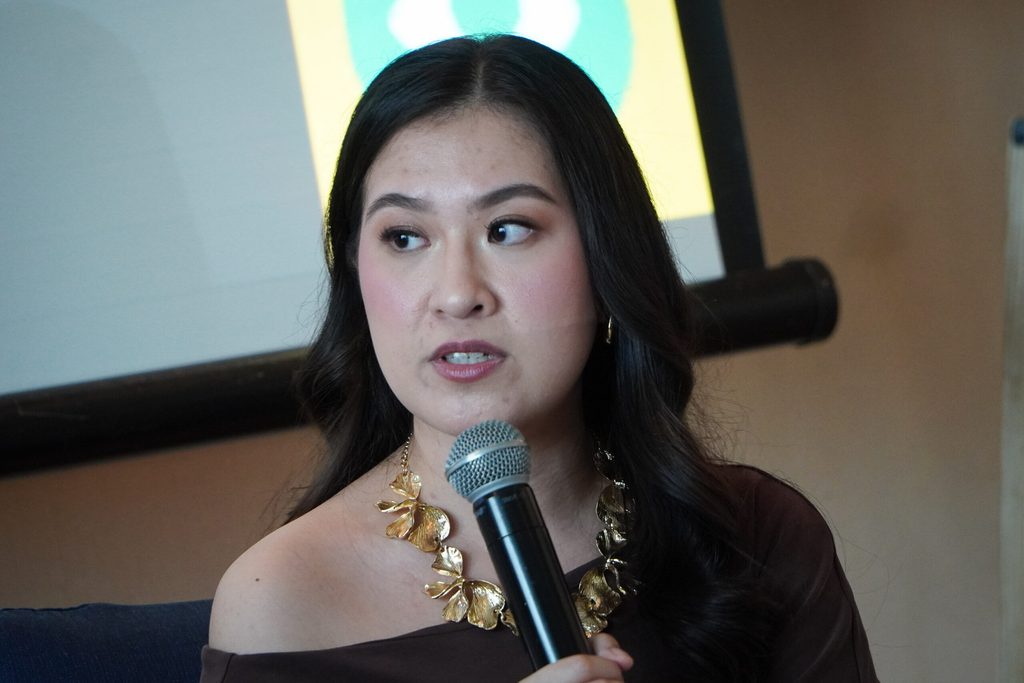 Steph Naval at We the Humans, Social Good Summit at BGC, Taguig City, on November 20, 2026.
“Chatbots, when you go there for a replacement of therapy or well-being, what happens is that you don’t get the benefit of having difficult conversations and corrective behavior. Because that’s something that you do in therapy,” Naval said, adding that it was in her painful therapy sessions that she was actually able to heal and grow most.
Must Read Unpacking mental health chats with AI: Finding comfort, but not treatment
It’s the same with social media, which has become a fierce breeding ground for insecurity. Naval said these apps can detect that through your images and videos, and “responds by pushing certain products or content that can exacerbate these negative thoughts.
“For example, it takes a lot of photos of your body or the gym and then they can detect if you feel insecure. Then they’ll push products to you. So I find that’s something to definitely take note of because that has really caused and affected a generation,” said Naval.
When technology comes before policySocial media and chatbots, however, don’t just offer you a false sense of companionship and feed on your biggest vulnerabilities. They have also doubled a platform for groups to promote violence among young children — and this is something that has become apparent in the alarming rise of school shooting incidents in the Philippines.
Must Read [Be The Good] Not another school shooting please
Still, Akbayan Representative Perci Cendaña believes that the growing reliance on these chatbots isn’t something you can blame on those who turn to it, especially in countries like the Philippines where mental health services are scarce. From then on, it only leads to a bigger set of issues that the country is not yet equipped to properly address.
“We lack mental health assistance, that’s why our countrymen go online instead. They rely on chatbots. They rely on the warmth and affirmation they get from these platforms, and this phenomenon, combined with other social realities, are fueling these isolated incidents,” Cendaña said in a mix of Filipino and English.
“Nauuna ang teknolohiya sa polisiya. Nauuna ang teknolohiya sa government framework (Technology is prioritized over policy. Technology is ahead of the government framework),” he added.
 Perci Cendaña at We the Humans, Social Good Summit at BGC, Taguig City, on November 20, 2026.
This is what Cendaña hopes to address through the National AI Governance Act — which is anchored on human-centeredness. It contains the AI Bill of Rights, which holds that humans should have the authority to override platform systems.
Cendaña then believes that tech executives and government officials shouldn’t be the only ones making decisions about AI governance. Because it’s human well-being at the very core of it all, civil society should have a seat at the table, too.
Back to your communityThe solutions to the impact of AI and technology on community mental health requires an intensive systemic approach. But these policies are not what we should only rely on, because these safeguards should start at home.
“Home should be the safest space. That’s the first line of defense — families, friends… So let’s make sure that we are that for our children,” Calzado said.
 Iza Calzado at We the Humans, Social Good Summit at BGC, Taguig City, on November 20, 2026.
Parents need their own community, too, however. It takes more than a village to raise a child in this era, and parents also need their own kind of support and human connection so they can come home strong to their kids.
For Naval, one of the best ways to do that is to dedicate time to activities that will allow you to interact with other human beings. Take a wellness class. Join clubs for your hobbies. Make the effort to see your friends in person.
Technology and AI are here to stay. Decentering it, then, requires us to go back to our roots as humans and hone in on that. – Rappler.com