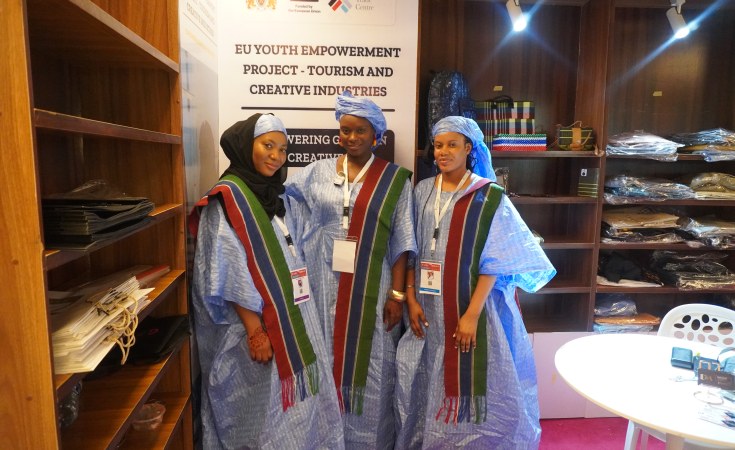
For Gambian fashion entrepreneur Ndey Bassin Faye, building an internationally recognised brand begins with empowering women, celebrating local culture, and embracing African-made textiles. At CANEX WKND 2026 in Lagos, she and fellow entrepreneurs are looking beyond borders to build connections that could help transform their businesses and the continent's fashion industry.
When Ndey Bassin Faye discusses her fashion brand's global expansion, she also refers to promoting Gambian culture internationally.
The founder of Bassin's Couture, established in 2016, is one of three Gambian fashion and tailoring entrepreneurs, Mariama Jallow, Ndey Bassin, and Ida, attending the Creative Africa Nexus Weekend (CANEX WKND) 2026 in Lagos, Nigeria.Their attendance is sponsored by the Andandorr programme, with support from EU YEP – Tourism and Creative Industries.
For entrepreneurs, the four-day gathering is more than an opportunity to showcase their work. It is a chance to meet potential partners, connect with suppliers, learn from industry experts, and explore new markets for their businesses.
At the heart of Faye's work is a commitment to women and girls. Through Bassin's Couture, she uses fashion not only as a business opportunity but also as a means of empowering women to pursue entrepreneurship while promoting Gambian culture through design.
Like many African fashion entrepreneurs, she faces challenges that extend beyond creativity and craftsmanship. One of the biggest obstacles is accessing materials.
"One of the challenges we face is the difficulty of sourcing diverse fabrics, particularly those outside of Gambian culture," says Faye.
She highlights the challenges of sourcing materials from other African countries, noting that, in some instances, it is easier to access supplies from Europe and China than from within the continent.
While the continent is home to rich textile traditions, cotton-producing countries, and a growing community of designers, connecting the different parts of the value chain remains difficult.
For Faye and her partners, CANEX offers an opportunity to help bridge some of those gaps. She hopes to use the gathering to establish relationships with suppliers, meet fellow designers, and explore collaborations that could strengthen her business and expand its reach.
"I want us to go international. I want our brand to be seen and to be known internationally," she says.
She also wishes to see more African materials incorporated into African fashion.
The Gambia has a tradition of handweaving, and Faye is proud to work with locally grown cotton. By incorporating hand-woven fabrics into her designs, she is taking practical steps towards building a fashion business that promotes local resources while celebrating the country's cultural identity.
Building a fashion industry that supports African designers
The challenges facing entrepreneurs such as Faye are part of the bigger conversations at CANEX, particularly during different masterclasses offered by experts in the textile industry. In a masterclass about how African fashion businesses could strengthen their marketing management and expand into global markets, luxury brand consultant Anita Ehui highlighted the structural difficulties that continue to affect African fashion businesses, particularly in manufacturing, textiles, sourcing, quality control, and pricing.
"I think we have a big manufacturing problem, whether in textiles or production itself, and that makes things difficult," Ehui said.
She explained that while many designers aspire to manufacture their products entirely on the continent, achieving this can be challenging due to limitations in material availability, production capacity, and quality.
Designers are often forced to make compromises, whether on quality, pricing, or design, because the necessary resources and infrastructure are not always readily available. Ehui encouraged entrepreneurs to prioritise African sourcing and production wherever possible, arguing that increasing demand for locally manufactured products could help strengthen the continent's manufacturing ecosystem.
However, she also cautioned against some common mistakes made by emerging fashion businesses.
One common mistake is overcomplicating business decisions, such as designing and selling products based solely on personal preferences rather than genuine customer demand.
For African fashion businesses aiming for growth, identifying the correct market is crucial. Instead of trying to appeal to everyone, entrepreneurs should understand their target customers, their desires, and the most effective ways to communicate the value of their products.
She highlighted how CANEX provides an important platform for designers to connect with potential customers and fosters conversations that can lead to partnerships and new ideas.
"CANEX is giving fashion designers a platform. It is also connecting some of the brands with customers," she stated.
She added that gatherings like CANEX create opportunities for collaboration, knowledge-sharing, and has potential to expose creators to new perspectives.
"When we gather at CANEX, there is always a conversation that can spark a collaboration or even open your mind to something new," she said.
To complete the process, please follow the instructions in the email we just sent you.
There was a problem processing your submission. Please try again later.
For the three Gambian entrepreneurs, these conversations are particularly important as they plan the next phase of their businesses. Access to industry experts through masterclasses, exposure to other African brands and suppliers, and opportunities to engage with potential business partners offer valuable insights into building sustainable fashion enterprises.
Organised by the African Export-Import Bank (Afreximbank) and hosted by the Federal Government of Nigeria, CANEX WKND brings together leading African and diaspora creatives, investors, and policymakers from various sectors including music, film, fashion, sport, publishing, gastronomy, and visual arts.
The four-day event is designed to facilitate partnerships, encourage investment, and expand access to international markets for Africa's creative industries.
For Faye, the journey towards that future is already underway. The vision is to reach international markets without losing the local identity that makes the brand distinctive. Faye and Ehui agree that African fashion can compete globally, but the continent must first make it easier for African creatives to work, source, produce, and grow together.
#AfricaMadeIt #MakeItInAfrica #BuildingforPower
CANEX Aims to Empower African Creatives to Compete in Global Markets and Drive Economic Growth
AllAfrica publishes around 600 reports a day from more than 90 news organizations and over 500 other institutions and individuals, representing a diversity of positions on every topic. We publish news and views ranging from vigorous opponents of governments to government publications and spokespersons. Publishers named above each report are responsible for their own content, which AllAfrica does not have the legal right to edit or correct.
Articles and commentaries that identify allAfrica.com as the publisher are produced or commissioned by AllAfrica. To address comments or complaints, please Contact us.
AllAfrica is a voice of, by and about Africa - aggregating, producing and distributing 600 news and information items daily from over 90 African news organizations and our own reporters to an African and global public. We operate from Cape Town, Dakar, Abuja, Johannesburg, Nairobi and Washington DC.
To complete the process, please follow the instructions in the email we just sent you.
There was a problem processing your submission. Please try again later.