The 2026 local government elections have delivered a bruising verdict on the ANC in Gauteng, with the party losing ground across the province as the DA strengthened its position and ActionSA consolidated its place among the province’s leading political forces.
From Johannesburg to Ekurhuleni, the results reveal an electorate increasingly divided between competing parties.
IEC chairperson Mosotho Moepya outlined the performance of the five leading parties in the 2026 local government elections, with the ANC receiving 30.76% of the national vote and securing 3 246 council seats.
“The ANC received 30.76% of the vote and secured 3 246 council seats,” Moepya said.
“The Democratic Alliance received 24.64% of the vote and secured 1 695 council seats.”
He said the MK Party received 9.76% and secured 785 seats, while the EFF obtained 6.22% and 588 seats.
“ActionSA received 5.67% of the vote and secured 313 council seats,” he said.
Moepya added that other political parties and independent candidates collectively received 22.97% of the vote.
Gauteng’s political landscape has also undergone a significant shift, with the ANC suffering one of its most serious electoral setbacks in the province while the DA emerged as the leading party in several municipalities.
The results have also brought a breakthrough for ActionSA, whose growing support has strengthened its electoral presence.
None of the three metros has an outright majority, leaving the next administrations dependent on coalition negotiations after years of political instability and complaints about poor service delivery.
In Johannesburg, the DA secured 91 of the council's 270 seats, up from 71 in 2021, while the ANC dropped from 91 to 63. ActionSA obtained 43 seats, compared with 44 in the previous elections.
The results mean that parties will have to negotiate to reach the 136 seats needed for a majority.
Johannesburg has experienced repeated changes in mayoral leadership since the 2021 elections, with successive administrations struggling to address water shortages, electricity interruptions and deteriorating infrastructure.
In Tshwane, the DA secured 74 seats, compared with 69 in 2021. ActionSA increased its representation from 19 to 48 councillors, while the ANC dropped from 75 to 44.
The 214-member council requires 108 seats for a majority, meaning no party can govern alone.
Ekurhuleni recorded another shift, with the DA securing 66 seats, followed by the ANC with 59 and ActionSA with 40.
The ANC previously held 86 seats, while ActionSA had only 15 councillors following the 2021 elections.
ActionSA leader Herman Mashaba welcomed the party's gains in Ekurhuleni, saying its representation had increased from 15 councillors in 2021 to 40 in 2026.
According to Mashaba, ActionSA secured 18.5% of the vote and won 17 wards outright, compared with none in the previous local government elections.
"This is a remarkable achievement and a clear sign that ActionSA is gaining momentum!" Mashaba said.
He congratulated the party's regional leadership, activists, campaign team and mayoral candidate Xolani Khumalo for their efforts during the elections.
"To the residents of Ekurhuleni, thank you for believing in ActionSA and entrusting us with your votes," Mashaba said.
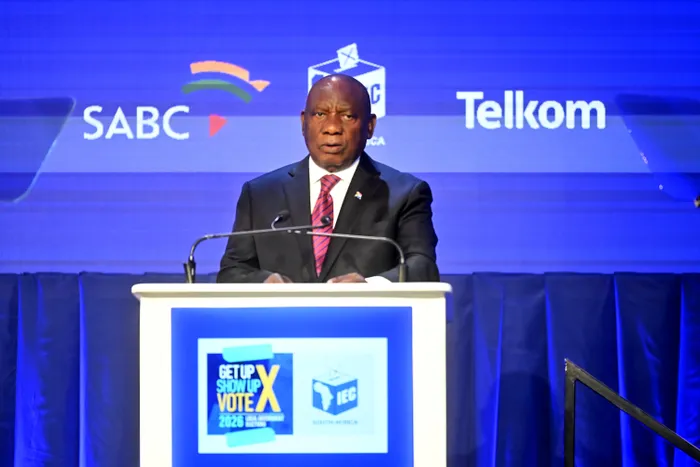
President Cyril Ramaphosa address the nation at the National Results Operations Centre at the Gallagher Convention Centre in Midrand on Sunday.
Meanwhile, EFF leader Julius Malema blamed the ANC's decision to enter the Government of National Unity (GNU) with the DA in 2024 for helping the party gain support in the municipal elections.
Speaking at the National Results Operations Centre in Midrand on Saturday, Malema rejected suggestions that the DA had stolen votes from the EFF.
"Comrades, there is no DA that stole votes. Our people voted for DA. To say DA stole votes, you are lying. DA did not steal votes."
Malema argued that the ANC had made the DA more acceptable to voters by bringing it into national government after years of portraying it as a political opponent.
"That is the psychology of our people, and those are the repercussions we are suffering from today."
He also accused the ANC of strengthening the DA's political position by giving it influential Cabinet portfolios.
"Helen Zille is more boastful than ever before, and they allowed her to do that," Malema said.
Turning to coalition negotiations, Malema warned that the EFF would not accept unfavourable agreements simply to prevent the DA from taking control of municipalities.
"If the negotiation people still want to become arrogant, you know what we are going to do? We're going to fold our arms, and Helen will take this," he said.
In its November 7 statement, the ANC warned that political instability in coalition-run municipalities had affected service delivery, with some councils changing mayors several times during a single term.
The party said repeated leadership changes had disrupted budgets and municipal planning, leaving residents to bear the consequences.
It urged parties entering coalition agreements to put residents first, warning that political disagreements should not interfere with municipal services.
President Cyril Ramaphosa has urged newly elected councillors to put residents’ interests ahead of political ambitions, saying their election comes with a responsibility to improve people’s daily lives.
Addressing the announcement of the 2026 local government election results in Midrand on Sunday, he said: “Your responsibility is not simply to occupy a seat in a council chamber. It is to serve the communities that have placed their trust in you.”
He also cautioned political parties against allowing coalition disagreements to undermine service delivery. “The stability of our municipalities cannot be sacrificed to narrow political interests. The delivery of essential services cannot be held hostage by political disagreements,” Ramaphosa said.
On the national outlook, Moepya said the ANC remained the country's largest party, securing 30.89% of the vote and 3164 council seats in the 2026 Local Government Elections.
The DA followed with 24.60% of the vote and 1527 council seats, while the uMkhonto weSizwe Party (MK Party) received 9.61%, translating into 701 seats.
The EFF secured 6.25% of the vote and 505 seats, while ActionSA received 5.68% and secured 219 council seats.
Other political parties and independent candidates collectively accounted for 22.97% of the vote, securing representation across municipal councils.
On municipal outcomes, the ANC achieved outright control in 51 municipalities and emerged as the leading party in 120 municipalities. The DA secured outright control in 12 municipalities and became the leading party in 29.
IFP achieved outright control in five municipalities and emerged as the leading party in 19, while the MK Party secured outright control in three municipalities and became the leading party in 18. Rise Tsantsabane Communities secured outright control in one municipality.
Moepya said that, of the country's 213 municipalities, 72 councils had a political party that secured an outright majority of seats.