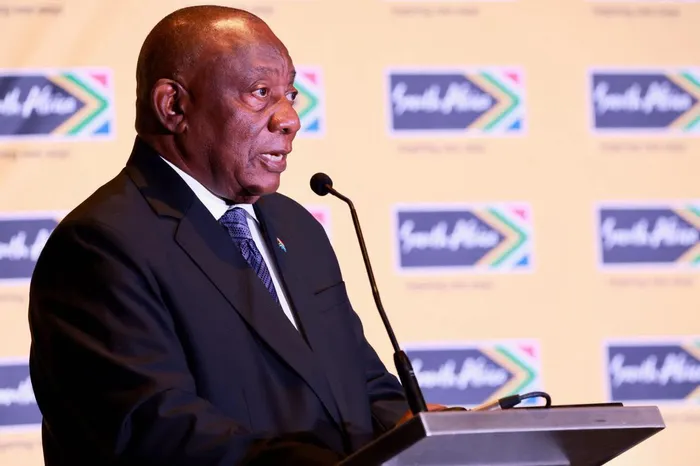
President Cyril Ramaphosa at the South Africa AI Opportunity Conference at the San José McEnery Convention Centre in California.
President Cyril Ramaphosa’s Silicon Valley mission has placed South Africa’s ambitions in the global artificial intelligence race under the spotlight, as the country seeks to move beyond consuming technologies developed elsewhere and build the infrastructure, skills and businesses needed to compete.
But questions remain over whether South Africa has the computing capacity, technical skills, policy certainty and investment environment to turn that ambition into reality.
Ramaphosa, who arrived in California on November 14, is leading a multi-stakeholder delegation of government representatives, business leaders, academics, researchers, technical experts and university students.
The visit, running until November 21, includes engagements with technology companies, investors and academic institutions, with discussions on data infrastructure, robotics, cloud computing, AI governance and the future of work.
The programme includes the Semafor: Silicon Valley and the World engagement and the South Africa AI Opportunity gathering, focused on building the African AI economy through infrastructure, investment and innovation.
The scale of the global race is reflected in investment flowing into the sector. Figures cited by the Presidency indicate that leading hyperscalers are planning approximately US $650 billion in AI capital expenditure in 2026, while venture capital investment in AI reached US $259 billion in 2025.
For South Africa, the challenge is not simply to attract investment, but to build local technological capabilities rather than become a host for infrastructure and platforms controlled elsewhere.
“We cannot afford to become merely consumers of these technologies that are controlled elsewhere, particularly in the northern hemisphere; we want to become active participants in shaping this new technological age. That is why we are here,” Ramaphosa said.
“We have not come to Silicon Valley merely to see the future. We have come to help shape South Africa’s place in that future,” he said.
He identified South Africa’s universities, research institutions and technology sector, alongside the presence of global cloud and data companies, as foundations for building its AI capabilities.
“We must move from being a location for digital infrastructure to becoming a centre of digital innovation; our ambition must be to make South Africa not only a gateway to Africa’s digital economy, but one of the engines that are driving its growth,” Ramaphosa said.
This ambition will depend on whether South Africa can close the gap between adopting AI and developing its own technology, says Vukosi Sambo, chief executive of STM Healthcare Investments and group chief information officer at PHA and Marara Holdings.
Speaking from Silicon Valley, Sambo said South Africa was making progress in adopting AI but remained behind in the infrastructure and capabilities needed to develop it.
“So we are keeping pace in using AI, but not yet in building it, in compute or in policy certainty,” he said.
He identified computing infrastructure and talent as two of the country’s biggest weaknesses, arguing that access to computing power should be treated as essential infrastructure. He pointed to India’s AI Mission, which makes high-end graphics processing units available to start-ups, researchers and institutions at subsidised rates, as an example of how governments can lower development costs.
South Africa also needed stronger links between universities, researchers, venture capital and industry to turn research into commercially viable products and businesses.
Rather than compete with global technology giants by building the biggest AI models, Sambo said the country should focus on solutions grounded in local data, languages and needs.
“Others can build the biggest models; we should build the most relevant ones,” he said.
Local innovation is already emerging, but the question is whether it can be scaled to make a meaningful difference to the economy.
Atenkosi Ngubevana, chairperson of the South African AI Awards and an AI executive, said AI should be used to solve real-world problems, improve lives and drive economic growth.
Having recently hosted the awards, Ngubevana said they attracted more than 400 nominations from start-ups, established businesses, researchers and innovators. Entries covered healthcare, education, financial services, agriculture, customer experience and social impact.
Among the initiatives recognised were Uhuru Marketplace, which uses AI to make digital commerce more accessible to everyday sellers, and Viewwave, recognised for making responsible AI governance practical within financial institutions.
“I don’t believe South Africa has an innovation problem. We have a scale opportunity problem,” Ngubevana said.
She said the challenge was to turn local innovation into globally competitive businesses, African intellectual property and solutions that could be deployed nationally. AI’s value should be measured by its impact on people, including through personalised learning, earlier health interventions, intelligence-led policing, predictive infrastructure maintenance and easier access to government services.
“That is when AI stops being a technology agenda and becomes a national development agenda,” she said.
Dr Mark Nasila, chief data and analytics officer at FNB, said South Africa needed to move beyond AI experimentation and focus on implementation.
The State of AI Adoption Maturity Report showed that although AI adoption was high, organisations struggled to move from experimental pilots to scalable applications delivering measurable value, he said.
Nasila said AI could help government detect fraud by analysing complex datasets, identifying suspicious procurement patterns and comparing tender prices with market benchmarks.
“AI allows us to analyse vast, complex datasets to spot anomalies that human auditors simply cannot,” he said.
He said early-warning systems could help identify indicators of state capture before they became entrenched. However, AI systems needed to be accountable and accurate enough to prevent false alerts from overwhelming investigators.
Nasila said implementation also required stronger governance, data security and regulatory alignment, alongside investment in technical expertise and AI literacy among public-sector leaders.
“We need to move beyond the hype by ensuring AI initiatives have strict success metrics and adequate funding,” he said.
Ramaphosa has also urged government to use AI more effectively to improve public services.
“We cannot afford to move at yesterday’s pace in a world that is changing at tomorrow’s speed. The pace of technological change will not wait for the pace of our bureaucracy,” he said.
Ramaphosa has proposed that within 90 days of the delegation’s return, government identify practical initiatives, including investment opportunities, research and skills partnerships, and AI applications to strengthen the economy and improve public services.