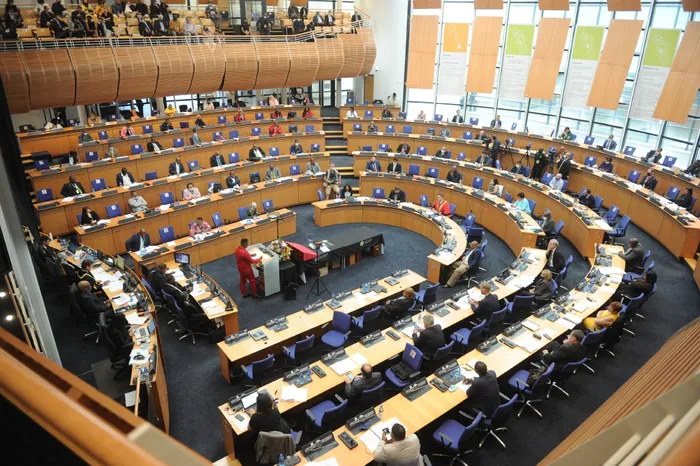
South Africa’s newly elected municipal councils have 14 days to hold their first meetings and elect political leaders, while 127 hung councils face coalition negotiations.
Image: Ayanda Ndamane/African New Agency(ANA)
The City of Cape Town council is set to welcome seven political parties making their first appearance in the chamber, bringing the total number of parties represented to 22 following last week's local government elections.
ActionSA emerged as the strongest-performing newcomer, securing seven seats, while the South African Communist Party (SACP), which contested the municipal elections independently following its breakaway from the African National Congress (ANC), secured two seats.
The African Transformation Movement (ATM) also won two seats, while the uMkhonto weSizwe (MK) Party, Build One South Africa (BOSA), People’s Movement for Change (PMC) and Hopeful Leaders Democrats each secured a single seat.
New parties outline their council priorities
BOSA technical director Chad Louw said the party intended to turn complaints raised by residents into formal matters requiring action from the City.
"Our BOSA representative will use council questions and committee seats to force clear timelines from the city administration on unresolved community issues like broken infrastructure and service backlogs. If the City fails to respond, we will use our legislative leverage to oppose budgets until everyday residents get results," he said.
The SACP, which will have representation across six municipalities in the Western Cape, described its electoral performance as an important breakthrough for working-class representation.
SACP provincial secretary, Benson Ngqentsu, said the party intended to use its seven seats across the six municipalities to push for an end to outsourcing basic municipal services and what it described as the exploitation of Expanded Public Works Programme (EPWP) workers.
Ngqentsu said the party wanted to rebuild the institutional and technical capacity of municipalities, adding that years of policy choices and austerity measures had weakened their ability to deliver basic services.
"We intend to use our seven seats to advance an aggressive working-class agenda of ending the outsourcing of basic municipal services to private interests, putting an end to the exploitation of EPWP workers as a source of cheap labour, and rebuilding the institutional and technical capacity of municipalities," he said.
ActionSA leader Herman Mashaba welcomed the party's performance in Cape Town, praising the party's candidate Dereleen James for securing support despite limited resources.
"We are proud of the sterling performance by Dereleen James, literally without any budget, just TikTok. We are happy to be officially represented by 7 councilors in the Cape Town Council. Great foundation for the future," he said.
Smaller parties seek greater accountability
Smaller political parties, which have declined in their support in the City of Cape Town, include the African Christian Democratic Party (ACDP), the Africa Restoration Alliance (ARA), the Cape Independence Party (CAPEXIT), and the National Coloured Congress (NCC).
Political analyst Dr Levy Ndou said the emergence of smaller political parties was a reflection of democracy, but also highlighted growing competition for support traditionally enjoyed by established political movements.
"Democracy allows different political parties to be formed and to exist. The reason we've got so many political parties now in South Africa is the same reason why some parties are actually competing, and what they mostly do is that they take the votes from the traditional political parties," Ndou said.
He said smaller parties could play an important role in strengthening accountability, particularly in municipalities where one party has an outright majority.
DA retains Cape Town majority
"The existence of these smaller parties has an even much bigger impact on the other parties because they would ensure that they make the bigger parties to account but also building their own support base."
Ndou said the political dynamics in Cape Town would differ from those in hung municipalities, where parties are often forced to negotiate coalitions to establish a government.
The DA retains its majority in the City of Cape Town, meaning the incoming parties will largely occupy the opposition benches.
"All other parties have to make sure that the party that is in charge has to be accountable. That is the main role of the smaller parties," he said.