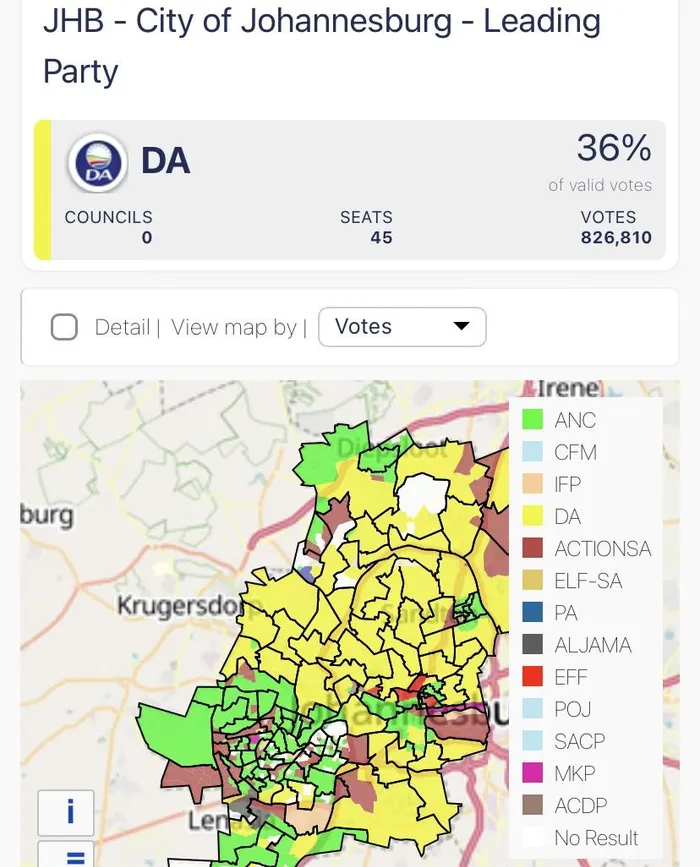
The DA is pulling ahead of the ANC in the battle for Johannesburg, leading the vote count as the race for the mayoral chain heats up and political parties begin exploring possible coalition arrangements.
The DA has opened a commanding lead over the ANC in the City of Johannesburg vote count, positioning itself for a possible takeover of the metro as coalition negotiations begin ahead of the final election results.
This is as the race for control of the troubled metro is heating up.
With 98% of the national vote counted by the time of writing this article, the African National Congress (ANC) remained ahead nationally, followed by the DA and the uMkhonto weSizwe (MK) Party.
The ANC had secured 30.95% of the national vote, receiving 8,907,059 votes. It was leading in 115 councils and had secured control of 48, with 3,048 seats.
The DA followed with 24.55% of the vote and 1,375 seats. It was leading in 27 councils and had secured control of 11.
The MK Party was in third place nationally, with 9.62% of the vote and 674 seats. It was leading in 18 councils and had secured control of three.
DA leads in Gauteng
In Gauteng, where 94% of the provincial vote had been counted, the DA was leading the vote count with 34.43%, translating to 2,284,954 votes and 206 seats.
The ANC was in second place with 21.18% of the vote and 208 seats.
It was leading in three councils but had not secured control of any.
ActionSA followed with 17.09% of the vote and 62 seats.
The party was not leading in any council and had not secured control of one.
Other political parties followed, as the results continued to point to a highly competitive political landscape in the province.
DA ahead in Johannesburg mayoral race
Attention has also turned to the City of Johannesburg, one of the country's most closely watched metros, where parties are vying for control of the troubled municipality.
Preliminary results showed the DA leading the vote count with 36%, translating to 826,810 votes at the time of writing.
The ANC was in second place with 37 seats and 19.67% of the vote, while ActionSA followed with 16.28% and eight seats.
According to the preliminary results, coalition negotiations could play a decisive role in determining who governs Johannesburg.
Coalition talks begin
Meanwhile, as the vote-counting process approaches its final stages, some political parties have already begun discussions about possible coalition arrangements.
On Friday, DA leader Geordin Hill-Lewis said the party had approached several political organisations in areas where coalition governments were expected.
Hill-Lewis said the discussions were informal at this stage and were likely to continue over the coming days.
However, ANC national spokesperson Mahlengi Bengu said the party had not yet engaged other political organisations about possible coalition arrangements in the metros.
Zille faces competition for Johannesburg mayoral position
DA Johannesburg mayoral candidate Helen Zille is among several prominent political figures contesting the closely watched mayoral race.
Her rivals include ActionSA leader Herman Mashaba, EFF candidate Dr Tlaleng Mofokeng, African Transformation Movement (ATM) leader Vuyo Zungula, Patriotic Alliance (PA) candidate Kenny Kunene and Build One South Africa's (BOSA) Nobuntu Hlazo-Webster.
Despite the competition, Zille previously said she hoped the DA would secure an outright majority in the local government elections.
The former Cape Town mayor and Western Cape premier also ruled out relying on the EFF to secure a majority through a coalition arrangement.
Zille defended the DA's previous participation in a multi-party coalition in Johannesburg but said the party would not repeat the same arrangement.
Asked how the DA would govern Johannesburg differently after previously leading the city, Zille said it would not rely on a nine-party coalition that depended on the EFF for a majority.
"We won't run it in the second [term]... in the nine-party coalition that depended on the EFF to get there. I promise you we have to run it [differently,] not in a nine-party coalition.
"Because you cannot do it in a nine-party [coalition] that is still a minority option," she said.
Zille later clarified that she was not suggesting that securing an outright majority was the party's only option.
"No, I'm not saying it's all or nothing. Obviously the best solution is... [to secure] an outright majority in our [favour].
"Because then we can have a solid, stable DA government for five years. And then you can see what we can do. But if we don't get there we'll try and negotiate a workable coalition. But I'm saying a nine-party minority coalition dependent on the EFF for a majority is not a workable coalition," she said.
Meanwhile, vote counting and verification continue, with the IEC expected to announce the final election results on Sunday.