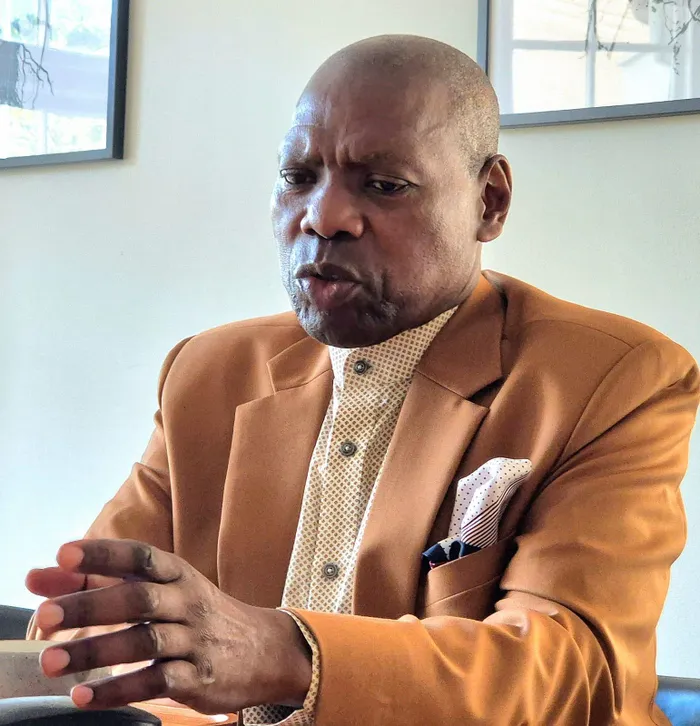
The ANC must undertake serious introspection, apologise to voters and address internal divisions if it hopes to reverse its declining electoral fortunes, says Zweli Mkhize.
ANC national executive committee member and chairperson of Parliament’s portfolio committee on Cooperative Governance and Traditional Affairs, Dr Zweli Mkhize, says political leaders must accept one another as products of the will of the people, regardless of their political differences.
“It is important to respect those who have decided upon us as leadership. People cannot be correct if they elect us but they are wrong if they elect someone else who is my adversary. From that perspective it is important to understand that each one of the political parties is an outcome of people who were trying to find the best vehicle to express their feelings and also to create a mechanism for their needs to be pursued,” Mkhize said in an exclusive interview with the Sunday Tribune midweek.
He said this was particularly important in South Africa, and KwaZulu-Natal in particular, given the province’s history of serious political intolerance.
“Any suggestions that tend to create a sense of lack of legitimacy of parties that would have come from the same process from which we have also emerged cannot be a one-sided kind of situation. That for me is the starting point,” Mkhize said, reflecting on the hung municipalities that emerged from the November 4 local government elections.
The provincial question
Of KwaZulu-Natal’s 44 municipalities, only nine produced an outright single-party majority, leaving 35 hung councils.
The ANC secured an outright majority in Greater Kokstad Municipality in southern KwaZulu-Natal, where it won all the wards and gained a council majority through an electoral overhang, despite receiving less than half of the total vote.
The party also emerged as the largest in a handful of hung councils, including uMzimkhulu, where it won 21 of the 43 seats.
Provincially, the ANC finished second with 20.27% of the vote, or 1,289,398 votes, behind the uMkhonto weSizwe Party (MKP), which secured 34.32%. The Inkatha Freedom Party (IFP) followed closely behind the ANC with 20.13%.
The IFP won outright control of five municipalities: Nongoma, Ulundi, Msinga, Mthonjaneni and Nkandla. The MKP secured three, including Impendle, Richmond and Johannes Phumani Phungula, formerly known as Ubuhlebezwe.
The Democratic Alliance retained control of uMngeni, where Chris Pappas retained his mayoral chain and became the first mayor to be sworn in following the elections.
Mkhize said the ANC needed to confront the reasons behind its electoral decline through serious introspection and an assessment of the leadership’s contribution to the outcome.
“Coming from a history of having had overwhelming support there is something that needs to be corrected in the way the ANC is managing its affairs. The ANC has to engage in a thorough soul-searching and introspection.”
He said the sharp decline in the party’s support reflected a drastic change in voter behaviour that required a correction.
Mkhize said the ANC’s renewal programme should not be viewed as an exercise that inevitably resulted in the party losing support.
“The reward of renewal is public support,” he said.
Three point diagnosis
He identified three broad areas that had contributed to the party’s declining fortunes: economic conditions and their socio-economic consequences, service delivery and political leadership.
On the economy, Mkhize said there was a strong correlation between per capita income, public sentiment and the ANC’s electoral appeal.
“There has always been a very strong correlation between the per capita income to the national mood and the appeal of the ANC. If you are feeling the economic situation is making us feel comfortable then certainly somebody is doing a good job. So the level of unemployment has gone up quite drastically moved back from 23% up to 33% with much higher level in rural areas and amongst the youth. The high level of unemployment with the large number of young people who had been out of school for a number of years, some for up to a decade. Small businesses, who are struggling to survive, professionals, and the middle class who are feeling the squeeze and failing to cope. All of these issues are serious that would eventually have a very negative to the ANC as the ruling party.”
He said unemployment, poverty and economic pressure were contributing to rising crime and drug abuse, with consequences for the social fabric of communities.
“If you look at what that gets associated with is the high level of crime and drug abuse. You start seeing strange things. For example, I've been to a several funerals where rituals performed at funerals are rituals from prisoners in jail. Where people go out and do stuff which was only limited to people in jail. Then you see the burning of cars and ululations and so on. There is a cultural disruptions that is brought by entrenched criminality in society,” Mkhize said.
He warned that entrenched criminality was placing rural communities under increasing pressure and could eventually undermine government's ability to maintain control in some rural towns.
On service delivery, he said reliable water and electricity supplies, as well as general access to basic services, remained major challenges. In areas where services were available, government was also having to contend with illegal connections.
Turning to political leadership, Mkhize said the ANC needed to confront problems relating to party unity, irregularities in membership and internal conferences.
Weathering breakaways
He also criticised the practice of gatekeeping party membership, saying it enabled the appointment of incompetent people and entrenched factionalism.
Mkhize said the ANC owed the public an apology for failing to live up to the support people had given it over the years.
“The ANC owes the public an apology. People have stood with the ANC. When people were shot and killed, the ANC didn't die, instead the same people rose in large numbers to support it.”
He said he fully supported former president Thabo Mbeki’s call for ANC leaders to be held accountable for the party’s poor electoral performance.
Despite its poor electoral performance, Mkhize said the ANC could still recover, pointing to its history of surviving breakaways driven by ideological differences and political intolerance. He cited the formation of the PAC in the 1950s, the UDM in the 1990s, Cope, the EFF and, most recently, the uMkhonto weSizwe Party as examples of splits the party had weathered.