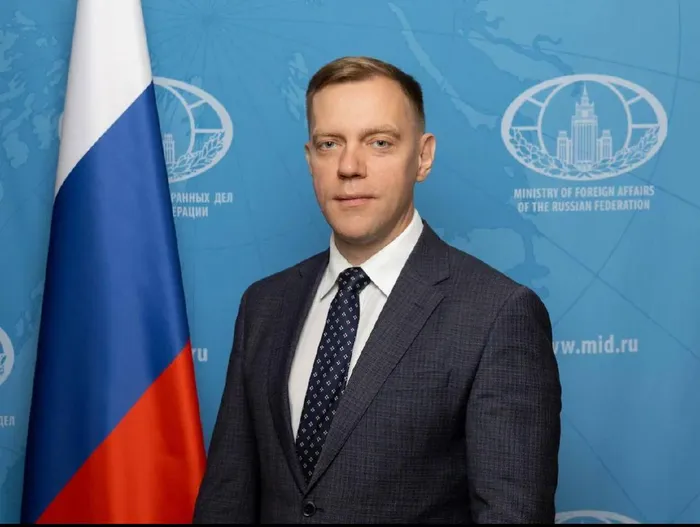
Russian Consul General Ruslan Golubovskiy
Russia is seeking to turn its longstanding relationship with Africa into a deeper economic partnership, with trade, investment, food security and alternative payment systems taking centre stage at the third Russia-Africa Summit in Moscow.
Held on October 28 and 29, the summit brought together high-ranking delegations from 48 African countries, alongside business representatives, civil society organisations and regional integration bodies.
More than 40 events covered political, economic, humanitarian and technological cooperation, highlighting Moscow's ambition to move beyond historical ties and political solidarity towards practical, long-term partnerships.
On October 28, Russian President Vladimir Putin raised a toast to strengthening friendship and cooperation between Russia and African states, as well as to peace, well-being and prosperity for people across the two continents.
Behind the celebratory atmosphere, however, was a significant political and economic agenda.
Putin stressed that close political relations should translate into tangible economic benefits. Russia is seeking to expand trade, invest in manufacturing, develop infrastructure and share technology with African partners.
Russia's trade with African countries has already reached $27 billion, while Russian investments across the continent are valued at tens of billions of dollars.
Putin said future trade growth should also involve a change in its structure, with Russia seeking to increase imports of African products rather than simply exporting its own goods.
The stated ambition is to develop a more balanced trading relationship in which African countries participate more fully in production and international value chains, rather than remaining primarily suppliers of raw materials.
Russia pushes for trade in national currencies
A key element of the economic agenda was the gradual shift towards settling trade in national currencies.
According to the figures presented at the summit, the share of transactions conducted in national currencies, including the Russian rouble, has reached 85% of trade settlements with African partners.
The development reflects Russia's efforts to reduce dependence on Western financial infrastructure and establish alternative mechanisms for international trade.
The issue has also featured prominently in wider <Link url={turn815618search1.url.uri} title="BRICS discussions on the use of national currencies"/> and efforts to expand financial cooperation among developing economies.
Russia reaffirmed its readiness to supply African countries with grain, mineral fertilisers and other agricultural products, while sharing agricultural technology.
More than 18 million tonnes of grain were supplied to African countries during the previous year, with a further 13 million tonnes delivered in the first nine months of 2026.
Russian fertiliser exports during the same period exceeded 2.2 million tonnes, compared with approximately 1.5 million tonnes for the whole of the previous year.
The humanitarian agenda included plans to increase the number of African students at Russian universities, establish university branches and educational centres across the continent, and expand medical cooperation.
The programme supporting African countries in their fight against infectious diseases is also set to be extended until 2029.
Russia promotes a multipolar world order
The summit's economic discussions were closely connected to a broader political objective: strengthening national sovereignty and promoting a multipolar world order.
Russia opposes what it describes as a global system in which individual countries or groups of states claim the authority to determine the rules for everyone else.
In this context, cooperation with organisations representing the Global South is particularly important.
BRICS, the African Union, the African Continental Free Trade Area (AfCFTA) and other regional organisations are increasingly being viewed as platforms not only for political dialogue but also for developing alternative economic partnerships.
According to the figures cited in the summit discussions, BRICS member countries account for more than 40% of global gross domestic product measured in purchasing power parity, compared with less than 30% for the G7.
These figures reflect the changing balance of the global economy and the growing influence of developing economies.
Russia's position is that international cooperation should not be conditional on political demands, interference in domestic affairs or restrictions on countries' right to determine their own development paths.
One of the significant events on the sidelines of the summit was Putin's meeting with representatives of leading African regional and integration organisations.
Participants included representatives of the African Union, AfCFTA, the Southern African Development Community (SADC), the East African Community (EAC), the Common Market for Eastern and Southern Africa (COMESA), the Economic Community of West African States (ECOWAS), the Arab Maghreb Union and the African Export-Import Bank.
The Eurasian Economic Commission and the Commonwealth of Independent States also participated in discussions on Eurasian integration.
Africa's role in shaping international partnerships
The summit also highlighted differences in how the Moscow meeting was interpreted by Russian and foreign media.
According to AFP reports carried by Cape Town newspapers, international coverage largely focused on Moscow's efforts to strengthen its influence in Africa and attract partners amid its tensions with Western countries.
From this perspective, the summit was primarily viewed through the lens of geopolitical competition.
Less attention was given to the practical areas of cooperation discussed, including agreements with African regional organisations, payment arrangements, trade and economic initiatives, and plans for future joint work.
The argument presented by Russia is that the continuing effects of colonialism and the economic dependence of African countries remain important considerations in the continent's international relationships.
Despite the competing interpretations, the summit outlined several mechanisms through which Russia and African countries intend to develop their relationship.
These include a cooperation plan with African organisations, closer engagement between African and Eurasian integration structures, expanded cooperation with the African Union and alternative payment mechanisms.
Progress in these areas will provide measurable indications of whether the commitments made in Moscow translate into lasting partnerships.
Importantly, African countries are not simply passive participants in this process. They are determining their own cooperation priorities, seeking access to technology, investment and new markets, and using a wider network of international partnerships to strengthen their positions.
This approach reflects the multi-vector foreign policy pursued by many countries across the continent.
The Moscow Declaration and the Joint Action Plan of the Russia-Africa Partnership Forum for 2027–2029 were adopted as a strategic roadmap for long-term cooperation.
The documents reaffirm the participants' commitment to a multipolar world order, international law, the sovereign equality of states and the expansion of mutually beneficial partnerships.
The plan covers further cooperation in trade and economic relations, as well as social and humanitarian affairs.
Russia has reaffirmed its view of Africa as a long-term strategic partner, while the summit provided a platform for African countries to discuss ways of strengthening their international standing and expanding their room for independent decision-making.
Ultimately, Russia-Africa relations are increasingly being framed around more than historical friendship and political solidarity. The focus is shifting towards economic, financial and institutional mechanisms intended to deliver tangible benefits to both sides.
The views expressed do not necessarily reflect those of IOL Media.