Some recreate the night sky on a date of your choosing. Others incorporate actual fragments of space rock. These nine creations reveal the imaginative ways watchmakers interpret the universe.
Star charts, lunar landscapes and space-age designs reveal the many ways the cosmos continues to inspire watchmaking. (Photos: Courtesy of respective brands; Art: CNA/Chern Ling)
Star charts, lunar landscapes and space-age designs reveal the many ways the cosmos continues to inspire watchmaking. (Photos: Courtesy of respective brands; Art: CNA/Chern Ling)

The heavens have long inspired watchmakers, shaping how time is measured and providing a wealth of myths and imagery. These eight creations explore that fascination in poetic, playful and wonderfully eccentric ways, from moving sky charts and legendary love stories to personal moments preserved in star maps.
The first Patek Philippe grand complications wristwatch to display sunrise and sunset times, Reference 6105G-001 combines these new indications with a moving chart of the night sky. Developed over five years and involving six patent applications, the watch combines intricate mechanics with space-age design. Calibrated for Geneva, its sunrise and sunset displays can be adjusted together with the local time when the city switches between summer and winter time.
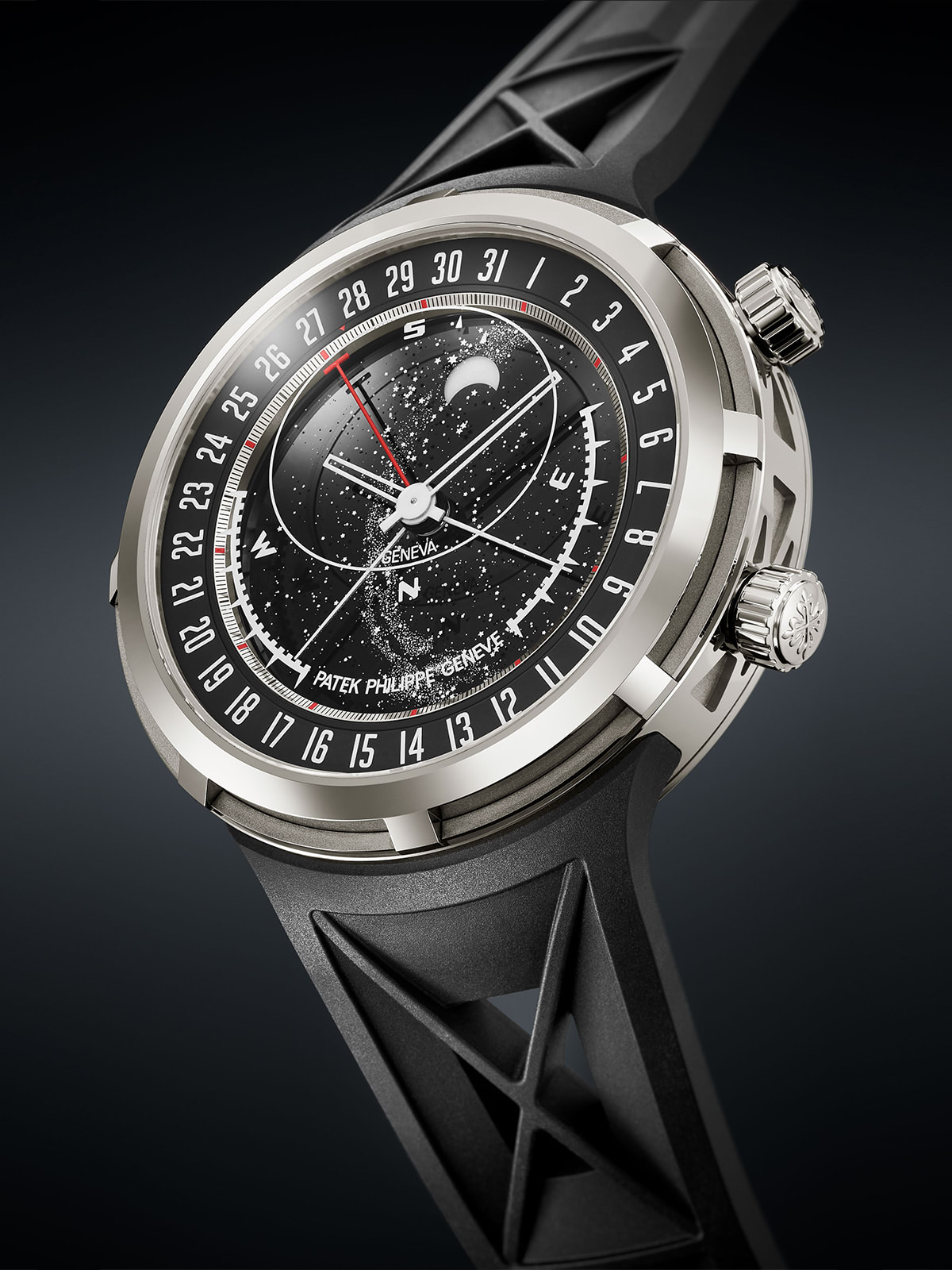 The Patek Philippe Reference 6105G-001. (Photo: Patek Philippe)
Three transparent discs rotate at different speeds to reproduce the movement of the stars and moon, as well as the moon’s changing phases. An oval marks the portion of the sky visible from Geneva and other cities at the same latitude. Stars decorate the upper surface of the sky-chart disc, with the Milky Way printed underneath to create depth. The moonphase display requires a one-day correction only once every 3,000 years.
The 47mm white gold case boasts raised X-shaped motifs inspired by the tubular structures of space modules. Contrasting polished and satin-brushed finishes define the pattern, which continues across the solid caseback and black composite strap. Powering the watch is the self-winding calibre 240 C LU CL LCSO, comprising 426 components.
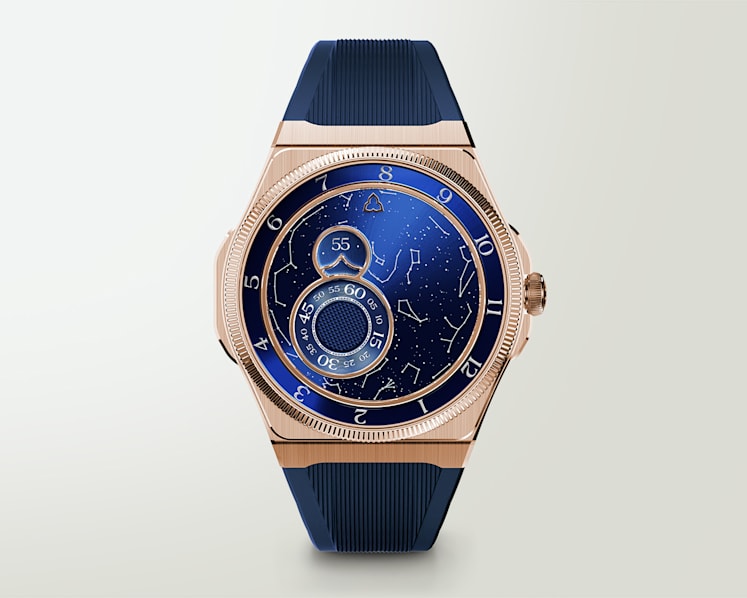 The Trilobe Trente-Deux Secret Edition in rose gold with a rubber strap. (Photo: Trilobe)
Independent French watchmaker Trilobe’s Trente-Deux Secret Edition captures a personal moment in the stars. Each dial features a bespoke map of the sky calculated for a chosen date, time and place, whether that marks a birth, a wedding or another occasion worth remembering. A future date can also be selected. The significance can remain known only to the wearer, making the watch an intimate keepsake.
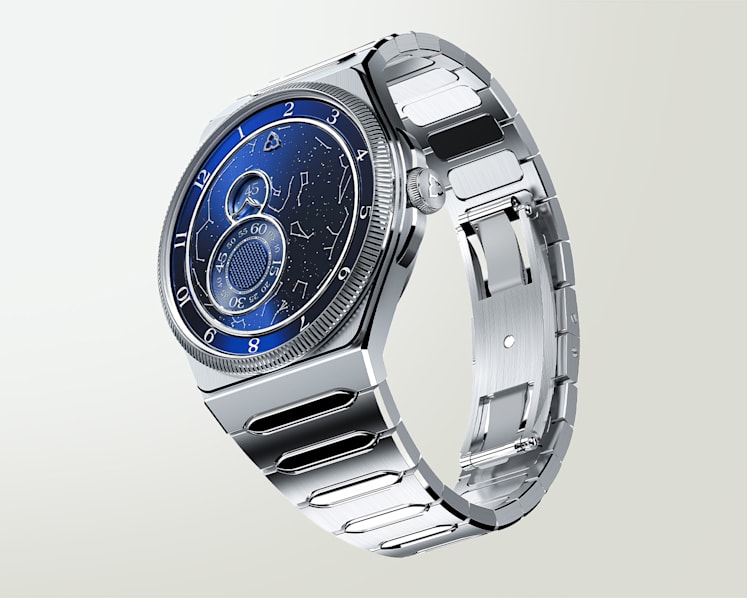 The Trilobe Trente-Deux Secret Edition in stainless steel with a bracelet. (Photo: Trilobe)
The positions of the stars are calculated using an algorithm based on the work of Belgian astronomer Jean Meeus. An artisan then transfers the map onto the dial through pad printing, building up powdered silver ink in fine layers. This gives the stars a subtle relief against the sunburst lacquered background.
There are no conventional hands on this watch. Instead, three rotating rings display the hours, minutes and seconds against fixed pointers, sharing the dial with the personalised sky. The 39.5mm case is offered in stainless steel with a matching bracelet or rose gold with a rubber strap. Alternating polished, satin-brushed and microblasted finishes accentuate the case and fluted bezel. Power comes from the X-Nihilo, Trilobe’s first in-house movement, designed and assembled at its Paris manufacture. The self-winding calibre has a 42-hour power reserve.
Van Cleef & Arpels Lady Rencontre Celeste and Lady Retrouvailles Celestes
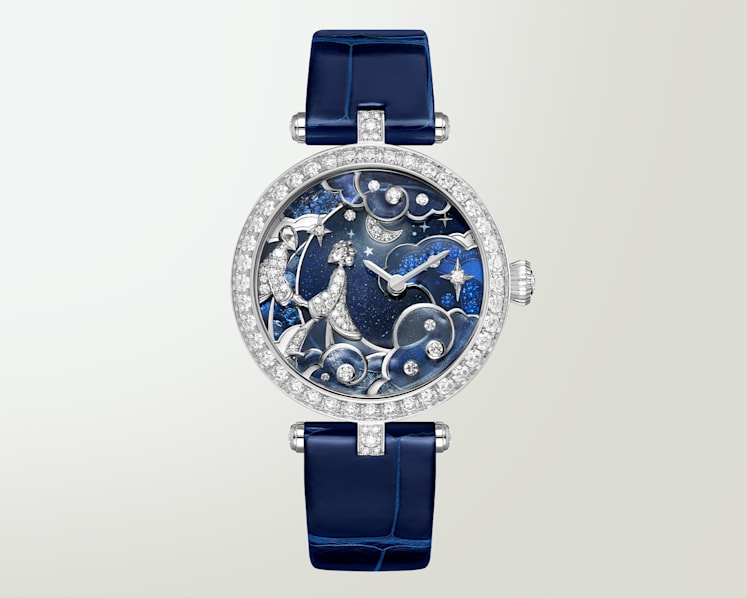 The Van Cleef & Arpels Lady Rencontre Celeste in white gold and diamonds. (Photo: Van Cleef & Arpels)
Van Cleef & Arpels’ Lady Rencontre Celeste and Lady Retrouvailles Celestes tell a love story. They portray Zhinu, a celestial weaver, and Niulang, a mortal cowherd, represented by the stars Vega and Altair. According to Chinese legend, the lovers are separated by the Milky Way, reuniting only once a year on the seventh day of the seventh lunar month, when magpies form a bridge across the sky.
Rendered in shades of blue, the Lady Rencontre Celeste features the couple holding hands beneath a starry sky and diamond-set moon. Their figures are sculpted in white gold, with rose-cut diamonds representing their faces. Clouds sparkle with diamonds set directly into translucent plique-a-jour enamel, while champleve and grisaille enamel give the background tonal depth.
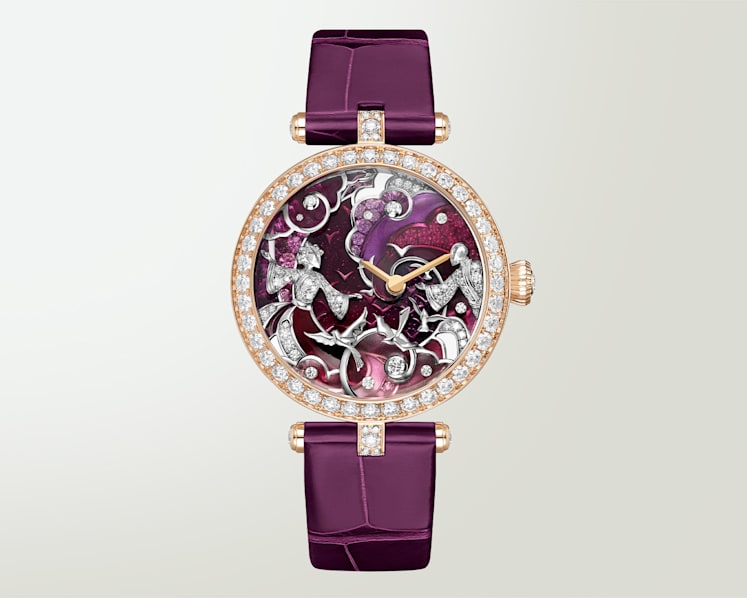 The Van Cleef & Arpels Lady Retrouvailles Celestes in rose gold with diamonds. (Photo: Van Cleef & Arpels)
Set in a rose gold case, the Lady Retrouvailles Celestes depicts the lovers reaching towards each other across a bridge of sculpted white gold birds, framed by mauve sapphires. Pink and mauve enamel clouds and veils allow light through. On both 33mm watches, gemstones are set directly into enamel using a patented technique, without additional metal settings. The Summer Triangle – a prominent pattern of stars formed by Altair, Vega and Deneb – is engraved on each caseback. Both watches are powered by manually wound mechanical movements.
Vacheron Constantin Egerie Moon Phase Spring Blossom
 The Vacheron Constantin Egerie Moon Phase Spring Blossom. (Photo: Vacheron Constantin)
Spring blossoms and a pink night sky set a romantic tone for Vacheron Constantin’s Egerie Moon Phase Spring Blossom. In the off-centre moonphase display, a gold moon waxes and wanes behind gold-edged mother-of-pearl clouds against a dusky pink, starry background. A ring of 36 diamonds frames the scene between 1 and 3 o’clock, beside a moonstone-set crown. The pink mother-of-pearl dial draws on the collection’s couture influences. Pleated textures recall the folds of a skirt, polished gold beads outline the centre, and curling Arabic numerals suggest scalloped lace. Another 58 diamonds surround the bezel of the 37mm pink gold case.
For the first time, Vacheron Constantin has applied miniature painting to a watch strap. Delicate blossoms are painted by hand onto pink calfskin leather, with variations in the brushwork and mother-of-pearl ensuring subtle differences across the 100 numbered pieces. The watch also comes with shiny raspberry-pink alligator and blush-pink grosgrain straps, each fitted with a pink gold buckle and a tool-free strap-changing system. Visible through the sapphire caseback, the self-winding calibre 1088 L offers a power reserve of about 40 hours.
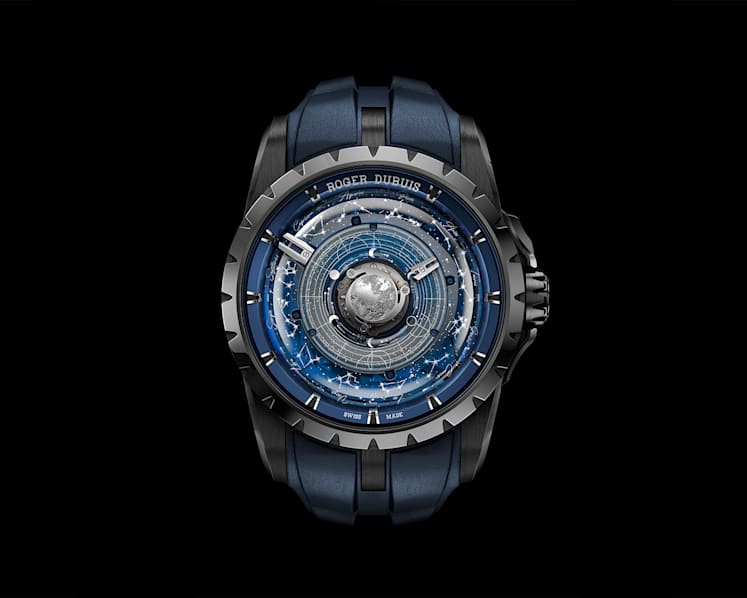 The Roger Dubuis Excalibur Moonlight. (Photo: Roger Dubuis)
An engraved miniature of the moon turns at the centre of the Roger Dubuis Excalibur Moonlight, completing a rotation every minute atop its tourbillon cage. Created through the watchmaker’s Rarities programme for unique and bespoke watches, this one-off piece recreates the night sky across a layered dial.
With the tourbillon occupying the centre, the hours and minutes are displayed on two rotating discs of translucent blue Murano-type glass. The hour disc features the 12 zodiac constellations, with their names written in luminescent paint. Above it, the minute disc carries celestial motifs and luminous illustrations of the moon’s phases.
The sapphire caseback is laser-engraved with tiny cavities inspired by the stars of the Milky Way. Filled by hand with luminescent material, they glow green in the dark. Constellations also decorate the barrel cover and can be personalised to reflect a significant date, such as the owner’s birthday. A 45mm black DLC titanium case houses the RD115 calibre, with a 72-hour power reserve and two patented mechanisms for its gear train and time setting. Its 283 components feature 19 different finishes, in keeping with its Geneva Seal certification. A midnight blue calfskin strap completes the design.
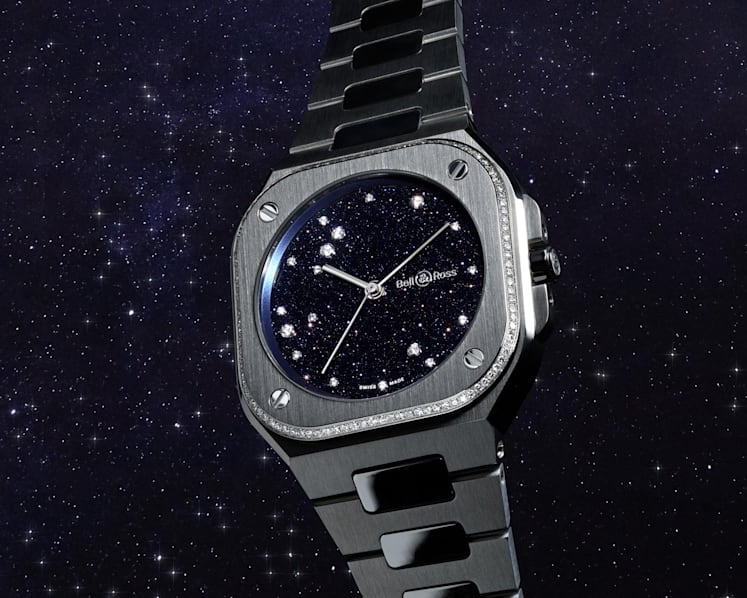 The Bell & Ross BR-05 Blue Diamond Eagle. (Photo: Bell & Ross)
The Eagle constellation, also known as Aquila, is formed by seven diamonds on the blue aventurine glass dial of Bell & Ross’ BR-05 Blue Diamond Eagle. The largest stone, positioned between 10 and 11 o’clock, represents Altair, its brightest star. Smaller stones trace the bird’s wings and tail, against sparkling inclusions that resemble a scattering of distant stars. A diamond-set bezel adds 108 stones to the brand’s signature round-in-a-square design. The steel case measures 36mm wide and 8.7mm thick, with alternating satin-finished and polished surfaces continuing onto the integrated bracelet.
Behind the decorative effect lies a delicate construction process. Aventurine glass must be cut, drilled and secured to a rigid brass plate before the gemstones can be fitted. Each diamond sits in a custom-made, four-pronged brass setting, inserted precisely into the dial to avoid stressing the glass. The constellation appears again as a laser engraving on the caseback. Powering the watch is the automatic BR-CAL.329 calibre, with a 54-hour power reserve.
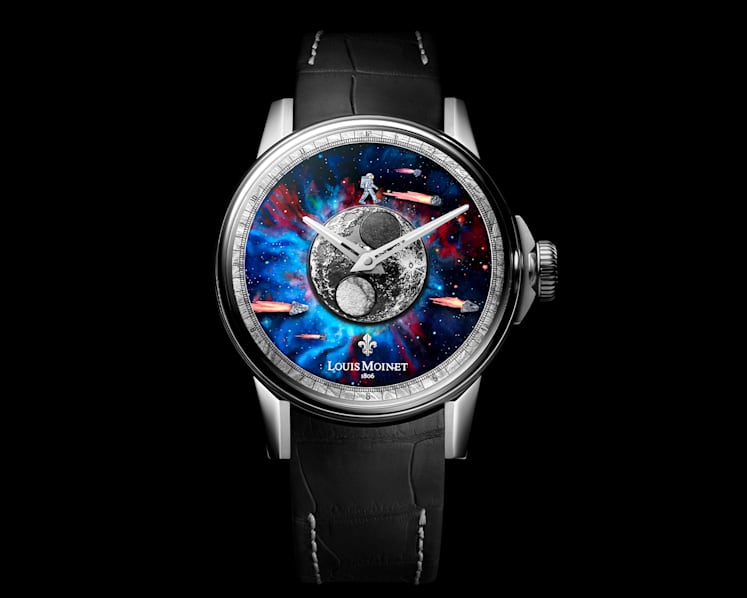 The Louis Moinet Moon Meteor in the light. (Photo: Louis Moinet)
Fragments of six meteorites make Louis Moinet’s Moon Meteor a small collection of extraterrestrial material on the wrist. Three represent meteors crossing a hand-painted nebula, including NWA 13925 from Mars. Around the dial, a flange cut from the roughly 4.5-billion-year-old Muonionalusta meteorite displays its distinctive crystalline patterns.
At the centre is a domed lunar disc with engraved and hand-painted craters. Two lunar meteorite fragments mark the full and new moons: the marbled grey-and-white Gadamis 005 and black Dhofar 457. Above them, a tiny hand-painted astronaut serves as the fixed reference point for reading the lunar phase as the disc turns beneath his feet.
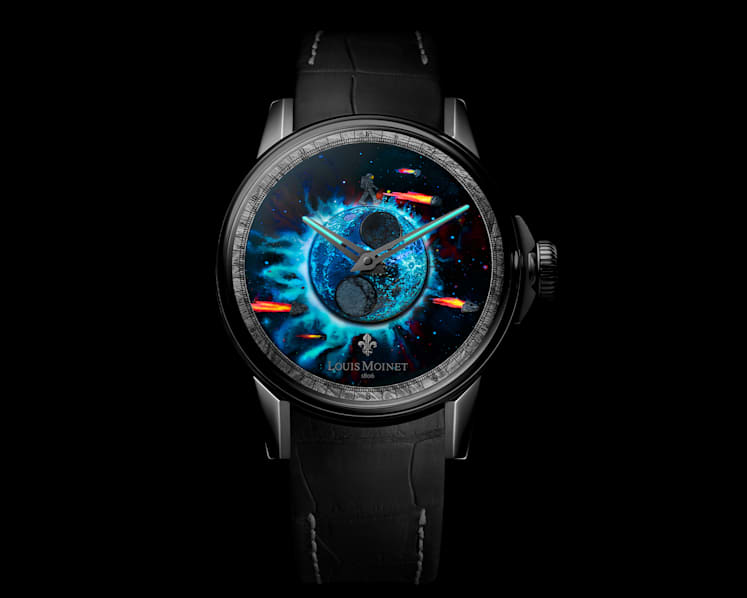 The Louis Moinet Moon Meteor in the dark. (Photo: Louis Moinet)
The miniature painting takes on a different appearance in the dark, when luminescent pigments reveal the nebula and lunar terrain. Working under a binocular microscope with a brush of just a few hairs, the artisan builds up layers of lacquer, varnish and luminous paint, checking the effect in both light and darkness. Limited to 12 pieces, the watch features a 40.7mm Grade 5 titanium case and the self-winding LM113 calibre, with a 48-hour power reserve. Its astronomical moon display requires a one-day correction only once every 122 years.
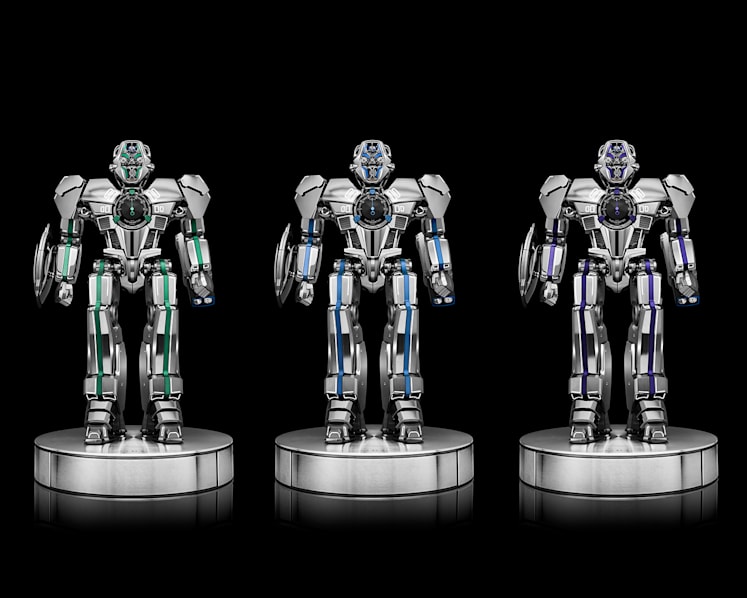 The MB&F HM12 The Guardian robots in green, blue and purple. (Photo: MB&F)
What if a robot’s head were a watch? That question from MB&F founder Maximilian Busser became the starting point for HM12 The Guardian, developed with designer Maximilian Maertens over four years. Its sci-fi styling draws on their childhood influences, from the robots and toys of the 1970s and 1980s to films such as Transformers and I, Robot.
The wristwatch forms the head of a robot created with long-standing collaborator and Swiss clockmaker L’Epee. Including its base, the robot stands 38.2cm tall and weighs about 15kg. The watch itself measures 49.3mm by 43.6mm and 13.8mm thick, with a titanium case framing a mechanical face. Rotating discs display jumping hours in the left eye and minutes in the right. A battle-axe-shaped winding rotor forms the mouth, with a flying tourbillon visible above it through sapphire crystals.
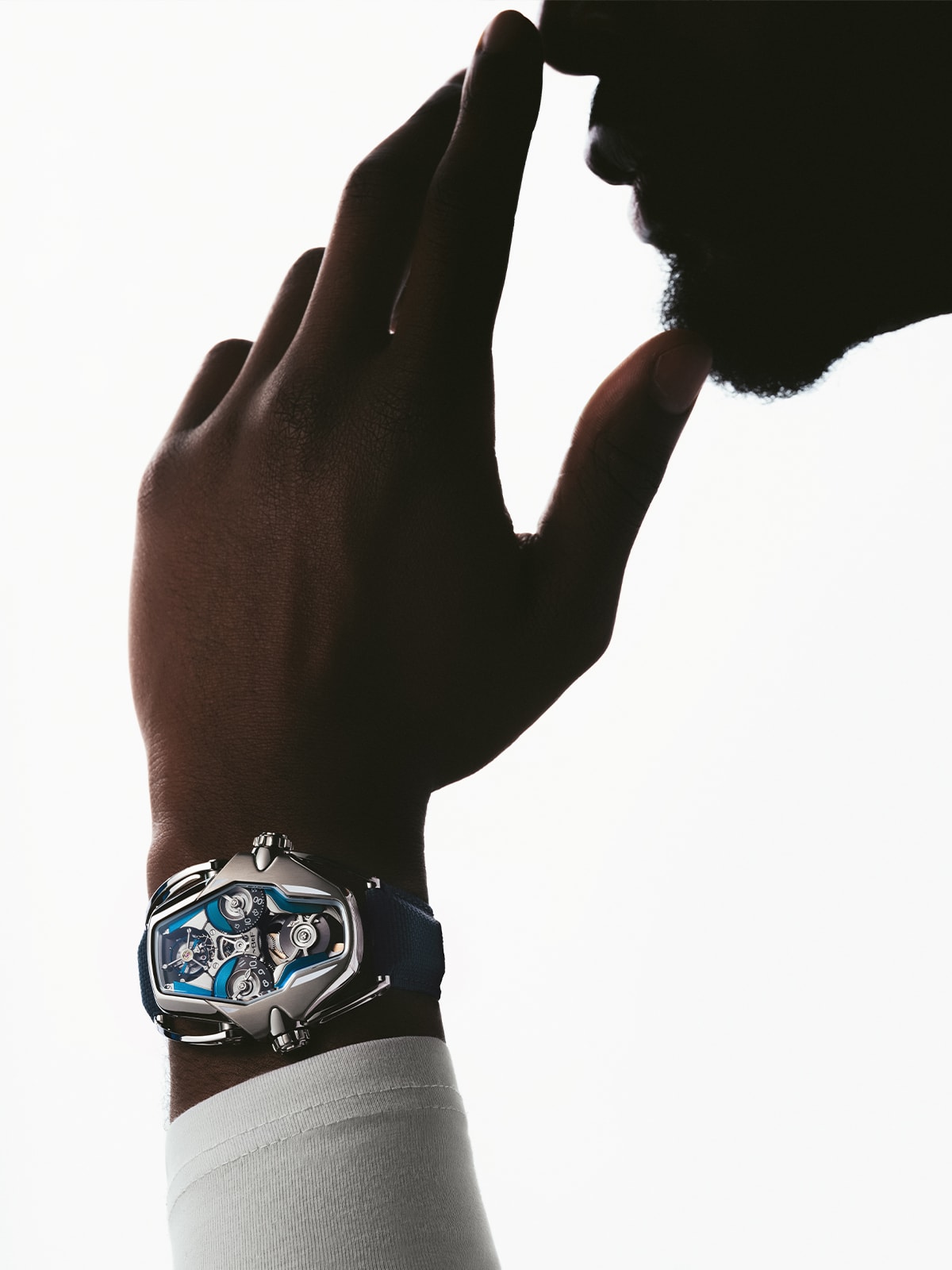 The MB&F HM12 The Guardian in blue. (Photo: MB&F)
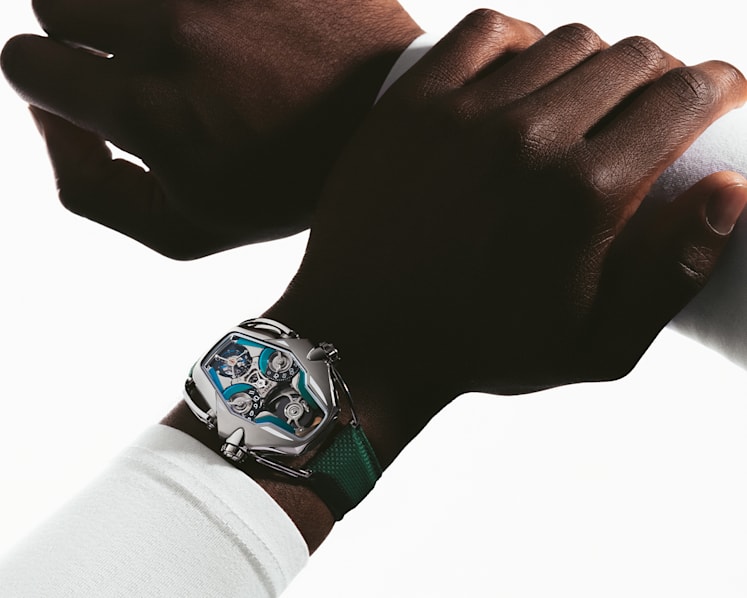 The MB&F HM12 The Guardian in green. (Photo: MB&F)
Turning the left crown opens or closes coloured face shields, which can be stopped at any point between fully exposed and concealed. More than 200 components are devoted to this mechanism, which operates independently of the timekeeping movement. The self-winding calibre has an 84-hour power reserve. On the reverse, curved, hand-finished bridges surround a rotor with a domed guilloche surface, decorated by independent watchmaker Kari Voutilainen and his team.