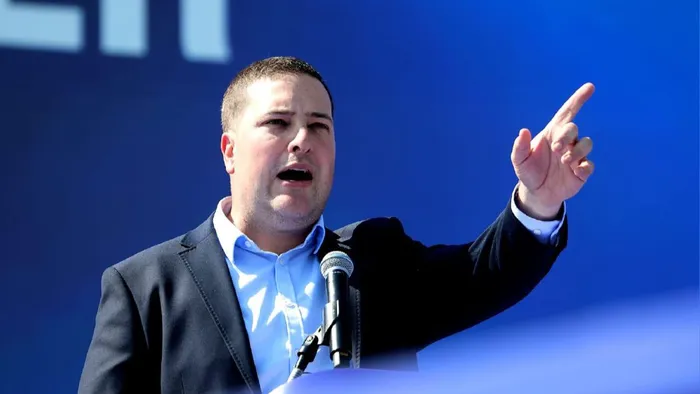
DA leader Geordin Hill-Lewis was cautiously optimistic on Monday that the ANC will buy into the DA's power-sharing proposal for the country's 137 hung municipalities.
As the Johannesburg city council convened to swear in new councillors, elect a speaker and the mayor of the country’s economic hub, DA leader Geordin Hill-Lewis arrived in the city with the hope of convincing the ANC to back his party's power-sharing proposal.
The election of Joburg mayor was eventually postponed as coalition talks were still ongoing.
Hill-Lewis confirmed on Monday that he was in town to continue talks with the ANC and was hoping the party, whose national executive committee (NEC) was meeting in Boksburg, would accept the proposal of a working arrangement which the DA published on Sunday.
“They didn’t reject it. That's the thing. We decided to release it publicly because we didn't hear back,” said Hill-Lewis.
“In fact, they (individuals) said it's very powerful, they understand the logic of it very clearly, and it's hard to argue with its logic.” Hill-Lewis said he, however, feared “a certain faction in the NEC that was driving the NEC to a very particular outcome”.
He claimed that the DA’s offer had not been properly circulated or carefully considered by a wide variety across the negotiating team, and that informed his party's decision to publish the document. The DA's proposal to the ANC is to support each other to bring stable government to 137 municipalities across South Africa where no party won a majority. Under the proposal, the ANC would lead 93 councils, the DA 24 and the IFP 20, subject to agreement with the IFP.
On Monday, Hill-Lewis indicated he was cautiously optimistic but largely hoping for a positive response from the ANC.
“I really sincerely am. I don't give it a huge amount of success, but the fact is the logic is so obvious. It is so obvious that we could, in one simple proposal, sort out all local government instability across the entire country.
“We could cement the national government too and give all of these places the best chance to turn around than they've had in years.”
He said everyone he had spoken to, in the ANC, over the weekend had said “some version of those words”.
“They see the logic; they see how powerful that proposal is. The question is, can they overcome those in the NEC who are vehemently opposed to the DA?”
Hill-Lewis said the DA was willing to further negotiate with the ANC on the Gauteng metros, despite being the leading party in all three metros. “We understand that even though we are the largest party in all of them, we may not be able to govern all of them. So I've built that flexibility in there, saying, let's talk.”
Hill-Lewis described the other parties’ reluctance to coalesce with his party as purely political. Parties were wary of a DA government because the party grows wherever it gets a foothold, he said.
“From the perspective of our opponents, I understand why you would be very reluctant to allow the DA to govern in the Gauteng metros; because it is a huge threat.”
He cited how the party had governed Umngeni Local Municipality following a victory which came by a margin of 42 votes in November 2021, to winning the municipality with 62% of the vote five years later.
Even in Cape Town in 2006, the party led a seven-party coalition and has grown in subsequent elections.
“This is what this is, the risk that you get a foothold and then you prove that you can deliver, and then you get a much bigger foothold next time. So, from a purely rational perspective, actually, I get it.”
Besides the “personal vendettas” relating to Mashaba and Zille, which he described as a stumbling block, Hill-Lewis said a DA government in Joburg would have interrupted the patronage and corruption networks, and that plays a role in opposing the party taking the reins.
“I think all of these factors come together to make it very hard for any of these parties to accept a deal in which the DA governs all three Gauteng metros, which is why we offered compromise. We understood that. A part of me feels like it's predictable and understandable from a political perspective.” It was devastating, though, for the residents of the metros, whose message, through the ballot, was a need for change and a more stable government that could improve services in the metros.
On the call to withdraw Zille’s mayoral candidacy, Hill-Lewis described this as not only unreasonable but tantamount to extortion.
“The party must choose its own representatives. Miss Zille was put before the people as our mayoral candidate, and she started campaigning way before; it’s not like it was a surprise and it’s not like they raised this when her candidacy was announced.”
He found "great irony" in ActionSA’s opposition to Zille because the EFF had demanded the same when Mashaba was the DA’s Joburg mayoral candidate in 2006 but that the DA backed him.
Hill-Lewis added there was genuine trepidation towards Zille because she was an “incredibly formidable politician” who is uniquely suited to fixing something as broken as Johannesburg, and politicians were wary of what her success would mean for them politically.
“I think there are some personal issues and they probably don't like her personally, but there's also this recognition that despite what anyone thinks of her, she is one of the most formidable politicians in South Africa, if not the most formidable and that promises a very threatening situation for them, that they that they genuinely are afraid of.”