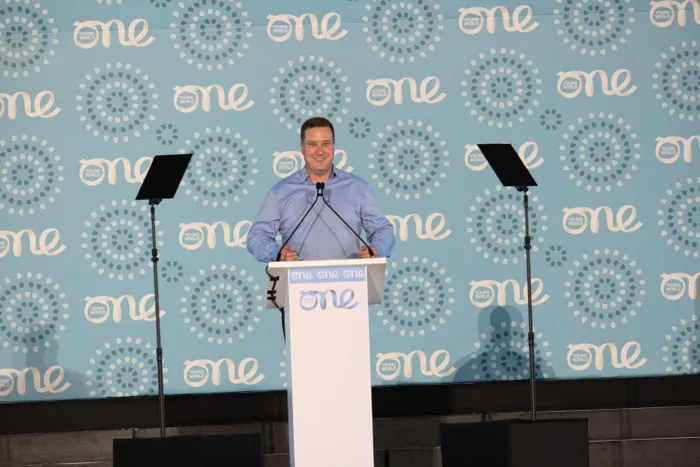
Cape Town mayor Geordin Hill-Lewis at the opening of the One Young World Summit 2026 in Cape Town.
Employers, educators and governments must urgently invest in young people rather than leave them stranded on the margins of an artificial intelligence revolution, international leaders warned at the opening of the One Young World Summit 2026 in Cape Town.
Addressing thousands of delegates gathered in the shadow of Table Mountain, corporate executives and political figures delivered a collective rebuke to the persistent narrative that new graduates are unprepared for the modern economy, insisting that business must take direct responsibility for opening doors to the next generation.
Charise Le, Chief Human Resources Officer at Schneider Electric, mounted a vigorous defence of new graduates entering an increasingly automated labour market, challenging the common corporate reluctance to hire candidates who lack extensive CVs.
“Every manager wants someone who comes with experience, someone who can do the job immediately. But I think the question is more: how can we help youth when they graduate from school to get that experience?” she said, pointing out that every seasoned professional had to start somewhere. She urged companies to forge deeper institutional partnerships with universities and technical colleges to align academic curricula with evolving industrial demands.
The rapid rollout of artificial intelligence has heightened anxieties among young jobseekers fearing immediate obsolescence, yet summit speakers framed technological disruption as an opportunity to reinvent the workplace rather than replace human talent. Machanis stressed that employers carry a duty to continually reskill and mentor staff, arguing that technology should augment human ingenuity rather than supplant it.
While technical literacy remains essential, she observed that employers prize distinctly human attributes above all else—principally critical thinking, robust communication, collaboration and networking.
“At the end of the day, I think the employer plays a key role there as well in how you engage, continue to upskill and reskill, helping your workforce to transform,” she said.
The demand for tangible opportunity was matched by an equally forceful plea for political representation. Cape Town Mayor Geordin Hill-Lewis dismissed the frequent rhetorical platitude that young people are merely the leaders of tomorrow, noting that vital decisions concerning urban planning, climate action, economic strategy and digital governance are continually made without their input today.
Invoking the fiftieth anniversary of the 1976 Soweto uprising, when South African schoolchildren mobilised against discriminatory apartheid education policies, Hill-Lewis reminded delegates that youth have never been passive spectators of history, but active catalysts of fundamental societal change.
Addressing an international audience that included delegates from nations where civil liberties remain constrained, Hill-Lewis emphasised that democratic engagement remains the single most powerful lever young citizens possess to demand accountability. Though acknowledging that South Africa’s own constitutional democracy remains an ongoing project, he underscored that casting a ballot remains a hard-won, indispensable right that must never be surrendered to apathy.
The proceedings in Cape Town have established a sharp, unambiguous agenda for the remainder of the week: polite encouragement is no longer sufficient currency for a generation confronting economic volatility and technological transformation. If the promises of the digital age are to be realised equitably, institutions must bridge the divide between classroom theory and industry practice, dismantling the barriers that keep youthful ambition locked outside the workplace.