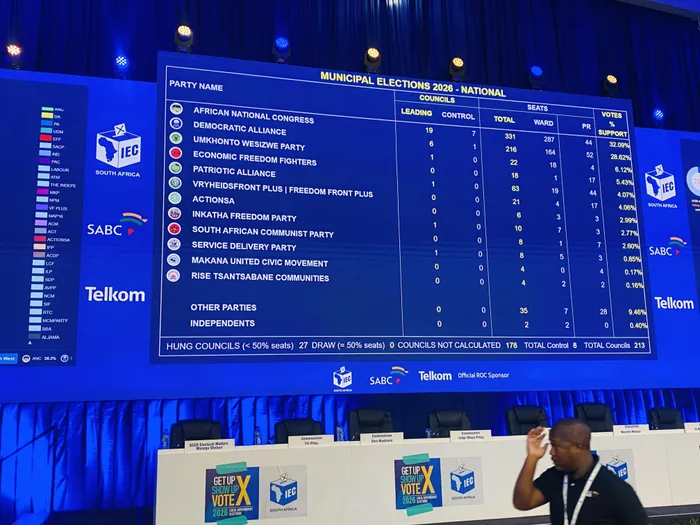
The IEC says 15.9 million South Africans participated in the 2026 local government elections so far.
The 2026 local government elections have passed. Election slogans are fading from memory, campaign posters are supposed to come down from lampposts, and newly elected councillors are preparing to take their seats in municipal chambers around the country. As the dust settles, South Africans are at a critical juncture. The outcome has sent a clear message: people want more from local government than political pledges. They want a new normal.
Local governance has been plagued by persistent difficulties for a long time. Municipal instability, coalition breakdowns, poor service delivery, financial distress, infrastructure backlogs and dwindling public confidence have all become commonplace. Communities have frequently voiced their dissatisfaction through protests, public meetings and, eventually, the ballot box.
It is therefore not enough to see the 2026 elections as merely a contest that political parties win or lose. They are a moment to reflect on the future of local government in South Africa, and a chance to reconsider local democracy and how municipalities are run.
One of the most important lessons is that coalition governance is no longer the exception. It is becoming the norm. Many councils now lack clear majorities, which requires parties to cooperate in governing arrangements. Coalition politics often draws criticism because of political bargaining and instability, but it also offers a chance for democratic maturity. South Africa must now move from coalitions of convenience to coalitions of purpose. Municipal governance is not only about negotiating executive benefits, committee chairmanships and mayoral positions. Communities expect coalition partners to prioritise service delivery over political agendas, and stable agreements built on shared developmental priorities can greatly improve governance.
Municipalities have extensive developmental responsibilities. They are in charge of many of the services people need every day, including roads, waste management, water, sanitation and local economic growth. When municipalities collapse, citizens experience the failure of government directly. Residents’ everyday circumstances cannot be separated from the shortcomings of their local authority.
Performance, rather than politics, must therefore be the focus of the new normal. Elected leaders should be judged on measurable results, not on political rhetoric. Residents should be able to see progress in local economic growth, financial management, service delivery response times and infrastructure maintenance. Good governance needs to be visible and tangible.
Rebuilding public trust is equally crucial. In many places the relationship between citizens and their municipality has deteriorated. Allegations of corruption, poor management and political infighting have damaged confidence in local institutions. The new municipal term offers a chance to rebuild that trust through openness, accountability and ethical leadership.
Municipal councils should also be places of constructive collaboration, not constant confrontation. Healthy debate is essential to democracy, but governance is too often undermined by endless political disputes. Opposition parties must hold governing parties to account, but accountability and obstruction are not the same thing. Effective councils need strong oversight and cooperative problem-solving.
Professionalism in municipal administration should be another hallmark of the new normal. Municipal officials must be able to carry out their duties without undue political interference. Whatever the political shifts, professionalising local government remains crucial for building institutional capacity and ensuring continuity. In the end, strong institutions matter more than powerful individuals.
Municipalities must also give greater priority to local economic growth. Unemployment remains high in South Africa, especially among young people. Local government cannot solve the problem on its own, but it can create conditions that attract investment, support small businesses and strengthen local economies. Municipal success should increasingly be judged by how well it creates opportunities for communities to flourish.
The elections have also reminded us that democracy is about more than casting a ballot every five years. Meaningful democracy requires active public accountability, community consultation and continuous citizen participation. Citizens must be visible outside election campaigns and must keep helping to shape municipal priorities throughout the term of government.
In the end, the significance of the 2026 local government elections will not be determined by who wins the most seats or the most powerful posts. Their true legacy will depend on how responsive, accountable and developmental municipalities become over the next five years.
South Africa’s local government system is at a critical juncture. By voting, the electorate has done its part. The responsibility now rests with those tasked with governing. This is not the time for victory laps, factional conflicts and endless coalition disputes. It is time to take charge. The election season is over, and the season of governance has begun. The 2026 elections could mark the start of a new era in local government if municipalities adopt cooperation, professionalism, accountability and service delivery as their guiding principles, and measure themselves by performance, integrity and outcomes rather than political contestation.
The challenge is clear. The opportunity is here. What remains is for South Africa’s local leaders to seize it.
* Dr Xolisile Ngumbela is Assistant Dean: Teaching and Learning in the Department of Government Management, Faculty of Management Sciences, at the Central University of Technology, Free State (Welkom Campus).