Despite geopolitical challenges, it is imperative to draw the attention of political leaders to climate action, says Minister for Sustainability and the Environment Grace Fu.
Minister for Sustainability and the Environment Grace Fu speaking to the media in Singapore ahead of her trip to Antalya, Turkiye for COP31. (Photo: CNA/Syamil Sapari)
Minister for Sustainability and the Environment Grace Fu speaking to the media in Singapore ahead of her trip to Antalya, Turkiye for COP31. (Photo: CNA/Syamil Sapari)



SINGAPORE: Talks at COP31 this year are expected to be tougher than in previous years amid heightened global tensions and competing domestic priorities, said Minister for Sustainability and the Environment Grace Fu.
"I think that the world is more fragmented than before. There are many other tensions and headwinds. We are talking about the Middle East crisis that has caused inflation around the world.
“Governments around the world are very focused on the here and now," said Ms Fu, citing social unrest, inflation, job concerns and security.
The minister was speaking ahead of her trip to Antalya, Turkiye, where countries will convene for the 31st United Nations Climate Change Conference, or COP31, from Monday (Nov 9) to Nov 20.
"The attention on climate has to be called for, and it's important for COP31 that we draw the global attention of political leaders on global climate action,” she added.
"Global climate action is urgent, it's critical, and you have seen many events around the world showing us the urgency and the impact of climate change," Ms Fu said, citing the Tibet-Nepal floods as an example.
Another issue is the conflict in the Middle East, and growing concerns over energy security could pull governments in different directions on climate action, she added.
Some countries have turned to cheaper fossil fuels, such as coal, reviving older coal plants or extending their use. On the other hand, shortages have spurred the shift towards renewable energy in some countries.
"Countries are now evaluating their longer-term energy policies and how they protect themselves a bit more against shortages in fossil fuels," said Ms Fu.
“These are all elements that impact countries differently, and I'm sure there will be some of these tensions manifested at climate discussions.”
Talks to move away from fossil fuels will be “as difficult, if not more difficult, than before”, she added.
SINGAPORE AT COP
As the world gathers for COP31, Singapore will be organising a country pavilion to showcase its commitment to climate action, innovation and partnerships.
Despite the challenges, Ms Fu maintained that Singapore needs to be at COP31 to contribute to discussions. She said that Singapore can “bring energy" to global climate talks.
"The world needs all of us to show that COP is important, and being there ... we hope that we are able to contribute meaningfully and impactfully, so that COP31 continues to be the multilateral platform for all of us,” she added.
While Ms Fu has co-chaired negotiations at previous COP summits, she will not be doing so this year and expects to have more time to take part in discussions and express Singapore's position more effectively.
Ms Fu said she hoped the pavilion could serve as a platform for announcing and initiating projects that translate climate commitments into action.
“It is our wish that the Singapore Pavilion will play that very constructive, facilitative, and convening role that Singapore plays at the global platform,” she said.
CNA Games
 Guess Word
Crack the word, one row at a time
 Buzzword
Create words using the given letters
 Mini Sudoku
Tiny puzzle, mighty brain teaser
 Mini Crossword
Small grid, big challenge
 Word Search
Spot as many words as you can
Show More
Show Less
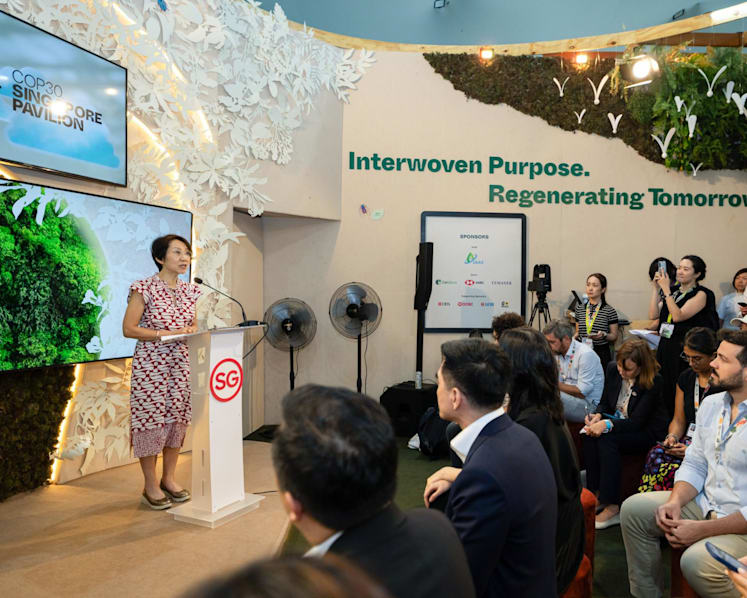 Minister for Sustainability and the Environment Grace Fu speaking at the Carbon Markets Networking Evening at the COP30 Singapore Pavilion in Belém, Brazil, Nov 17, 2025. (Photo: COP30 Singapore Pavilion)
Ms Fu added: "Very often, when we talk about negotiation, we talk about how to have a work plan or a roadmap, it stays at the policy level, but we think about how that policy is going to be translated into real-life application.
Minister for Sustainability and the Environment Grace Fu speaking at the Carbon Markets Networking Evening at the COP30 Singapore Pavilion in Belém, Brazil, Nov 17, 2025. (Photo: COP30 Singapore Pavilion)
"You need to bring in the businesses, you need to bring in the project developers, you need to bring in the communities that are being impacted by those roadmaps.”
She described the pavilion as a physical symbol of Singapore's role in bridging the gap between policy and implementation, and connecting solutions with finance.
The United Nations Environment Programme warned earlier this year that global temperature rise is set to exceed the 1.5 degrees Celsius threshold set by the Paris Agreement.
The Paris Agreement is a legally binding international treaty on climate change adopted at COP21 in Paris in 2015, with the aim of keeping the temperature increase well below 2 degrees Celsius and pursuing efforts to limit it to 1.5 degrees Celsius above pre-industrial levels.
The US officially withdrew from the Paris Agreement on Jan 27, 2026, although a team of US lawmakers will travel to this year’s conference.
Key themes at COP31 include clean energy transition and electrification, zero waste and methane reduction, and climate finance.

Asked what would constitute a good outcome from Singapore's perspective, Ms Fu said it would like to see parties engaged in negotiations.
"The biggest risk, I think, to climate action is that governments turn away from it because they just have too many other priorities,” said Ms Fu.
"We want them to prioritise climate action and environmental protection in their work. So we'd like to see the full participation of political leaders at COP. We'd like to see engagement on difficult issues.
“We expect many of such issues to surface at COP, but I think engagements, exchanges will lead to better understanding.
“So, to me, engagement is more important than … an outcome that is of less relevance. So the more we are able to engage on important issues, the better it is, outcome or not.”
Beyond keeping countries at the negotiating table, Ms Fu also wants COP31 to pay greater attention to communities already bearing the brunt of climate change.
Singapore, as an island state, faces similar challenges to other island nations threatened by rising sea levels and storm surges, Ms Fu noted.
"I think for too long we have focused on mitigation. I think it's now for us to bring the adaptation element to all our strategies," she said.
As a low-lying island state, Singapore is vulnerable to rising sea levels. According to its Third National Climate Change Study, mean sea level could rise up to 1.15m by 2100.
Coupled with storm surges and high tides, sea levels could rise up to 5m. Singapore is particularly vulnerable to the threat of sea level rise, as around 30 per cent of the country is less than 5m above mean sea level.