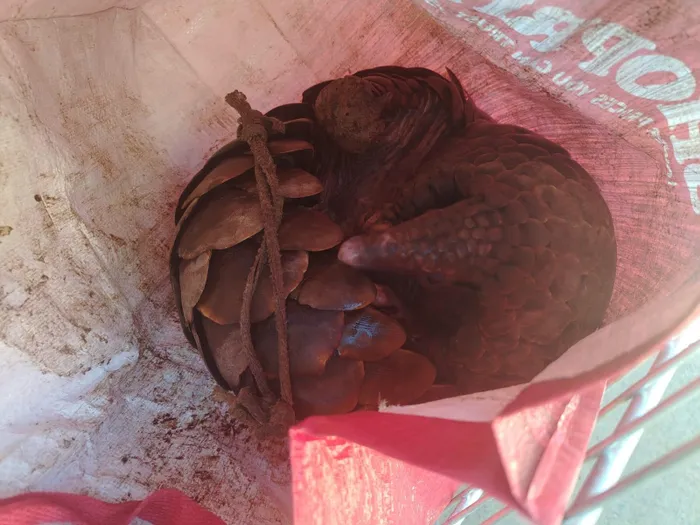
Five people are facing charges relating to the illegal possession of an endangered species after they were allegedly caught with a live adult pangolin.
The South African Police Service (SAPS) in the Northern Cape has arrested five suspects for the alleged illegal possession of a live adult pangolin.
The suspects were arrested during a routine vehicle search in the Kuruman Central Business District (CBD) on Tuesday.
According to SAPS spokesperson Warrant Officer Molefi Shemane, police officers were conducting high-density patrols as part of Operation Shanela II when they spotted a grey Renault approaching the traffic circle near Kuruman Mall.
Shemane said police became suspicious of the vehicle when it came to a standstill after noticing the police vehicle and stopped it for a routine inspection.
Police searched the vehicle and discovered the pangolin inside a red carry bag, prompting an immediate arrest of all the occupants. The four men and a woman are expected to appear at the Kuruman Magistrate’s Court soon.
They all face charges for illegally possessing an endangered species under the National Environmental Biodiversity Act (NEMBA).
Shemane said the police remind the public that the illegal possession, capture and poaching of protected and endangered wildlife are criminal offences.
“Communities, particularly in areas of the John Taolo Gaetsewe District where wildlife-related crimes have been reported, are urged to refrain from engaging in poaching activities and to report any information relating to the illegal trade or possession of endangered species to the police,” said Shemane.
Why are pangolins poached?
According to the World Wildlife Fund (WWF), pangolins are the most trafficked mammals in the world. Most of the trafficking is of African species that are smuggled to Asian countries, with a high demand in China and Vietnam.
The organisation says pangolins are mostly trafficked for their meat, which is considered a delicacy, and for their scales, which are used in traditional medicine and folk remedies to treat ailments such as asthma, rheumatism, and arthritis.
They are also trafficked in the Americas for their skin, which is used to make leather products such as boots, bags and belts.
Outside of the international illegal trade of pangolins, in South Africa they are poached for traditional medicine. The African Pangolin Working Group notes that pangolins are also seen as valuable in many cultures because they are viewed as the greatest gift to give to a person in authority.
Professor Raymond Jansen from the Department of Environmental, Water and Earth Sciences at Tshwane University of Technology (TUT) said pangolin trafficking is not for Asian markets but for traditional medicine.
Jansen explained that in some parts of South Africa, pangolins are also poached for their blood and fat, which traditional healers consider valuable for medicine.
Jansen said one pangolin can be traded for 12 cattle. He also said illegal trade of pangolins was more prevalent among people living in rural areas than in cities.