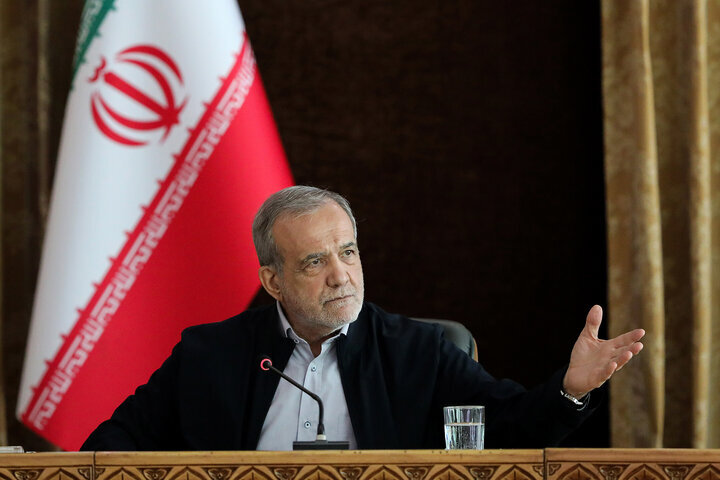
TEHRAN– President Masoud Pezeshkian has stressed the need for Iran to move beyond the state of “neither war nor peace” as soon as possible, with dignity and strength, describing the prolonged uncertainty as detrimental to the country and an obstacle to addressing its challenges.
Speaking on Saturday night, Pezeshkian said Iran’s adversaries were seeking to disrupt the country’s production chain to fuel unemployment, create economic and social problems, and foment public dissatisfaction.
He emphasized that reforming consumption patterns would enable the Iranian nation to thwart these efforts and dash the adversaries’ hopes.
Addressing the country’s current circumstances, the president described the continuation of the neither-war-nor-peace situation as harmful, underscoring the need to bring it to an end without delay.
“We must get out of this situation, which is a form of uncertainty, as soon as possible, with dignity and strength,” he said.
Pezeshkian also pointed to Iran’s abundant natural wealth, noting that the country is situated in a region endowed with vast mineral resources and valuable reserves, including gold. He said a rational and clearly defined resolution to the current situation could pave the way for addressing many of the country’s problems.
Earlier this month, Pezeshkian said Leader of the Islamic Revolution Ayatollah Seyyed Mojtaba Hosseini Khamenei had instructed officials to bring the neither-war-nor-peace situation to an end.
The president reiterated that Iran was prepared to engage in negotiations on the basis of dignity, justice and equality, but would not bow to coercion or bullying.
Secretary of Iran’s Supreme National Security Council Mohsen Rezaei has also called on Washington to stop circulating fabricated reports about negotiations with Tehran and accept Iran’s seven conditions.
Foreign Minister Abbas Araghchi, meanwhile, has said Washington must choose between accepting Iran’s conditions and continuing the war, emphasizing that Iran’s Armed Forces are fully prepared for either eventuality.
In a related development, Iran has proposed a 48-hour roadmap for restoring security in the Strait of Hormuz. Under the proposal, the strategic waterway would be reopened to commercial shipping within two days if the United States lifts its naval blockade of Iranian ports, ends the war on all fronts, and unfreezes Iranian assets held abroad.
Foreign Ministry spokesperson Esmaeil Baqaei has described the proposal as a logical roadmap for restoring security in the strategic strait.