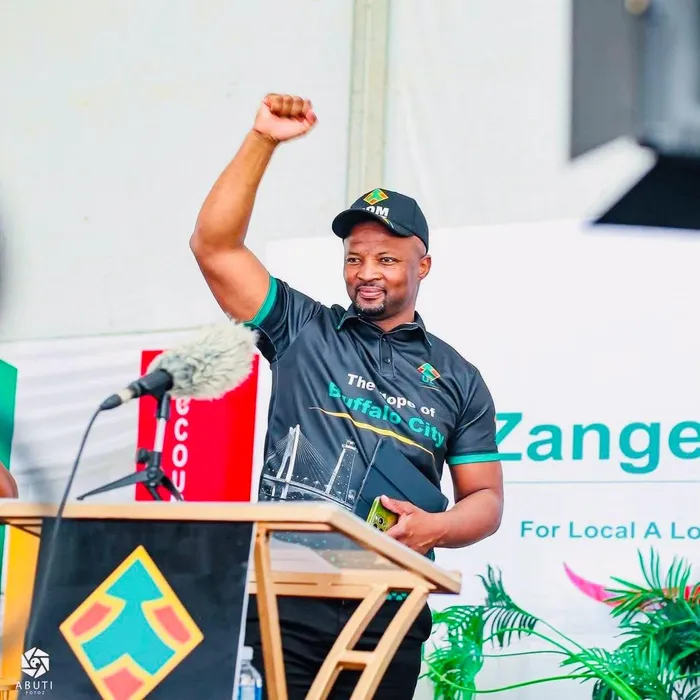
UDM deputy president and Buffalo City Metro mayoral candidate Nqabayomzi Kwankwa says the party plans to take its Eastern Cape election strategy to other provinces as it seeks to grow its support.
The United Democratic Movement (UDM) is looking to build on its gains in the Eastern Cape by taking its election strategy to other provinces, where it hopes to reconnect with voters through a stronger focus on service delivery, deputy president and Buffalo City Metro mayoral candidate Nqabayomzi Kwankwa said.
Speaking to Newzroom Afrika, Kwankwa said the party had deliberately channelled resources into the Eastern Cape after recognising that it had neglected its traditional support base.
The UDM emerged as the second-largest party in Buffalo City Metro in the recent local government elections, overtaking the Democratic Alliance (DA) with 18.39% of the vote. The African National Congress (ANC) remained the largest party with 41.93%.
The party's share of the vote in the Eastern Cape increased from 2.81% in the 2021 local government elections to 6.13% in 2026. It secured 76 seats in the province alone, contributing to an overall increase in its council representation nationally.
“We channelled a lot of our resources to the Eastern Cape for this, because we realised that over the past few years, we had neglected our base. So from the growth of experience in the Eastern Cape, we're going to grow into other provinces,” Kwankwa said.
He said the UDM would use the experience gained in the province to expand its presence in the Western Cape, Gauteng, Mpumalanga and North West, while also seeking to rebuild its support in KwaZulu-Natal ahead of the 2029 elections.
UDM wants to reconnect with voters
Kwankwa said the party's approach was informed by the need for political parties to establish and strengthen a support base rather than spread their resources too thinly across the country.
He pointed to the DA's support in the Western Cape, the MK Party's presence in KwaZulu-Natal and the IFP's established support base as examples of parties that had focused on particular areas.
He said the UDM wanted to reactivate voters who had previously supported the party but had become disengaged because of dissatisfaction with service delivery or a feeling that they had been neglected.
The party also intended to remind voters of its 30-year history, its values and its contribution to South African politics, while positioning itself as a party committed to clean and better governance.
Kwankwa said the UDM's campaign had sought to respond to local concerns rather than simply criticise the state of municipalities.
“The difference with our campaign strategy, particularly this time around, is that we didn't just lament about the service delivery problems they're experiencing. We tried to be a solution to that problem,” he said.
He said UDM councillors-elect in Buffalo City and King Sabata Dalindyebo (KSD) had already started engaging with service delivery problems in their respective areas before being sworn into office.
Kwankwa also criticised the state of municipalities governed by the ANC, saying local government campaigns gave parties an opportunity to address the specific challenges affecting communities.
UDM continues coalition negotiations
The UDM's performance in Buffalo City has also put it in a position to negotiate over the municipality's next administration.
Kwankwa said he had been given a clear mandate by the party when he was deployed as its mayoral candidate in the metro: to become mayor or be part of a governing arrangement.
“My mandate, when I was deployed by the party in BCM, I was deployed with a clear mandate. You either become a mayor or become part of a government arrangement in BCM,” he said.
He confirmed that the party had been engaging with other political organisations since the election results were declared, with discussions initially taking place informally before being formalised.
The negotiations involve possible arrangements in Buffalo City, Nelson Mandela Bay, KSD and other municipalities in the province where the UDM could work with opposition parties.
“Those discussions have been formalised. Party leaders have been discussing various possibilities in terms of how we could potentially work together, because they have to obviously focus on what's happening elsewhere,” he said.
Kwankwa said the party's negotiations with other political organisations were continuing, while its representative, Mlimandlela Ndamase, was also involved in discussions in KSD.
The party expected the negotiations to continue until the councils were constituted, with the swearing-in process scheduled for Tuesday next week.
Kwankwa cautioned against assuming that discussions meant agreements had already been reached, saying parties needed to conclude negotiations before making announcements.
“For us, it will not be over until the final swearing-in ceremony, which is scheduled to take place on Tuesday next week. So up until then, we're just going to continue negotiating with sister opposition parties and looking at possibilities,” he said.