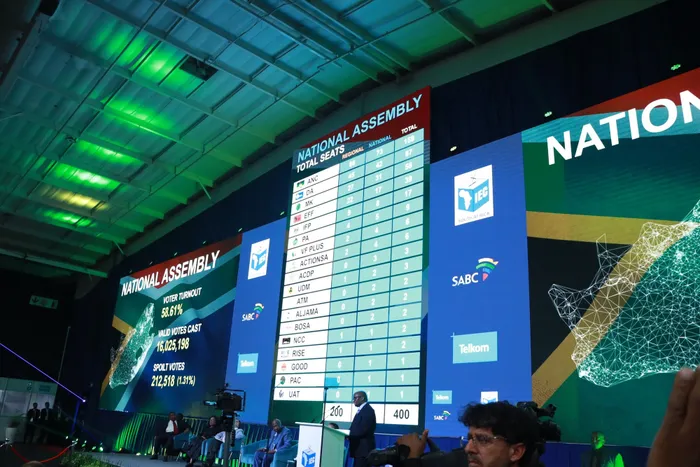
The IEC has ordered recounts in five wards after receiving 197 objections to the 2026 local government election results.
The Electoral Commission (IEC) has ordered recounts in five wards after receiving 197 objections to South Africa's 2026 local government election results, with the final declaration scheduled for Sunday, November 8.
IEC chairperson Mosotho Moepya said at a media briefing on Saturday, November 7, that 54 objections had been dismissed, eight withdrawn and two upheld.
The two upheld objections resulted in recounts being ordered in five wards. The IEC also ordered an additional editing window to allow corrections following the upheld objections.
The final declaration of the election results is scheduled for 6pm on Sunday, November 8.
The 197 objections are separate from the more than 800 complaints the IEC had received from political contestants earlier in the week. The commission previously said most of those complaints concerned allegations that party agents had been prevented from observing voting and counting. It stressed that complaints lodged through its Political Liaison Committees did not automatically constitute formal objections under Section 65 of the Municipal Electoral Act.
The distinction between election objections and complaints is important because the two processes are not interchangeable. The formal objection process was subject to a 5pm deadline on Friday, November 6.
IEC orders recounts in five wards
Wards 57 and 102 in the City of Tshwane, Gauteng.
Ward 4 in Thaba Chweu Local Municipality, Mpumalanga.
Ward 12 in Breede Valley Local Municipality, Western Cape.
The recounts form part of the IEC's process to resolve objections before the final election results are declared.
What happens when an election objection is upheld?
Under Section 65 of the Municipal Electoral Act, objections must relate to matters that could materially affect an election outcome.
These may include irregularities involving voting, counting, intimidation or unlawful interference.
Where an objection is upheld, the IEC may take corrective measures, including excluding voting-station votes, deducting votes, amending results or referring serious irregularities to the Electoral Court.
Any changes to vote totals could affect the allocation of council seats.
Which municipalities are still awaiting results?
According to the IEC's Saturday update, results processing had been completed in the Free State, Mpumalanga, Northern Cape, Western Cape, Eastern Cape and Limpopo.
Results were still being finalised in Emfuleni, Johannesburg, Ekurhuleni, Rustenburg, Msunduzi and eThekwini.
The commission expected the outstanding results to be completed on Saturday evening.
The Western Cape election results process had previously included a progress update indicating that 65% of provincial results had been captured.
The IEC also warned against the circulation of false or unverified election results while counting and verification continued.
The official announcement of the 2026 local government election results is scheduled for 6pm on Sunday, November 8.
Until the final declaration, election results remain subject to the IEC's objection and correction processes.