MANILA, Philippines – One in eight Filipino students aged 13 to 15 years old were users of electronic cigarettes or vape in 2024, the Department of Health (DOH) said on Friday, November 20.
According to the DOH’s 2024 Global Youth Tobacco Survey, the rate of students who used vapes within the month they participated in the study was at 12.8%. It was a decrease from 14.1% in 2019.
But the survey also found that 26.7% of students have “used electronic cigarettes in their entire life,” slightly higher than the 24.6% in 2019.
“What we see as a potential room for us to actually act on, we can see that those who actually experiment… only half of those are actually current users of electronic cigarettes,” Dr. Alethea de Guzman, director of the DOH Epidemiology Bureau, said in a press conference.
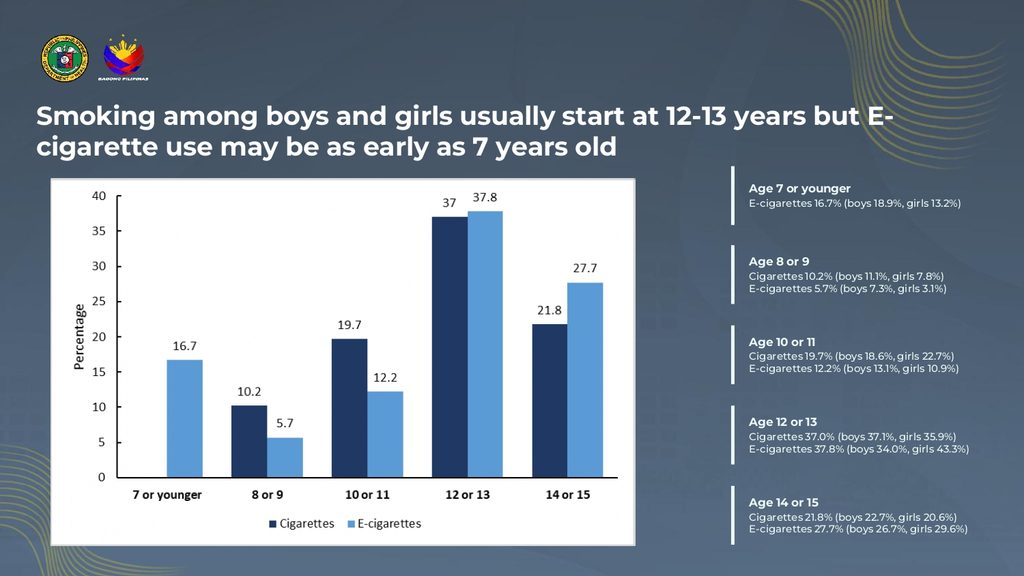
Health Assistant Secretary Lester Tan said it was alarming that there are e-cigarette users who started at 7 years old, according to the survey.
 Department of Health
De Guzman said that smoking is the number one risk factor for non-communicable diseases.
She pointed to the accessibility of vape and to the information about these products for the apparent increase in the use of e-cigarettes.
“Are our youth being targeted by the industry, by those that are selling and distributing these products?” De Guzman said.
According to the survey, e-cigarette use is the most prevalent among Filipino youth at 12.8%, followed by cigarettes (7.1%), smokeless tobacco (5.7%), and other smoke tobacco (4.1%).
Alethea also noted that the figure of current e-cigarette users was higher than the figure for current cigarette users.
“However, this rate shows cigarette smoking persists among the youth with those age 16 years and above having around twice as higher rate at 13.1% versus the younger age group was 6.2% to 7.1%,” she said.
“The rate for current use is increasing as the students get older,” she said in a mix of English and Filipino.
Au Quilala, executive director of the Philippine Legislators’ Committee on Population and Development (PLCPD), said that while it is the responsibility of adults to prevent young ones from accessing cigarettes and vapes, it is the government’s duty to enforce existing laws.
Republic Act No. 11900 or the Vaporized Nicotine and Non-Nicotine Products Regulation Act provides that 18 years old is the minimum allowable age for the purchase, sale, and use of these products.
It also prohibits the sale, promotion, advertising, and product demonstration of vapes within 100 meters of the perimeter of a school, playground, or other facility frequented by minors.
“It is important that we amend RA 11900. Children should not have access to vapes. I hope we raise the minimum age to access vape or cigarette,” Rizza Duro, Philippine Smoke-Free Movement national coordinator, said in Filipino.
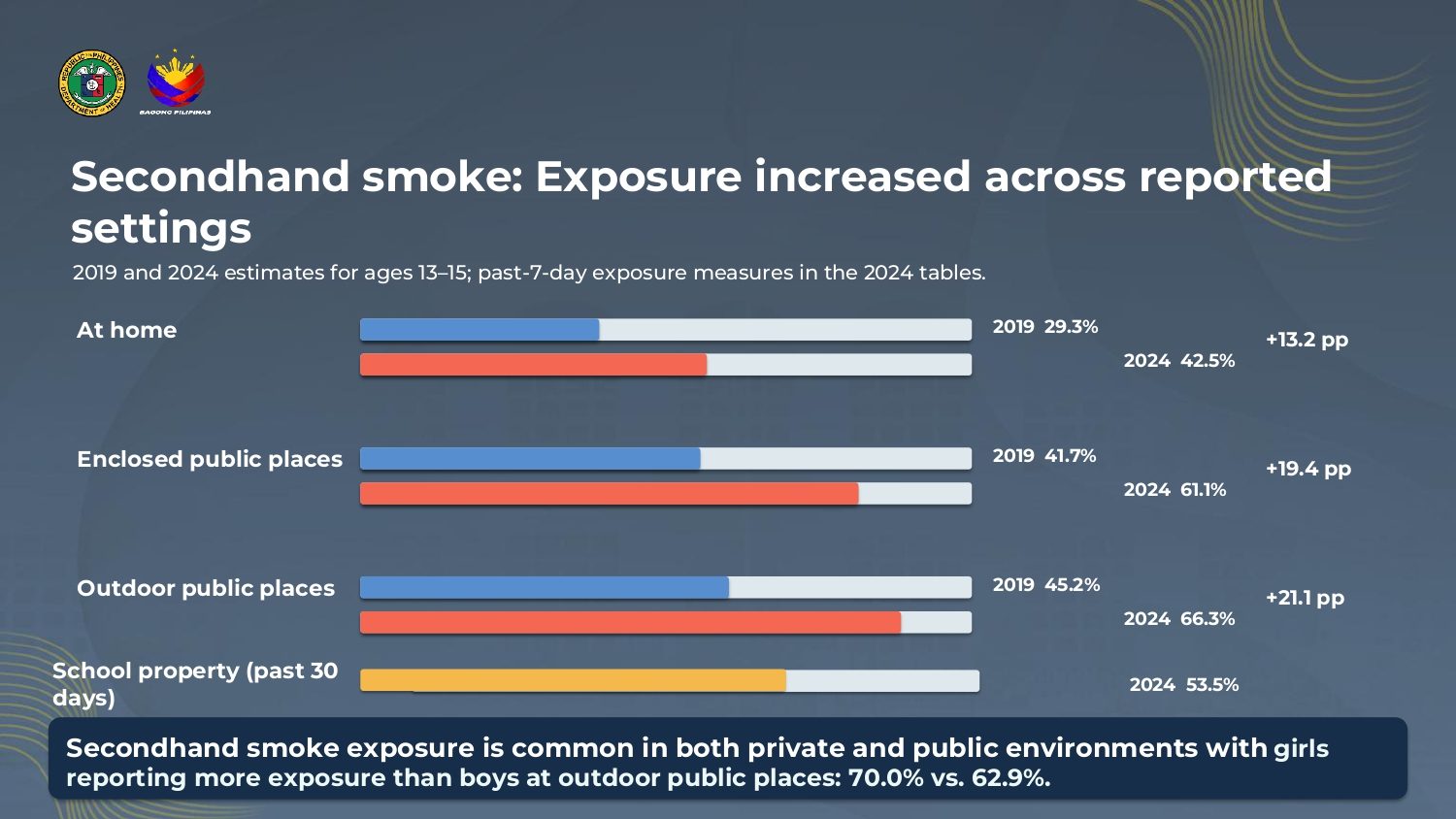
Move to fight secondhand smokeExposure to secondhand smoke also increased across settings of home, enclosed public places, and outdoor places, according to the survey.
There was also high exposure to secondhand smoke in school properties in 2024, Alethea noted.
 Department of Health
Health advocates rallied for the passage of the smoke-free and vape-free environment bill, which seeks to protect public health from exposure to secondhand cigarette smoke and vape aerosol in all public spaces and workplaces, especially those frequented by children.
The proposed measure has moved forward in the House of Representatives following its approval in the chamber’s health committee on November 11, the PLCPD said.
Amid the legislative push, Dr. Dominic Maddumba, DOH Health Promotion Bureau head, said the agency had released a template ordinance for local government units to implement a smoke-free and vape-free environment.
He said the DOH is also stepping up efforts on making smoking and vaping cessation services accessible.
But they will also study the messaging against the use of vape and tobacco products as graphic pictures may have already lost their effectiveness.
Over 8,000 students across 96 schools participated in the 2024 Global Youth Tobacco Survey. The DOH presented findings coming from over 6,000 students aged 13 to 15 years old. – Rappler.com