Scottish Secretary Douglas Alexander’s speech at the Pontignano Conference, Rome, 27 November 2026.
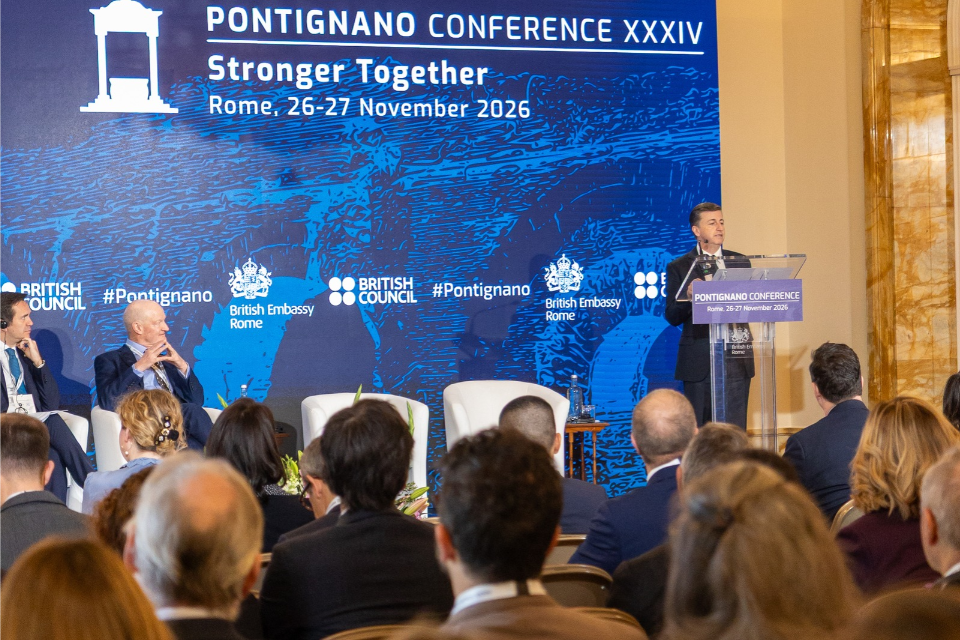
Can I say first of all what an immense pleasure it is to be here with you in Rome and I want to start by of course acknowledging our host, Stephen Hickey, the British Council, and to our co-chairs, Lord Willetts and Alessandro Cattaneo, for bringing us together here.
In the garden outside run thirty-six arches of a Roman aqueduct, built almost two thousand years ago to carry water across great distances to the people who needed it. And it’s that spirit of connection I want to bring to this conference today. And as a Scot, I feel it deeply, and nowhere more than here when I am in Italy.
Glasgow University was modelled on Bologna. Italian families, many from Barga, built Scotland’s cafés, chip shops, restaurants and ice cream parlours, and I am terribly grateful for the improvement in our cuisine that your arrival anticipated. And on the island of Orkney, Italian prisoners of war built the Italian Chapel, a place of beauty made in time of war.
As Scots, our ties run right across this continent. The founder of modern Scots law wrote much of his great work in exile in Leiden. The great economist, Adam Smith, began The Wealth of Nations while living in France. And today, France is the biggest market for Scottish salmon. Polish soldiers who defended our coast in the face of fascism in the 1940s stayed and made their lives with us. And on the River Clyde, at the height of its powers, Scotland built around a fifth of the world’s ships, carrying trade to Europe and beyond.
Scotland has never been made great by building walls. We were made great by building bridges.
Ten years ago this month, I gave a lecture at the European Studies Centre in Oxford where I said I was Scottish, British and European, and that I saw no reason why I should have to choose between those identities. I called myself a rooted internationalist. And I still am.
So today I want to advance these arguments. First, that the last decade was a decade of divergence, not just in our domestic politics but in our international order. Second, that we are now living through an era of great power rivalry, and that it will largely define the decade ahead in international affairs. And third, that the answer, for the whole of Britain, and for Scotland, is interdependence not independence, advancing a politics that gives people back control by giving them back a future.
Let’s take a moment to look back before we look ahead.
For most of my life, the story of Europe was one of convergence. After 1945, nations that had torn each other apart twice in the last century bound themselves together through the rule of law, underpinning and underpinned by economic and then technological convergence. As the decades passed, capital, goods, services, ideas and data all moved faster and faster across borders.
The last decade has broken that pattern. Because, after decades of convergence, we have seen divergence. Our world has become more polarised, more regionalised and more protectionist. And of course, most relevant to our discussions today, ten years ago this year, the United Kingdom voted to leave the European Union.
I watched the results come in with my family in Scotland, late into the night. I remember Sunderland declaring just after midnight, and the sinking feeling that this was real. By morning, every one of Scotland’s 32 local council areas had voted to remain within the European Union. What I felt wasn’t anger. It was closer to sadness, not for an institution in Brussels - my old boss, Tony Blair, said that your love of the European Union is an inverse relationship to your contact with the institutions - but for the economic opportunities forgone and, in particular, for the young people that I feared would grow up with fewer opportunities than enjoyed by my own generation.
Looking back, Britain and Europe came apart because our politics came apart. In country after country, three forces converged to make this rupture. First, economic anger, as wages stagnated for a decade and the rewards of globalisation flowed to the few. Weak economics makes for angry politics. Second, political alienation, after a financial crash that shattered trust in the powerful, and in the old promise that our children would be better off than us. And thirdly - along with economic anxiety and political alienation - cultural anxiety, among people who felt that what was around them no longer felt like the country they had known.
The international order was diverging because, at home, our economics and our politics were coming apart too.
Many who voted Leave were simply sick and tired of being sick and tired. And they were asking the most human questions. Why can’t I get on, no matter how hard I work? Who’s going to help me with my rising bills? Why does it feel like everyone else gets looked after except me? Will my children have a better future? Those were the right questions to ask, even if I disagreed with the answer.
And today, a decade on, and contrary to the claims of the Brexiteers at the time, we are living in a more uncertain and more dangerous world. We are living through an era of great power rivalry. It isn’t some distant prospect. It’s happening right now, and it will partly define the next decade.
Look ahead to the middle of the century and we will be in a world - as Tony Blair described it - of the three giants, the US, China and India. Three giants by sheer weight of population. Meanwhile, in trade, the world is fragmenting into great blocs.
Geopolitical, geoeconomic and technological shocks are reshaping the international order, as our networks of economic interdependence are increasingly weaponised as part of this great power rivalry. And of course, alongside conventional state power, in AI and technology, we are also seeing a simultaneous and massive consolidation of power in a small number of hugely powerful companies.
Far from experiencing ‘The End of History’, we are living through history-making times. Russia’s barbaric invasion of Ukraine has brought the deadliest war to our continent since 1945. Russian sabotage, cyber-attacks, and disinformation challenge the security of our underseas cables, our power grids and our elections. At the same time our American allies are rightly asking Europe to carry more of the weight of its own defence. The late Sir Alex Younger, the former Chief of MI6, captured it well. We are moving from the world of Helsinki to the world of Yalta: from a world of rules and cooperation, to a world where great powers decide.
We saw that last week in a tale of two summits. In Shenzhen, nearly 6,000 miles from Rome, the leaders of America, China and Russia sat together around one table. Two superpowers and one former superpower, self-consciously seeking to echo the imagery of Yalta. A day later in Brussels, Britain and the European Union sat down together as partners.
Together, those two pictures, I would argue, gave us a glimpse of the world taking shape. One where scale decides who has a voice. And they pose a question every European country now has to answer. How do we accumulate and project power in the coming decades?
On this issue - ‘how can we influence that future?’ - I will have more to say shortly.
But first, let us recognise that what underpinned the politics of the last decade was often yesterday more than tomorrow. The weaponisation of nostalgia, and a yearning to reclaim control. Think back to the slogan that won the 2016 referendum: take back control. The most important word in it was “back”. The offer was not a better tomorrow, but a better yesterday. It represented the politics not of transformation, but of restoration. People were right to want more control over their lives. Brexit was a democratic decision, and I respect that. But respecting a vote doesn’t mean denying the costs or consequences of that choice.
But alas there were no fireworks. Instead, credible independent estimates suggest our economy will be between 4 and 8 percent smaller than it otherwise would have been. Our food and drink exports to the EU are down by almost a quarter in real terms. Too many forgotten towns are still waiting to be remembered.
Then there was the promise of “Global Britain.” Cut our ties with our neighbours, we were told, and we would walk taller in every capital of the world. We didn’t. The Channel is still 21 miles wide. The idea that deals on the other side of the world would make up for leaving the deepest free trade area we had always been part of was always a post-imperial fiction. For a decade, Britain has been a cork bobbing on the tides of history, when we should have been helping steer them.
Brexit is no longer an abstract idea or a series of impossible promises. It’s our reality. And we now know it has failed even on its own terms. The choice today is whether we settle for that diminished status quo, or seek to change it by giving our people more power, more control, and more hope for a better future. And the way to do that is by making our country stronger, both abroad and critically, at home.
What was agreed in Brussels last week should be regarded as a floor - a proof of concept, not a ceiling on our ambitions. As the Prime Minister has said, there will be no “banging on about Europe”. We will leave that to others who have dedicated much of their adult lives to that particular pastime. Instead, our government is offering a calm and constructive effort to build further a relationship that is in both Britain and Europe’s long-term interest. We’re not interested in reopening old wounds from a decade ago. We’re simply being pragmatic and patriotic about what Britain and its people need in our fast-changing and increasingly dangerous world.
We cannot deliver the change Britain needs over the next decade without changing our relationship with Europe. When the status quo is not working, you don’t stand still. You move forward. When the status quo is broken, you don’t ignore it. You fix it.
Sovereignty in this century should involve more than striking poses about standing alone. It should involve the power to shape our future. And in an age of giants, you get that power by standing with others - with our friends, with our neighbours and our allies. So let us return to the question of how together we can influence our future.
Internationally, politics is increasingly about the projection of power internationally. For Scotland and the United Kingdom, that means pooling and sharing our resources. That is how Scotland stands taller in the world, as part of a country with a permanent seat on the UN Security Council, a leading voice in NATO and one of the world’s largest economies.
In 2016, 62 per cent of Scots voted to remain. That wasn’t a passing mood. It came from something old and deep in who we are. A nation that for centuries has been part of a multinational union and that has always looked outward, to Europe and to the world. Those who know me well know that I’m a lifelong devolutionist. I believe in power shared, and in layered identities and loyalties. We can be Glaswegian, Scottish, British, and European all at once.
Our new Prime Minister, Andy Burnham, is not just an advocate for devolution, he is a practitioner of it. Too often, over the last quarter century, devolution in the United Kingdom, has in practice meant ‘devolve and forget’ as far as Whitehall is concerned. Our approach as a government is different - devolve and cooperate. I believe the need for partnership working applies just as much at home as it does internationally. But as ambitious as we are as a UK Government to work in partnership with the Scottish Government on our shared aspirations, the Prime Minister has been clear that we will simply have to agree to disagree on the issue of independence.