
The preliminary estimate was calculated by Professor Euston Quah of Nanyang Technological University and Dr. Eugene Or of the Singapore University of Social Sciences.
Their findings were built upon a peer-reviewed cost framework developed in 2015 by Quah and fellow researchers, which adjusted the original 2015 haze bill of $1.83 billion to $2.23 billion in September 2026 prices.
Calling the 2026 pollution crisis "the worst in more than a decade," the academics argued that the sheer scale of the economic damage strengthens the case for funding regional prevention efforts alongside tougher penalties, according to The Business Times.
The researchers attributed the financial jump to Singapore's larger population, higher baseline incomes, greater visitor spending, and updated health assumptions.
The 2026 health burden, which factors in treatment bills alongside the economic value of reducing illness and premature death risks, surpassed 2015 levels.
Tourism losses were also higher than a decade ago, encompassing both direct revenue drops and broader business disruptions based on modern arrival and spending data.
Conversely, economic disruptions from lost working and non-working hours were lower this year, as the shorter haze duration outweighed the impact of higher median earnings and population growth, they said.
The cost of protective equipment such as face masks also fell from 2015 levels, while the final calculation factored in general public well-being by measuring residents' willingness to pay for cleaner air.
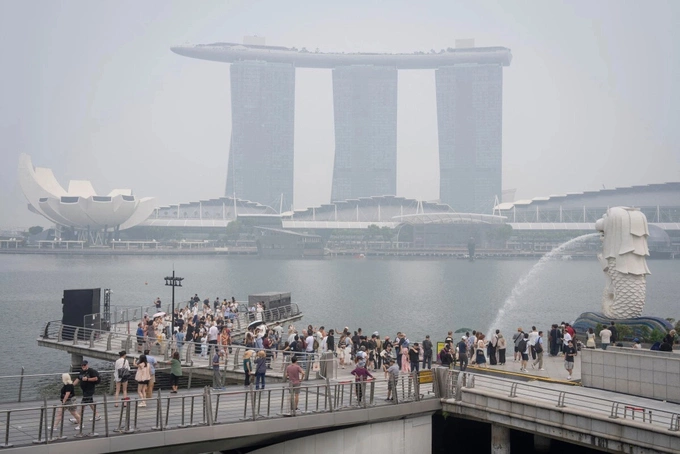
People visit Merlion Park in Singapore on Oct. 16, 2026, as the country is shrouded in haze caused by fires in Indonesia. Photo by AFP
To mitigate future crises, Quah and Or proposed a "victim-pays" approach where Singapore and other impacted nations help finance sustainable alternatives to slash-and-burn land clearing, particularly in Indonesia, as cited by Asia One.
"If supporting fire-free practices costs less than the damage avoided, contributing can leave these countries better off," the researchers argued.
While acknowledging the inherent fairness concerns of such a model, they stressed that culpable companies must still face strict penalties and remain fully accountable for starting illegal fires.
Singapore experienced transboundary haze from Indonesian forest and land fires from Sept. 4 to Oct. 25, 2026, with air quality reaching unhealthy and very unhealthy levels during the period.
Since then, air quality has improved to the moderate and good range, according to the National Environment Agency.
Singapore's Parliament on Nov. 4 debated and passed amendments to the Transboundary Haze Pollution Act, strengthening enforcement powers, increasing penalties, and introducing tougher measures against companies linked to air pollution caused by forest fires.
Under the amendments, offenses under the Act will be classified as arrestable, while courts will be allowed to conduct trials in absentia against defendants based overseas or those who cannot be contacted, according to Channel News Asia.
Fines for companies failing to comply with regulations will increase tenfold to nearly US$800,000 per day, while the maximum penalty will rise to more than US$15.6 million.