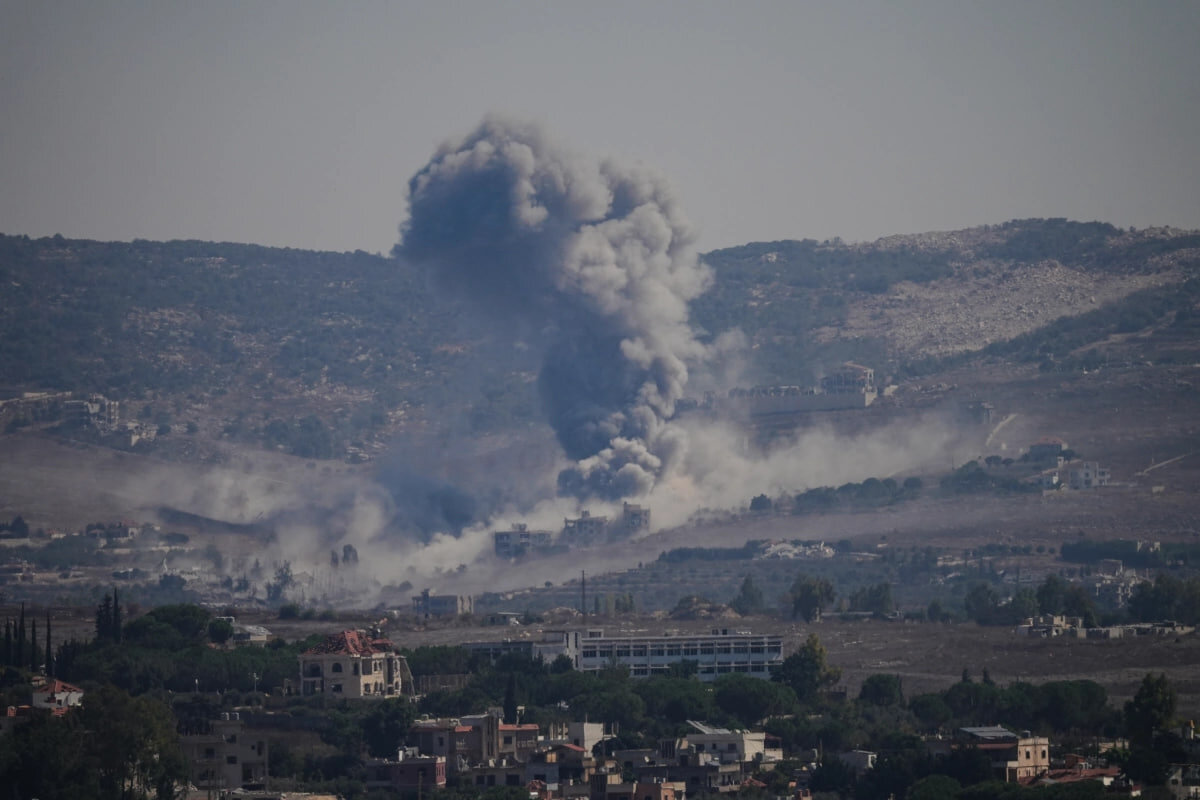
TEHRAN — Israel’s military is systematically leveling residential neighborhoods and agricultural land across southern Lebanon, turning a U.S.-brokered withdrawal framework into cover for permanent depopulation.
On Sunday evening, as Lebanon marked the 83rd anniversary of its independence, Israeli troops detonated explosives on the outskirts of Qantara in the Marjayoun district, according to local media outlets.
Massive blasts also shook Zawtar al-Sharqiyah and Kfar Tebnit in Nabatieh, sending shockwaves across the south.
Artillery units shelled Haddatha, al-Mansouri, and the outskirts of Nabatieh al-Fawqa. In Zawtar al-Sharqiyah, soldiers fired flares and blew up houses while their owners watched from nearby.
Protests erupted Sunday in Nabatieh al-Fawqa and Zawtar against the Beirut government’s silence over an Israeli occupation that has pushed to the Litani River since March.
Parliament Speaker Nabih Berri refused Independence Day greetings, calling Lebanon’s sovereignty “incomplete and unfulfilled” while border villages remain under foreign control.
Additionally, anger deepened after Israeli military spokeswoman Ella Waweya released a video on Independence Day showing her visiting a public middle school in the southern Christian village of Debel. Local officials confirmed the incursion took place weeks earlier.
Prime Minister Nawaf Salam and Education Minister Rima Karami condemned the filming of students as a “hostile show” designed to whitewash military rule, while lawmaker Ihab Hamadeh denounced the raid as an assault on children’s rights.
The June 26 framework signed by the Beirut government, Israel, and the United States was supposed to trade phased Israeli pullbacks for Lebanese army deployments.
Supposed pilot-zone operations began July 20 in Froun, Srifa, and Zawtar al-Gharbiyah, yet talks collapsed after eight rounds in October.
War Minister Israel Katz acknowledged last month that Israeli forces have destroyed roughly 60 villages and 23,000 homes, carving out a buffer zone covering five percent of Lebanese territory.
Even where troops withdrew, returning residents found deliberate ruin.
When Atef Kadouh and his wife, Soumaya Yaghi, reached their Zawtar al-Gharbiyah home of 40 years in July, they discovered Israeli soldiers had occupied the building, shot bullet holes through appliances, scrawled Hebrew rosters on hallway walls, and torched the rooms before leaving.
Lebanese army engineers had to dismantle explosives rigged inside the house. Bulldozers had uprooted the family’s pine and olive trees and crushed their tractor.
“We are back to square one,” Kadouh told NPR, living without water or power after troops smashed local solar panels. His 27-year-old son Adel, a volunteer ambulance driver, was killed alongside four other medics in a March 28 Israeli drone strike during a burial.
Critics and regional observers argue Washington has provided both the weapons and the diplomatic shield enabling Israel’s ongoing campaign of aggression, using the June framework to project an illusion of peacemaking while destruction continues on the ground. Israel has treated the agreement as a schedule for demolition.
Since March 2, Israeli attacks have killed at least 4,390 people, including over 135 medics, and uprooted more than one million residents, according to Lebanon's Health Ministry.