BULACAN, Philippines – For more than a week in August, following days of successive typhoons, floodwaters submerged parts of Triple Junction Subdivision in Barangay Matungao, Bulakan town in this province, giving residents no choice but to use boats to get around.
Nico (not his real name) said it was the worst flooding he had experienced in Triple Junction. “Nung mga nakaraang taon, normal naman na nakakaranas kami ng baha. Pero itong lately, this 2025, tapos nung taon na ‘to, grabe ‘yung baha kasi ultimo konting ulan lang, mahinang bagyo, lumalalim agad ‘yung tubig,” he added. (“In previous years, flooding was normal for us. But lately, in 2025 and this year, the floods have been severe. Even with just a little rain or a weak storm, the water rises quickly.”)
All this despite millions of taxpayers’ money spent on flood control structures in the town.
From 2022 to 2024, the Department of Public Works and Highways (DPWH) 1st District Engineering Office recorded 12 completed flood control projects in Bulakan, with a combined contract cost of P722.8 million. These included riverbank reinforcements, revetments, and concrete structures built along waterways. (READ: What’s a flood control project, anyway?)
However, residents and barangay officials continue to report unfinished sections of flood control structures. The gap between the recorded project status and conditions described on the ground raises questions about their implementation and effectiveness.
Four of the projects are located in Matungao, including structures along the Guiguinto River near Triple Junction.
Low-lying municipalityFernando Siringan of the University of the Philippines Marine Science Institute explained in a series of social media posts that the coastal plains of Bulacan, Pampanga, and Camanava (Caloocan, Malabon, Navotas, Valenzuela — all in Metro Manila) were formed over thousands of years by sediments carried downstream by rivers. Much of the area sits only 0 to 2 meters above sea level, leaving little difference in elevation to help water drain naturally toward the sea.
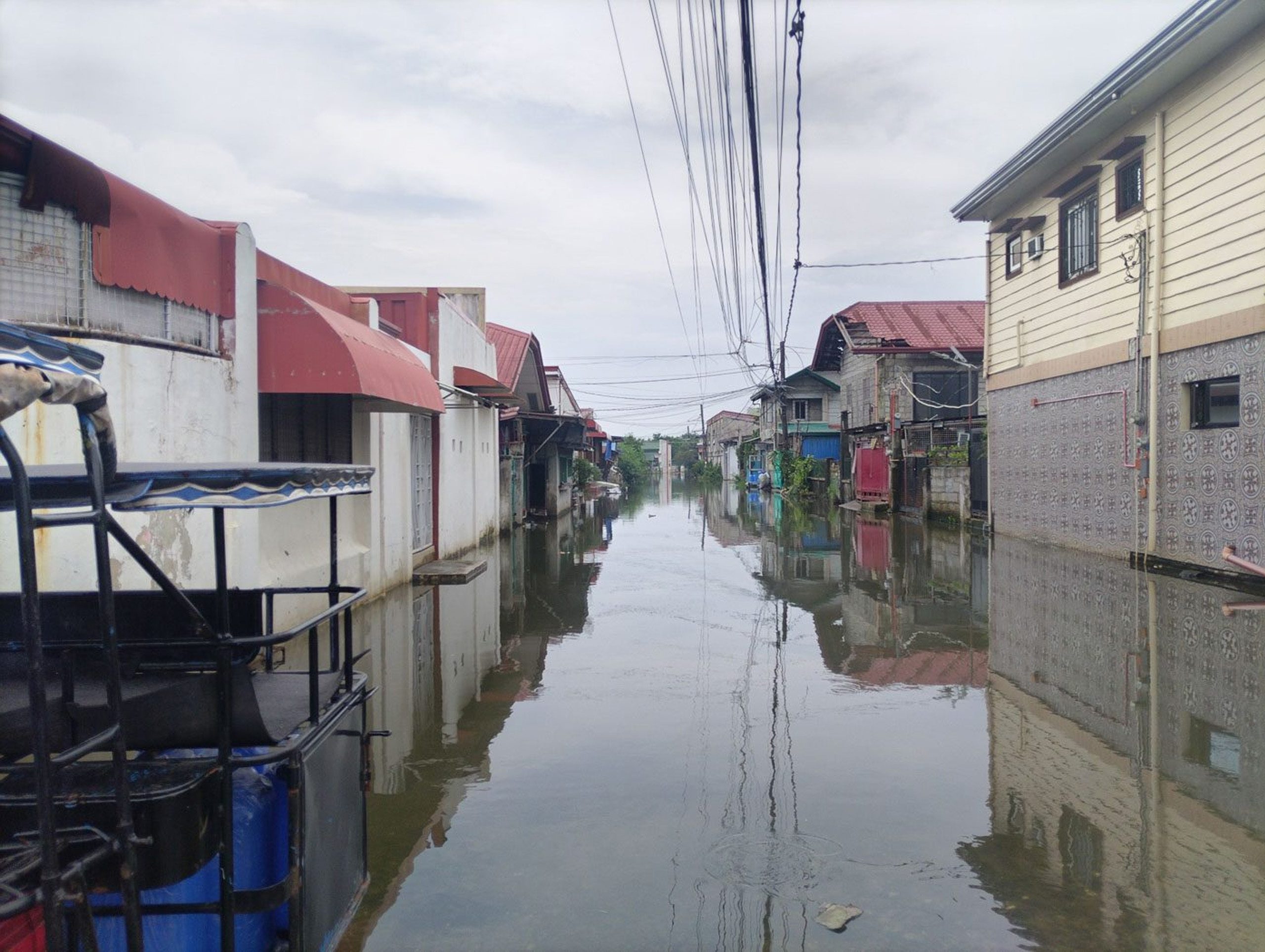 NEW NORMAL. Knee-high floodwaters in Triple Junction Subdivision in August 2026.
High tides make the problem worse. When sea levels rise, river water drains more slowly into Manila Bay, allowing water to back up and remain in low-lying communities.
Siringan also identified human activities that can worsen flooding. “Channels have narrowed due to structural encroachments, including residential housing, fishponds, reclaimed banks, river walls, and protruding bridge abutments. Simultaneously, severe upstream soil erosion and urban garbage accumulate on riverbeds,” he stated in a September 10 post.
For Bulakan, this means flood-control structures along individual riverbanks are only part of the equation. The municipality also has to contend with the condition of its rivers, drainage networks, and the routes through which water enters and leaves the area.
Disconnected floodwallsBarangay captain Anthony Mark R. Cruz said that some flood control structures in Matungao remain unfinished, with the sections of dikes “disconnected” from one another. They end up being useless, because the structures get in the way when water begins to recede, he said in Filipino.
The projects did not seem to have taken into account how water moves through nearby communities. In some areas, residents had to raise the ground around their properties with fill soil — just so the flood-control structures can work as intended.
Must Read 5 DPWH Bulacan engineers suspended over P118-M anomalous flood control projects
“Dito kasi sa looban, hindi rin kasi magiging lebel ‘yung cuffing ng flood control, hindi rin magiging lebel ng lupa, so possible talaga, kailangan, magtambak din talaga sila resident para lang mapakinabangan ‘yung flood control.” (“In the inner parts of the barangay, the flood control structure will not be level with the ground. Residents may actually need to raise the elevation of their properties with fill soil just to benefit from the flood control project.”)
Cruz said barangay officials need to be consulted before construction begins; they know which areas could be affected. But their involvement in monitoring projects remains limited, leaving them with little opportunity to verify whether completed structures follow approved plans or account for conditions on the ground.
 WHERE TAXES GO. The P77-million flood wall project at Triple Junction subdivision in Bulakan town.
Sometimes, he said, they would find out that a project has been completed after the workers had already left the site. It would be better if barangay inspections are made before a project is declared finished.
Inadequate drainageMatungao is also burdened by a poor drainage system.
Cruz said some channels lack functioning outlets, including the closed drainage outfall in Purok 2. Other drainage lines have been blocked, particularly those passing through two private subdivisions in the barangay.
With the barangay unable to finance a comprehensive drainage system on its own, Cruz said local officials would have to seek funding from the national government.
Matungao’s National Tax Allotment (NTA) increased from P13.9 million in 2024 to P19.6 million in 2026, with an indicative allocation of P21.7 million for 2027. Of the barangay’s 2026 NTA, only around 1% is allocated for infrastructure, amounting to approximately P200,000 to P250,000 annually. Of this amount, a measly P150,000 is earmarked for drainage projects.
“It’s difficult. We want to help everyone, but our budget is simply not sufficient for that,” he said in Filipino. “We can only do what the barangay can afford and make do with whatever funding the municipality provides.”
 CLOGGED. Drainage works alongside Matungao Street in Bulakan town.
Inside Triple Junction
Triple Junction was privately owned before it was turned over to the local government in 2000, during the establishment of the Bulacan State University (BulSU) Meneses campus. Its location beside the Guiguinto River has long exposed residents to flooding from the river.
Rosalyn, a Triple Junction homeowners association (HOA) member who requested anonymity, said road-raising works should be preceded by drainage improvements. Some residents have raised their homes to match the elevated roads, but she said this has not been enough to address flooding.
“Even the BulSU covered court can no longer be used,” she said in Filipino. “The surrounding area is also flooded. Look at the water levels now: they rise whether it is low tide or high tide. The people living there are the ones who suffer.”
Rosalyn pointed to gaps in the dike built as flood control inside Triple Junction, whose uneven construction leaves some sections higher than others, with several portions still open. These openings allow high-tide waters to enter the subdivision. When water also drains out slowly, it takes longer for flood levels to recede.
Water crosses municipal boundariesWater entering Triple Junction from neighboring towns of Balagtas and Guiguinto points to the need for coordination among municipalities, particularly when road-raising and drainage projects can redirect water across jurisdictional boundaries. Rosalyn urged local governments to agree on where excess water should flow before undertaking such projects.
Drainage routes through private subdivisions also require coordination with property owners to keep waterways unobstructed, Cruz noted. Rosalyn and Cruz both identified river dredging as a necessary measure to improve water flow.
“Floodwalls are not enough,” Rosalyn said. “They are not sufficient. Water still gets in. No matter how many dikes you build, if the river itself is not properly maintained, the first thing that needs to be done is to dredge it,” she added.
However, after living in Triple Junction for 23 years, Nico said he didn’t think dredging has helped. He said the excavation may have worsened flooding in Matungao, which he described as a natural catch basin for floodwaters. “Since they excavated the river here, it seems like the elevation of our area has gone even lower. It doesn’t seem to have helped,” he said in Filipino.
The differing views on dredging underscore the need for flood control measures to account for entire waterways and the communities they affect. While government planning and coordination are essential, residents also have a role in reducing flood risks.
Residents can help, but…Rosalyn shared that they have taken steps to reduce risks by reminding residents to follow garbage collection schedules, segregate waste, and put out trash only when collection trucks are due. The HOA also encouraged the homeowners to cut down on single-use plastics.
Nico’s family, on other hand, follows the HOA’s waste-management measures as its own contribution to preventing floods. He also called for greater community awareness of proper waste segregation and disaster preparedness, urging the local government to conduct seminars for residents who may lack the knowledge to properly manage their waste or prepare for calamities.
But he stressed that these efforts, no matter how consistent, cannot address the community’s larger problems without responsive leadership.
Under Department Order No. 23, series of 2015, the DPWH requires flood control and drainage projects to be based on a master plan or feasibility study for the river basin or urban area they cover. Engineering surveys must identify technical issues and possible alternatives, while project effectiveness is measured by reductions in flood-prone areas, property damage, and the duration of flooding.
DPWH records list 12 flood control projects as completed in Bulakan from 2022 to 2024. Yet residents’ accounts of unfinished structures, obstructed drainage, and prolonged flooding raise questions about how these projects fit into the municipality’s wider drainage and flood-control network.
Addressing these problems also requires coordination beyond Bulakan. Infrastructure projects in neighboring municipalities can affect how water moves across boundaries, while drainage routes passing through private subdivisions require cooperation with property owners. (As of writing, the DPWH 1st District Engineering Office had yet to respond to queries about the flood control projects in Bulakan.)
Residents can help manage waste and prepare for emergencies, but these efforts cannot repair obstructed drainage or compensate for unfinished infrastructure. Bulakan needs more than additional flood control structures. It needs a coordinated plan based on the municipality’s terrain, waterways, drainage systems, and connections to neighboring communities.
For those who continue to wait days for floodwaters to recede, that plan cannot come too late.
“Under our current system, we do not know what plans the government has for us,” Cruz said in Filipino. “Sometimes, they should also look at what is happening on the ground. We are often the ones blamed. Yes, this is our job, and we have sworn to fulfill this duty, but the government has its responsibilities, too. I hope we can work together.” – Rappler.com
Mark David Silencio is an information technology student at the Bulacan State University in Plaridel, Bulacan. An Aries Rufo Journalism Fellow for 2026, he is also the managing editor for Administration of Pacesetter.