What happens when the people you inherited a business with are also the people you can no longer work with? You can quit a job, sell your shares, or find a new business partner. But what if that partner is your brother, sister, cousin, or parent, and the company is something your grandparents spent their lives building?
I have covered Philippine business families for most of my journalism career, interviewing relatives locked in battles over ownership, leadership, inheritance, and family land. Some disputes were already playing out in court, while others were waged quietly behind closed boardroom doors even as the companies kept running. As the feud between cousins Federico “Piki” Lopez and Eugenio “Gabby” Lopez III unfolded this year, I found myself returning to those stories, my interview notes, and reading Harvard Business Review research on why family businesses fight and how some survive. In June, I joined family-business adviser Enrique Soriano in an online forum with business owners across Asia to discuss why even wildly successful dynasties break apart.
The Lopez cousins are hardly the first wealthy family to face this problem. India’s Ambani brothers split up the Reliance empire their father built, while the Ortigases fought over control of their real estate business. In Singapore, a father accused his son of trying to take over the board of one of the country’s biggest property developers. Some families eventually called a truce. Others decided they could no longer be business partners, and still fought for years, burning through cash on lawyers and leaving the next generation to clean up the mess.
All of this brought me back to one big question: Is keeping a family business together always worth the cost?
The Lopezes reach a crossroadsFor decades, the Lopez name has been tied to some of the Philippines’ most famous companies: ABS-CBN, Meralco, Benpres (now Lopez Holdings), First Philippine Holdings, First Gen, and Rockwell Land. The businesses changed over time, yet the family stayed connected to an empire their elders built, lost, won back, and rebuilt.
Under Oscar Lopez‘s leadership, the family published Phoenix, a book about how they bounced back from hard times. Piki wanted a different symbol for the next chapter: not the phoenix, which rises again after being destroyed, but the butterfly, which transforms into something completely new. He has also talked a lot about compounding, the idea that smart decisions made consistently over decades pay off far more than quick wins. In his September speeches to stockholders, he stressed that “direction matters more than speed,” pointing to the group’s decision ten years earlier to stop building coal-fired power plants even when coal was still making good money.
Must Read From ‘king’ to ‘steward’: How Piki Lopez answered the Lopez family rift question
That mindset explains Piki’s game plan for First Gen’s energy investments. He believes the company must prepare for a power market that relies more and more on renewable energy. His cousins have questioned whether the bets he’s making are worth the massive price tag, risks, and years of waiting. They have also challenged his authority to make those calls on his own. Gabby and his allied cousins wanted something very different: immediate cash flow and shared family stewardship over a distressed media mission—ABS-CBN—that could not afford to wait until 2031 for long-gestation hydro projects to pay off.
Must Read EXCLUSIVE: Inside Piki Lopez’s town hall as cousins rally for ABS-CBN
The fight turned public and personal. In April, majority owners of Lopez Inc.—representing three of the four branches of the family—accused Piki of acting “like a king without accountability,” questioning First Gen’s deals with Enrique Razon Jr.’s Prime Infrastructure, including selling control of its natural-gas business and investing in water-pumping hydropower projects. The majority group later called the hydropower bet “a horrible deal.” First Gen pushed back on those claims, defending the business logic, pricing, and board approvals behind its deals.
The cousins reached a ceasefire in May, but it didn’t hold, and by August, Gabby’s branch sold its 25.68% share in Lopez Inc., the private holding company sitting at the very top of the family empire, to businessman Ramon Ang for about P11.56 billion. Meanwhile, ABS-CBN lined up fresh funding. Piki then locked down control of the boards of Lopez Holdings and First Philippine Holdings (FPH), the two companies that hold the group’s stakes in First Gen and geothermal giant Energy Development Corporation (EDC). In November, FPH approved the proposed P15.92-billion sale of its 90.74% controlling stake in Rockwell Land to Gabby’s branch’s investment firm, Crème Investment Corporation, a deal that is still waiting to close. (READ: What it took to save ABS-CBN)
Taken together, these deals suggest the cousins are moving toward a future where they no longer have to agree on how to run the same businesses.
But is splitting up actually better than staying together?
When business disagreements become family warsOne family owner wants bigger cash payouts today, while the relative running the company wants to plow back those profits into growing the business. Another thinks they should sell the company while buyers are offering a good price, while someone else wants to save it for the grandkids. One wants to ride out an industry slump, convinced a struggling business will bounce back, while another wants to stop pouring money into what looks like a sinking ship, especially when that cash could fund a different business that takes years of heavy spending before turning a profit.
Yet each walks away believing the others are greedy, reckless, or unreasonable. The real trouble starts when the people around the boardroom table aren’t just ordinary investors, but siblings who grew up competing for their parents’ and uncles’ attention, cousins who feel their branch of the family sacrificed more, or heirs who remember the founder’s wishes differently.
Josh Baron and Rob Lachenauer, who advise business families and write for Harvard Business Review, explain how everyday business arguments turn deeply personal. In Why Fights Erupt in Family Businesses, they show how fights over money, power, and status get tangled up with family history. An argument over company spending can bring back old resentment over unequal treatment. A fight over who gets to be CEO can reopen old arguments about favoritism. Selling a company might look like a smart opportunity to one relative and a betrayal of the family legacy to another.
Soriano raised another complication during our webinar: many family businesses stay united for decades simply because one strong founder or family elder can settle all the arguments. Relatives might not like every decision, yet they accept the leader’s authority. Once that leader passes away, the next generation realizes it has inherited not only the businesses, but also old disagreements that were never truly resolved.
The Lopezes had larger-than-life leaders in Eugenio “Geny” Lopez Jr. and his brother Oscar, who died in 1999 and 2023, leaving their successors to figure out how to own and run surviving empires without those strong elders around to settle arguments.
Other Philippine families have ended up in far messier wars.
Take Banco Filipino, once the country’s biggest savings bank, famous for its slogan, “Subok na Matibay, Subok na Matatag (Tested Strong, Proven Stable).” Founded by Tomas Aguirre in 1964, the bank was shut down by the Central Bank in January 1985 before reopening in 1994 after the Supreme Court ruled the Central Bank had abused its power. But its headaches were far from over. It kept clashing with regulators over financial aid, its money troubles, and the fallout from its first shutdown.
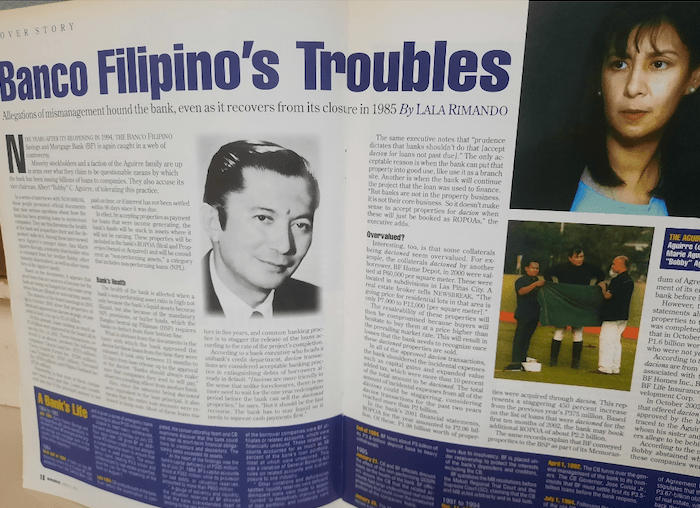 BANCO FILIPINO. This spread in Newsbreak’s March 3, 2003 issue shows the late Don Tomas Aguirre (left) and his children, Ana Marie Aguirre-Koruga (upper right), and Albert “Bobby” Aguirre (bottom right) on a polo field. Rappler
At the same time, the Aguirre family was tearing itself apart from the inside. I covered the legal fight involving Ana Maria Aguirre-Koruga, a minority stockholder who sued the bank’s directors in 2003, including her own brother, Albert Aguirre, who was then vice chairman. She accused them of risky banking practices, conflicts of interest, and shady loans meant to enrich insiders. The directors denied the claims. In 2009, the Supreme Court ruled in Koruga v. Arcenas that her complaints belonged with the Bangko Sentral ng Pilipinas (BSP), not a regular trial court. That ruling only decided who had authority to hear the case, not whether her accusations were true. The bank shut down for good on March 17, 2011, under BSP orders. The state deposit insurer, Philippine Deposit Insurance Corporation, took over a bank with 62 branches, 173,480 accounts, and P17.8 billion in customer deposits. The family and regulators kept arguing over who was to blame. While the sibling feud wasn’t the sole reason Banco Filipino collapsed—its financial and regulatory problems ran much deeper—the family war played out inside a bank holding the life savings of thousands of ordinary Filipinos.
The Ilusorio family feud got even more personal. Potenciano “Nanoy” Ilusorio built a multi-billion-peso empire anchored by prime real estate, the pioneering satellite firm Philcomsat, and the exclusive Baguio Country Club. But by 1999, his six children had split into rival camps over their parents, the family fortune, and who should be in charge. When Nanoy grew old and frail, some of his children took him under their care, prompting their mother, Erlinda Kalaw-Ilusorio, to sue them for allegedly keeping her husband away from her, a battle the Supreme Court dismissed in 2001 as the “sad tale of a prominent family shattered by conflicts on expectancy in fabled fortune.” (READ: What drives people to declare war against their own flesh and blood?)
Even Nanoy’s death in June that year didn’t stop nearly 300 civil and criminal lawsuits filed between the rival camps, and according to an account Soriano published in 2016, some children only found out of Erlinda’s death four days later, leading to separate funerals. At one service, the urn reportedly held Nanoy’s ashes because another branch of the family kept Erlinda’s. Another service reportedly barred three of the sisters at the door with security guards.
A fight that started over money and power had reached the point where children could not even mourn their parents together.
In other prominent Philippine clans, the fracture began not at a parent’s deathbed, but when siblings began questioning how a brother or sister was managing inherited assets—turning boardroom suspicions into criminal complaints and proxy wars.
For the Jacintos, who built their wealth in steel, banking, and real estate, also fought over their inheritance. After their patriarch, Fernando Jacinto died, his children clashed over how family properties were being managed and sold. Musician and businessman Ramon “RJ” Jacinto stepped in after relatives questioned real estate deals handled by their sister Marilene, who was running parts of the family business. One fight centered on a large property in Misamis Oriental sold in 2007 for P226 million, which RJ’s camp argued was far below its appraised value. Another involved a Novaliches property reportedly worth about P300 million. Acting as president of family-owned Oregon Land Inc., RJ accused Marilene of faking a deed to transfer the land. Prosecutors charged her in 2012 with falsifying public documents, an accusation that led to criminal proceedings, though not a conviction. The feud showed how inheritance fights can quickly spiral into claims of betrayal and criminal charges between brothers and sisters. (READ: Shaping the future: Family legacies)