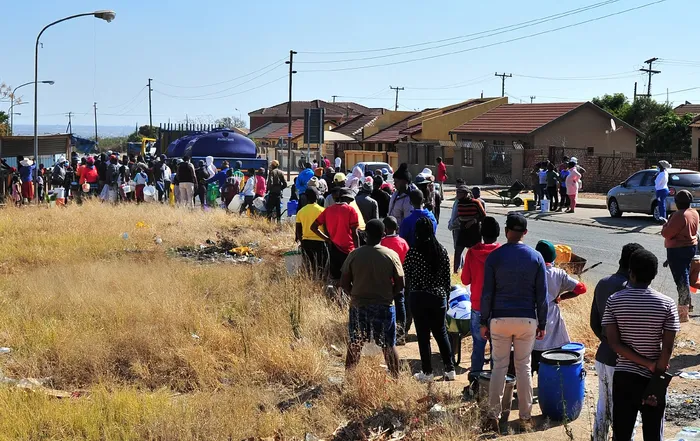
A water tanker supplies an informal settlement in Tshwane, where 170 settlements rely on 282 tankers and more than 1,250 static tanks, according to the SAHRC report.
Image: Oupa Mokoena / African News Agency (ANA)
TSHWANE is not simply running short of water. It is running short of the money, people and functioning infrastructure needed to deliver it.
The South African Human Rights Commission’s (SAHRC) final report into water and sanitation service delivery in Gauteng finds that the City has accumulated about R22.84 billion in unauthorised, irregular, fruitless and wasteful expenditure, carries an estimated R23bn infrastructure backlog, loses 39% of its water and operates with a 41% municipal vacancy rate.
The Commission found that Tshwane’s response has been “not yet sufficient to overcome the scale of the City's accumulated infrastructure, wastewater and institutional deficiencies”.
The SAHRC found that Tshwane received a qualified audit opinion and recorded about R22.84bn in unauthorised, irregular, fruitless and wasteful expenditure. The Auditor-General identified inadequate internal controls requiring intervention, and 14 material irregularities have been issued against the City since 2019.
“Eleven had been resolved, and appropriate action was being taken on the remaining three,” the report noted. But it adds: “The scale of the City's broader financial-control deficiencies remains substantial.”
Water losses alone amount to about R1.7bn annually, or 39% of the water flowing through municipal pipelines, well above National Treasury’s guideline range of 15% to 30%.
The City’s spending on externally procured water tankering was described as “exceptionally high”, rising from approximately R47 million in 2021/22 to R777m in 2024/25, before declining to about R362m in 2025/26.
“The magnitude of tanker expenditure requires particular attention,” the Commission found. While informal settlements create a genuine need for alternative supply, “sustained expenditure at this scale demonstrates both the cost of dependence upon road-based water distribution and the importance of ensuring that alternative provision does not become a permanent substitute for sustainable infrastructure”.
The Commission found that Tshwane experiences “severe institutional and technical-capacity constraints”. The overall vacancy rate is 41%, with 28% of senior-management positions and 25% of finance positions vacant.
The Water and Sanitation Business Unit is “particularly concerning”. Of an approved establishment of 1 826 positions, only 966 were filled. A further 92 funded positions were vacant, and 768 were unfunded.
“The scale of these vacancies materially limits the City’s operational capacity,” the Commission found.
The consequences are visible in daily service delivery. The City reported increased dependence on overtime, with the overtime budget generally exhausted by April. “Employees may then decline emergency or unplanned work where payment cannot be confirmed,” the report stated.
The Green Drop assessment identified a need for 16 process controllers, while Blue Drop technical-skills scores varied from 0% to 93.1% between systems.
“Capacity constraints are not merely reflected in vacancy statistics but have demonstrable operational consequences for maintenance, emergency response, water-quality monitoring and treatment operations,” the Commission found. “This constitutes one of the City’s significant underlying water-services risks.”
Wastewater treatment “constitutes a serious weakness within Tshwane’s water-services system”. The City achieved an overall Green Drop score of 33.8%, placing its performance in the poor category.
Tshwane operates 16 wastewater treatment works, but operating-capacity information was unavailable for 14. Daspoort Wastewater Treatment Works was operating at 119% of design capacity.
Department of Water and Sanitation (DWS) enforcement evidence identified directives or criminal proceedings concerning Sunderland Ridge, Zeekoeqat, Baviaanspoort, Klipgat, Godrich and Rooiwal, with continuing non-compliant discharges reported at several facilities.
“Rooiwal’s discharge into the Apies River has adversely affected raw-water quality available to the Temba Water Treatment Works,” the report stated.
Tshwane is also affected by failures beyond its jurisdiction. Raw-water contamination from Ekurhuleni’s Hartebeesfontein Wastewater Treatment Works affected production at Rietvlei.
There has been corrective action, particularly at Rooiwal, where repairs, upgrades and refurbishment are under way, and the Development Bank of Southern Africa has been appointed as implementing agent. The DWS-funded Klipdrift package plant provides interim drinking-water capacity for Hammanskraal.
“These interventions are substantive rather than merely institutional,” the Commission acknowledged. “However, continuing non-compliant discharges and the poor Green Drop score demonstrate that corrective action has not yet restored adequate wastewater performance.”
Tshwane’s drinking-water safety performance is “uneven and requires continued attention”. Its overall Blue Drop score of 35.2% falls within the low-risk category, but results vary considerably across its 12 water-supply systems.
Monitoring has also been affected by shortages of samplers, vehicles, process controllers and technical personnel. “A shortage of samplers resulted in no sampling at Bronkhorstbaai and Sokhulumi during April 2025, while insufficient vehicles were reported to affect the City’s ability to maintain the required monitoring frequency,” the report stated.
“Low Water Safety Plan scores and substantial variation between individual systems mean that strong performance in some systems cannot be treated as evidence of uniformly safe and resilient drinking-water management throughout the metropolitan area.”
The District Health Barometer recorded 1 950 diarrhoea separations and 16 deaths among children under five during 2024/25. “These figures do not establish that municipal drinking water caused the reported illnesses or deaths,” the Commission cautions, but says continued system-specific monitoring and preventative risk management are particularly important.
The City estimates its infrastructure backlog at about R23bn. Ageing infrastructure contributes to leaks and service interruptions, while about 463km² of the municipal area is underlain by dolomite.
Tshwane provided “considerably more detailed operational evidence concerning interruptions than most municipalities considered by the Commission”. The Commission cautioned that this should not be read as evidence of more failures, but rather as evidence of “comparatively developed operational monitoring”.
The Commission’s overall finding is that Tshwane demonstrates “substantial operational, infrastructure and governance pressures, but also comparatively strong evidence of municipal planning, monitoring and corrective action”.