Who is the real Ronnie Lazaro?
After a few decades, Ronnie Lazaro shows up on my radar with an invitation to attend the opening of his mobile photography exhibit, Lies The Truth.
It was set in the Avellana Art Gallery in Pasay, and going through the charmingly wooded complex of the Henry Hotel with houses dating back to the ’50s, I am sent back to a place called Cool Malate in the ’80s.
No such place exists anymore, but it exists in every artist’s heart of that generation who used to hang out in Hobbit House, the Penguin Café, Coco Banana, and Bistro Remedios. And the ultimate survivor, Café Adriatico.
So, there’s Ronnie, at his exhibit opening, fussing about the white wine not being cold enough and why the red wine was in the cooler. He seems to be the same man running about the set of City After Dark, a determined art director keeping up with the demands of the director, Ishmael Bernal, and the production designer, Peque Gallaga.
City After Dark was originally titled Manila By Night, but Imelda Marcos objected to Manila being depicted as a decadent city with drugs, gay bars, and prostitution on just about every corner (which it was). This was Ronnie’s fifth assignment as art director.
Age has not done too much to Ronnie. Maybe he was leaner during the City After Dark days, but he looks down at me with the same soulful eyes. Or maybe he didn’t recognize me and was trying to place me in his memory?
Ronnie casually opens the exhibition. Friendly, but definitely in charge.
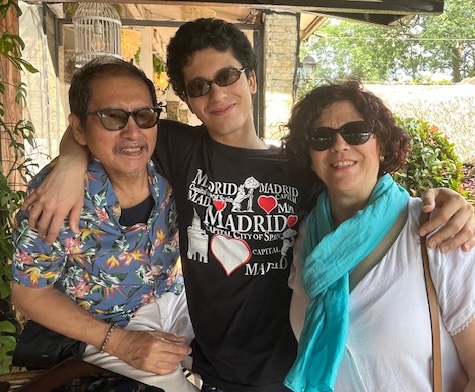 FAMILY FIRST. Ronnie Lazaro (left) with his wife Lola and son Gabriel. Contributed photo
One has to think about the message with this collection of photographs of artists covering their faces with both hands. Eyes are the mirror of the soul they say, but Ronnie’s subjects cover them up with both hands. Is it intimacy because they’re close-ups? Or the opposite, because they’re all covering their faces with their hands?
“The world is full of lies!” he moans.
Uprooting himself from his native Sagay, Negros Occidental, he set down to do the hard work in Manila. With a natural acting talent and an ability to adapt to any situation, Ronnie says, “I had to work hard. I could not go back a failure.”
So, coming up from the School of Hard Knocks, and living by his work philosophy, “Just show up,” Ronnie has certainly arrived.
“I went to every single art opening to learn, meet people, and also to eat. Hahaha,” he shakes his head, almost amused at himself thinking about those gritty days in the ’80s.
Needless to say, Peque was a major influence on Ronnie as an actor, but other artists like Cesare Syjuco and Jean Syjuco molded a new artist’s perspective in Ronnie, venturing out of his comfort zone and doing dozens of performance art around the city.
In Mendiola, he did Eto Ka, Eto Ako, Ngayon Na where he held up a mirror to each member of the audience. This was in 1984, if memory serves. We can certainly use some of that these days.
It’s not a surprise that the latest Fifth Wall Fest (@fifthwall.ph) invited him to comment on James Clar’s performance art centered around City After Dark.
“Bing, you have to come. Tayo na lang naiiwan (We’re the only ones left).”
After one production meeting for City After Dark, he gallantly escorted me to my car and we discovered I had a flat. Of course, he had to change the tire for me. Gallant as he was.
As he tightened the bolts, he said, “Ibig mo sabihin Bing, nakasalalay ang buhay mo sa akin? (Do you mean, Bing, that your life depends on me?)”
Well yes, I say.
“Then I better get this right.”
On another occasion, we were walking in Sagada, why there was only the two of us, I have no idea. Where was everyone? I was rattling on about some such nonsense, yadayadayada, when he stopped me in my tracks because a snake was crossing our path!
He was looking out for danger this whole time! (Or wasn’t listening at all).
Thank you for that, Ronnie.
Yes, a true galante (gallant) — somewhat soft spoken and introspective.
When you’ve had decades of work experience, it’s hard to name that defining moment. And yet, Ronnie says, the defining moment for him was when Mitch Valdez invited him to her group Reach for Inner Self, a spiritual workshop.
“That is where I learned to forgive and love myself.”
Ronnie hangs back for a beat, enjoying the memories this interview is bringing back. He talked about the time Mitch invited him to be on the board of OPM.
There was an awards night to be held in Tahiti. Everyone was busy so Ronnie had to take one for the team and attended the festival. He was to be a judge and Heber Bartolome was the talent. His eyes sparkled as he said, “Lots of nice girls there.”
His proudest moment, among several, was his directorial debut Edna (2014), with screenplay by Lally Bucoy. The film received glowing critical reviews as it moved away from the typical OFW story, but rather goes inward, exposing the tragic result of a family growing without a mother.
We both contemplate the depth of isolation and loneliness one feels when separated from family and home.
Ronnie has tackled his career as an actor like a man on a mission. In 2012, I reminded him, he had 11 projects listed in his filmography, not to mention the dizzying number of projects in television and theater.
Of note would be his Urian Award for Best Actor, Yanggaw (Affliction) in 2008, Urian Best Supporting Actor for Bagong Buwan (2001) and The Gospel of the Beast (2023).
Raymond Red’s Anino brought him to Cannes where it won Best Short Feature Film (2000), and in 2024, Ronnie attended the Venice International Film Festival as lead actor of Lav Diaz’s Phantosmia.
We put all of that aside for a moment and exchanged ideas for a new movie perhaps, exploring themes, fiction or non-fiction choices, perhaps a period piece. And just when I was saying to myself, how refreshing it was to just sit and shoot the creative breeze with someone so imaginative and passionate, a fire broke out!
Makati Cinema Square was on fire! I told him to quickly get out before the fire trucks completely blocked the road. No need to be galante this time. There were enough firemen to keep me safe. – Rappler.com