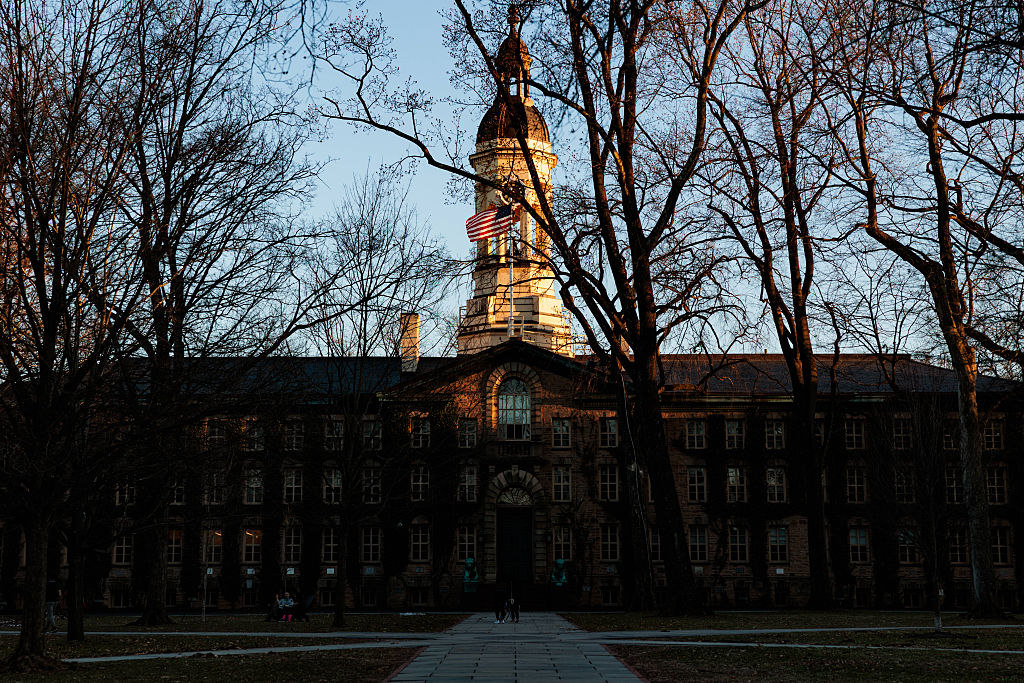
 Nassau Hall on Princeton University's campus is pictured in Princeton, New Jersey, on March 9, 2026. —Hannah Beier—The Washington Post via Getty Images
Immigration and Customs Enforcement (ICE) detained a Princeton University doctoral candidate on Nov. 19 at an airport in Arlington, Virginia. Her colleagues, classmates, and lawmakers are calling for her immediate release ahead of Thanksgiving Weekend.
Eva Yi Xie, a Chinese national, was detained at the Ronald Reagan Washington National Airport as she departed from an annual conference of the Society for Neuroscience. Xie’s lawyers say that she was not presented with a warrant.
She was later taken to the Caroline Detention Center in Virginia, a court filing says. U.S. District Judge Anthony Trenga ordered the federal government to respond to a petition challenging Xie’s detention by 5 p.m. E.T. on Wednesday. In the meantime, he ordered ICE not to transfer or remove Xie from the Eastern District of Virginia.
Read more: Trump Opens Door to Immigration Deal. Democrats Want Proof He's Serious
According to court documents, Xie, 24, came to New York on a travel visa with her family in March 2016. Four months later, Xie’s mother applied for asylum. The family’s case is still pending, with a hearing scheduled for January 2028. Xie was granted work authorization and does not have any criminal history.
Kerry Doyle, a lawyer who represents Xie, tells TIME that Xie has received “unprecedented” support from Princeton, as well as the Massachusetts Institute of Technology, where Xie earned her undergraduate degree in 2024. She says that there is an effort to collect letters of support in order to facilitate her release.
“We have this incredibly talented student—and by all accounts, an incredible person—who studies neuroscience. She has a very great future, and we're arresting her at the airport for no reason,” Doyle says.
In a statement shared with TIME, an ICE spokesperson says that a pending asylum application does not confer legal status and that Xie never held “valid authorization to study in the United States.”
“Xie was admitted to the United States on a temporary basis on March 16, 2016, but chose to violate our nation’s laws by refusing to depart by the required date of September 15, 2016,” the spokesperson says.
Democratic Senator Andy Kim of New Jersey, where Princeton is located, wrote on X on Monday that his office has been in touch with the school, Xie, and DHS in an effort to get more information and get her home.
“It's heartbreaking to see her detained and turned into another example of this administration's cruel immigration policies,” he said.
Representative Bonnie Watson Coleman, a Democrat who represents Princeton University’s congressional district, said her office is closely following this case.
TIME has reached out to both offices for additional comment.
About 250 people showed up to a “Free Eva” rally at Princeton University on Monday in support of Xie. The organizers put together a phone bank to urge supporters to contact their federal representatives on Xie’s behalf.
Brody Lab, a neuroscience research group at Princeton, announced Xie’s arrest in a social media post last week and has since urged followers to contact congressional lawmakers to advocate for her prompt release. It says that Xie messaged the lab’s Slack channel for help when she got detained.
Rodney Priestley, the dean of the Graduate School at Princeton University, said last Friday that Xie’s detention was “distressing.” The university has provided legal counsel to Xie and remains in contact with Xie’s family.
Xie’s PhD adviser Carlos Brody told the Associated Press in an interview on Tuesday that Xie called into a weekly lab meeting to thank her coworkers for their support and is in “remarkable spirits.”
Adrian Bondy, a research scholar in the lab, told AP that even in detention, Xie “wants the science to continue and is thinking about scientific ideas.”
Xie is not the first researcher arrested by ICE. Science reported that Di Liu, a chemistry assistant professor at Arizona State University with a valid work visa, was detained by ICE in July at an airport on his way to a scientific conference in Nashville, Tennessee. A few days later, he was released without explanation. Last year, Tufts researcher Rumeysa Ozturk was detained by ICE in Cambridge, Massachusetts. She decided in April 2026 to voluntarily leave the U.S.
ICE arrests at U.S. airports
Two days after Xie’s arrest, ICE officers detained a father and daughter at Seattle-Tacoma International Airport as passengers boarded an Alaska Airlines flight to Los Angeles. A viral video captured the moment when Mexican immigrant Ricardo Larrondo Mendoza and his daughter, Sofia Hernandez Mejia, were arrested. It showed Hernandez Mejia pleading for help before being dragged out of the jet bridge.
The recent arrests continue a trend seen throughout the Trump Administration’s second term. Stateline reported that there was a nationwide goal of 2,000 ICE arrests a day; a senior Department of Homeland Security (DHS) official told NBC News that officers were averaging 20 to 40 arrests a day at U.S. airports as of August.
Since May 2025, ICE has been obtaining traveler information through the Transportation Security Administration (TSA) through a previously undisclosed data-sharing program, according to records obtained by the watchdog group American Oversight. The New York Times reported that the program gives ICE access to the names and birth dates of passengers whom the TSA believes may be subject to arrest.
On July 21, two plainclothes ICE agents arrested Chantal Morales Rojas, a 27-year-old from Ecuador, at the jet bridge at Denver International Airport. The next day, ICE arrested Ethiopian Berhanu Kibret, a University of Maryland School of Pharmacy instructor returning from a conference where he received a teaching award, at the University of Maryland at Dallas Fort Worth International Airport.
“It's a desperate attempt to hit numbers for the sake of numbers,” Nayna Gupta, the policy director at the American Immigration Council, tells TIME.
The Trump Administration has also broadened its use of administrative warrants. Previous Administrations used such warrants to arrest people who were already in deportation proceedings. More recently, they have also been used in cases involving immigrants who are actively applying to renew their immigration status.
“In the past, people like that have never been prioritized for deportation if they pose no other public safety threat, given that they're taking steps to get into compliance with the law,” Gupta says.
“Our policy right now is to go after the worst of the worst,” DHS Secretary Markwayne Mullin said during a congressional hearing last week. “When we encounter someone here illegally, I am required to find out who they are.”
Backlogs and processing delays in the immigration system can put immigrants at risk of losing legal protections while their applications are pending, Gupta adds.
ICE agents have also been granted the authority to make arrests without a warrant in certain circumstances. For example, if they have probable cause to believe someone is in the country without legal status and is likely to escape if not immediately arrested. Gupta says that authority has been abused in previous immigration operations.
President Donald Trump has recently acknowledged that some immigration enforcement policies might be “too tough.” At the same time, he promoted Stephen Miller, the architect of his immigration crackdown, to White House Chief of Staff.
Less than a week after Democrats won a majority in the House and Senate during the 2026 Midterm Election, Mullin told reporters that Trump had encouraged him to work on immigration reform with the incoming Congress.