TEHRAN — Saleh Zahran’s olive trees are ripening and rotting at the same time. The 39-year-old farmer inherited 120 of them near Deir Abu Mishal, west of Ramallah, and this season he reached about 20.
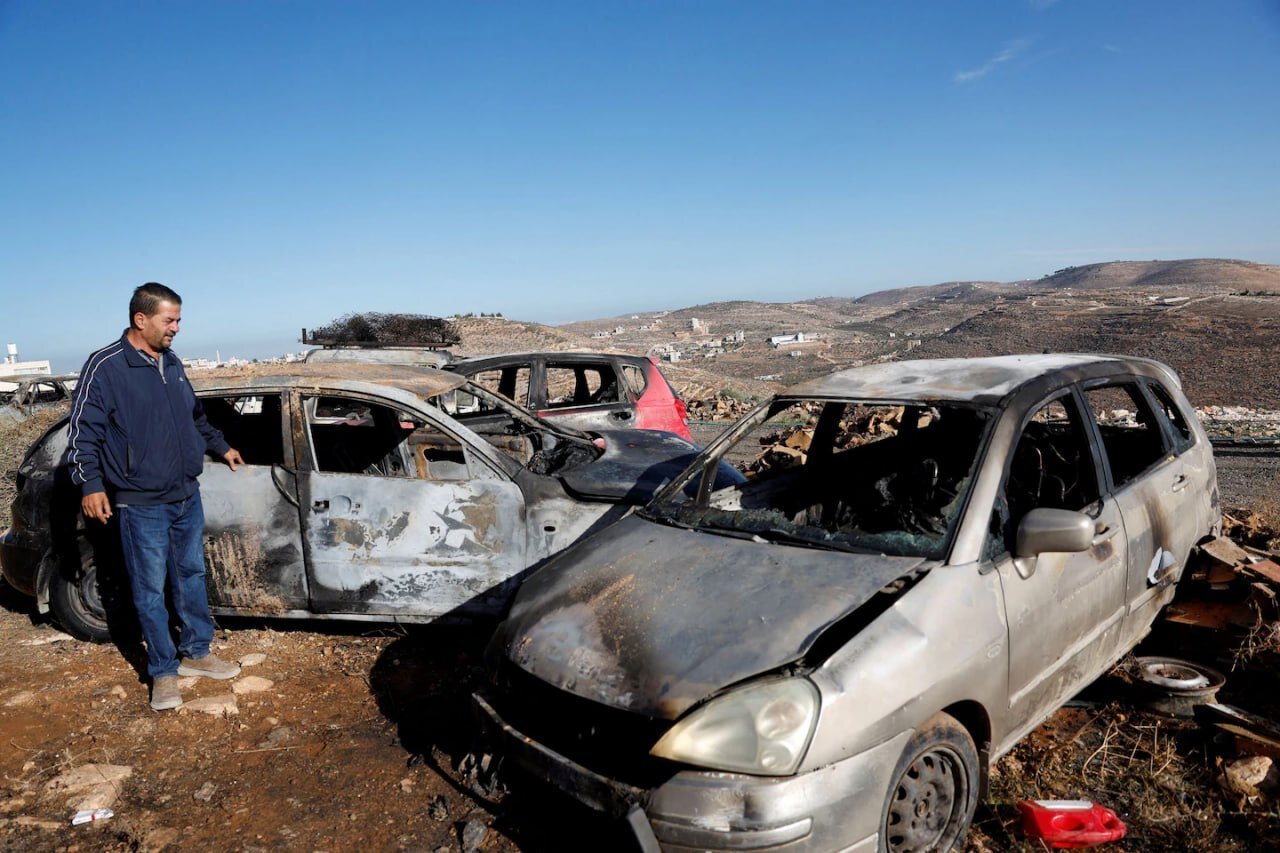
Settlers have held the approach to his land since June. Over the weekend they torched a dozen Palestinian cars in three nearby villages, and on Sunday Israeli forces flattened a herding community in the northern Jordan Valley.
In June settlers set up an outpost in Area B about a kilometer from Zahran’s land. For five months his family could not reach their farm room. On November 10, a High Court ruling granted the village two days of army-coordinated harvesting, and Zahran set out with his brothers.
About 20 settlers met them with stones, smashed the family truck and a four-wheeler, and slashed the tires. He saw no soldiers. Police never came, despite repeated calls.
The next day, soldiers were present but held farmers back until about 9 a.m., showed them a map of permitted areas, and ordered them out by 2:30 p.m. Their lawyer, Ghiyath Nasser, says villagers could reach under a third of the land, leaving Zahran about 20 of his 120 trees.
In the farm room he found his belongings stolen or smashed, settlers watering sheep at the two wells he had restored, and last year’s saplings dead of thirst.
After Nasser’s first petition, the army twice demolished the outpost, and settlers twice rebuilt it. The army then declared the site a closed military zone for Israelis only.
In theory, that is supposed to oblige soldiers to keep settlers out. Wail Qut, a lawyer with the Jerusalem (al-Quds) Legal Aid and Human Rights Center, says the practice runs the other way.
“Sometimes they declare an area closed to settlers, but in the application they close it to Palestinians,” he said.
Madama, south of Nablus, shows the sequence in reverse. The army gated the road to as much as a third of the village’s land about five years ago, and the High Court dismissed a petition.
Last April an outpost of about 10 caravans appeared inside the closed area, and the gate began opening for settlers.
Dror Etkes of Kerem Navot says this is routine. “There is no vacuum in the West Bank,” he said. A July report from his group and Peace Now found that farm outposts effectively controlled more than 1 million dunams, about 18 percent of the territory, by the end of 2025.
In al-Mughayyir, northeast of Ramallah, the outposts arrived first. Council member Marzouq Abu Naim says the first one appeared on the eastern plain in 2018 at 200 dunams and has grown to 5,000, with a dozen now around the village.
About 80 percent of its 43,000 dunams lies beyond the eastern entrance, closed for years, and villagers can move freely on only about 900. Abu Naim’s son Jihad, 32, was shot dead by a settler during an invasion of the village school in April.
On November 13, a settler’s word was enough to end a wedding.
A settler grazing his flock inside a closed military zone claimed someone from al-Mughayyir had thrown firecrackers or shot at him. He was unhurt. Soldiers took his word, sealed the village and raided it.
Samir Abu Alia, a council member, says about 20 army jeeps surrounded the wedding hall and soldiers threw stun grenades between the men and the women.
The groom, Hassan Abu Alia, was taken from his bride for two hours, and Abu Alia says he was beaten. Attendees deny there were gunshots or firecrackers.
After a shooting wounded an Israeli teenager in August 2025, the army ordered olive trees beside a settler road cleared as a security threat, and settlers joined in.
Locals say more than 10,000 trees were uprooted. The closure order that followed bars anyone without a permit, settlers included, and has been extended through December.
Yesh Din says it is enforced only against owners, and lawyer Lior Zur says the military turns closure orders into “a mechanism for transferring possession of land from its lawful Palestinian owners to settler trespassers.”
Overnight into Sunday, settlers burned seven cars in Kafr Malik, three in Deir Abu Mashaal and two in Deir al-Sudan, spraying racist slogans on homes, Wafa reported.
Near Hizma, soldiers fired live rounds at laborers crossing the separation wall, wounding several and detaining about 18.
On Sunday, Israeli forces demolished every structure in Khirbet Samra, one of the last herding communities in the northern Jordan Valley, including homes, animal shelters and water and power lines.
The Association for Civil Rights in Israel says more than 20 of those structures had never received a demolition order, yet Judge Ruth Ronnen declined an injunction that would have let families rebuild before winter.
Settlers shot dead an elderly woman and wounded ten others near Jericho on November 17.
Tuesday brought more raids: forces detained 17 Palestinians in Qalqilya, Nablus and Hebron and turned a Fatah office in Kafr Saba into a field interrogation site.
The UN says more than 400 settler attacks causing casualties or damage have been recorded since September, more than in any previous season.
PR damage control vs. unchecked terror on the ground
Facing some Western sanctions warnings, Israeli leaders staged a coordinated round of hollow condemnations this week to distance the regime from settler pogroms in the occupied West Bank.
At Monday’s ELNET conference in al-Quds (Jerusalem), President Isaac Herzog called weekend arson attacks near Ramallah “despicable” and claimed they do “not represent Israel.”
Hours later, Supreme Court President Yitzhak Amit, ruling on a petition from the besieged village of Burqa, termed the rampages a “systematic phenomenon,” yet framed his objection around protecting Israel’s global image, avoiding international sanctions, and safeguarding “the Zionist vision.”
Although the court ordered the Central Command chief and West Bank police to submit enforcement affidavits by December 3, Burqa council head Sael Kanaan stressed that residents remain completely unprotected: “Not a day goes by without an attack.”
Meanwhile, the Israeli establishment continues to shield colonial militias while pursuing genocide in Gaza and military aggression across Lebanon.
War Minister Israel Katz waited over a day to dismiss the arsonists as “a handful of rioters,” deflecting responsibility onto an unworkable August directive shifting civil enforcement from the occupation army to the police, after having abolished administrative detention for Jewish Israelis in November 2024, a measure Israel still weaponizes against thousands of Palestinians.
Similarly, Naftali Bennett condemned “despicable Jewish terrorism” solely as a threat to the settlements’ future, while Yashar chair Gadi Eisenkot, who is seeking to form the next coalition government, exploited the attacks to score political points against Netanyahu’s cabinet, demanding Shin Bet crackdowns and administrative detention while leaving the occupation itself unchallenged.
Together, these reactions expose how every faction of the Zionist establishment treats settler violence as a public-relations liability rather than an integral pillar of Israel’s broader project of ethnic cleansing.
Beyond the West Bank, the killing goes on. Gaza’s Health Ministry put the death toll at 74,746 on November 23, with 176,234 wounded since October 2023, and says more than 1,650 people have been killed since the October 2025 ceasefire.
An Israeli strike that day killed a UNRWA employee and at least two others. On November 24, the regime killed Gaza’s internal security chief.
In southern Lebanon, where the people are the victims of Eisenkot's "Dahiyeh Doctrine," Israeli shelling and airstrikes around Kfar Tibnit and Baraachit continue despite a U.S.-mediated framework, in a war that has killed more than 4,300 people there since March.
Washington keeps arming Israel while it calls itself a mediator and issues occasional mild statements. Hakeem Jeffries, the House Democratic leader, said Sunday he would push for sanctions on violent settlers and discuss limits on U.S. arms transfers.
Zahran’s children ask why they cannot go back to the farm room. He tells them it is too dangerous.