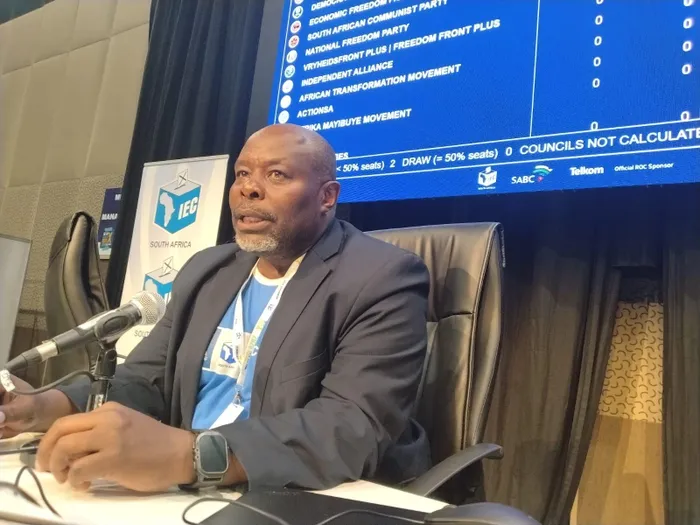
IEC National strategic Liason Officer Mawethu Mosery.
The IEC says outstanding objections in KwaZulu-Natal could affect final municipal election results and council seat allocation, which is expected to proceed after the objections process is completed.
IEC National strategic Liason Officer Mawethu Mosery said the commission would wait until tomorrow before proceeding with the process.
"We will wait until tomorrow. We have spent time with political parties explaining that process with them and we have a very good understanding," Masinga said.
He said the IEC had spent close to an hour and a half engaging political party representatives on the allocation of seats earlier in the day.
Mosery explained that municipal council seats are allocated in line with the country's proportional representation electoral system, which ensures that political parties receive representation according to their share of the vote.
He said a party's percentage of support in a municipality determines the number of seats it qualifies for, with both ward seats and proportional representation (PR) seats counting towards its overall entitlement.
"For example, as a party you got 10% voter support yesterday and the special vote days, therefore you qualify for 10% seats. That 10% includes both your PR seats and your ward seats," he said.
Using an example of a party that won four wards but whose overall vote share entitled it to only three council seats, Masinga explained that the party would retain the four ward seats but would not receive additional PR seats.
"We do not take away the ward. They keep the ward, but they definitely did not get a seat on the proportional representation seats," he said.
Mosery said the allocation process was difficult to explain without working through the actual figures but offered to arrange a further session with members of the media to explain the calculations.