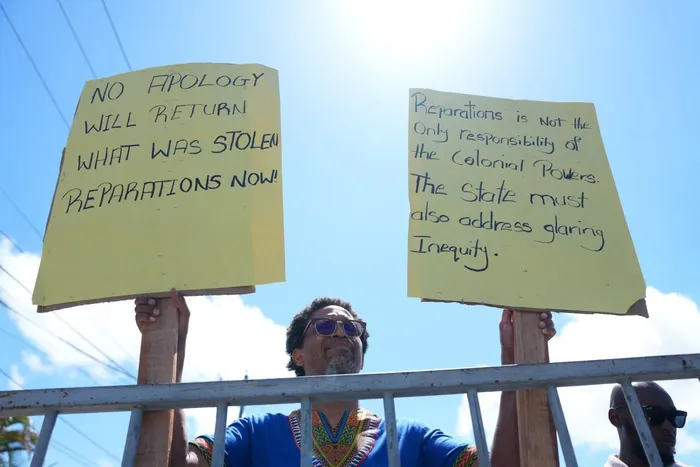
Terrence Campbell, head of the parliamentary opposition coalition A Partnership for National Unity (APNU), protests outside the National Toshaos Council in Georgetown, Guyana as Britain's King Charles III meets with indigenous leaders inside on October 30, 2026.
When King Charles III addressed the Commonwealth Heads of Government Meeting (CHOGM) in Antigua and Barbuda on 3 November 2026, he called the transatlantic slave trade a "shameful chapter of history".
He said that this fills his heart with horror and his soul with "the most profound personal sorrow". The King also said, "We cannot change the actions of those who came before us", which reflects a long-standing refusal to face the implications of Britain's historical responsibility. His vocabulary of sorrow is not new.
At CHOGM in Rwanda in 2022, he spoke of his "personal sorrow" over the legacy of slavery. In Kenya in 2023, he expressed "deepest regret" for colonial-era wrongdoing. On both occasions, he stopped short of an apology. Sorry appears to be the hardest word for the British King to say.
The monarchy is not an innocent bystander. Charles II granted the Royal African Company a monopoly over the English slave trade in 1672. Royal charters granted trading privileges to companies that profited from slavery.
Although the monarch cannot commit public funds on behalf of the State or determine government policy, Prime Minister Andy Burnham’s willingness to discuss a formal apology, even as he rules out financial reparations, raises questions about the Crown’s failure to issue an apology and the institutional accountability of the monarchy.
The Netherlands government apologised for its role in the slave-trade in 2022 and set up a €200 million fund. A year later, the Dutch King apologised. Both acknowledge that history carries obligations.
In his address this week, King Charles III reflected that history "is not ours to choose or to change", bequeathed to us by forebears we can never know, with their achievements and failures alike.
The legacy of slavery cannot be reduced to sorrowful memory. It cannot be conveniently consigned to the past. Between the 15th and 19th centuries, close to 12.5 million Africans were abducted and sold into slavery.
According to the Transatlantic Slave Trade Database, Britain transported close to 3.2 million of them, making it one of the most significant slave-trading nations. Millions died during capture, forced transportation, and the Middle Passage.
Survivors endured forced labour, sexual abuse and the systematic denial of their humanity. The profits fuelled European industrialisation while destabilising and destroying African societies.
In the Caribbean, the legacy of the transatlantic slave-trade is mass landlessness, entrenched poverty, weak public services and an unyielding racial hierarchy. Across the Commonwealth, it is visible in uneven accumulation, structural underdevelopment and unequal economic relations.
The King praised those who ended the international trade in enslaved people and pointed specifically to the Royal Navy's role in this regard. But abolition must not be mistaken for justice.
Under the Slavery Abolition Act of 1833, Britain set aside £20 million to compensate enslavers for the loss of their "property". The formerly enslaved received nothing. The first act of British "repair" was paid to the perpetrators.
Britain's reluctance has been consistent. In March 2026, the UN General Assembly adopted a Ghana-led resolution recognising the trafficking and chattel enslavement of Africans as "the gravest crime against humanity". A country so deeply implicated might have been expected to endorse it. Britain abstained.
CARICOM, the Caribbean Community of 23 member and associate member states including the Bahamas, Barbados and Jamaica, pushed for reparations to be placed on the CHOGM agenda. It received the King's pledge of a "modern partnership to address the wrongs of the past" through education, jobs, intra-Commonwealth trade and climate resilience, and Burnham's offer of a "debt reset" for poorer members.
While these measures are welcome, this is not reparation. They do not satisfy CARICOM's Ten-Point Plan for Reparatory Justice, which insists on a formal apology as well as concrete action: debt cancellation, educational and health investment, cultural restitution and development support. Outside the venue, protesters put it plainly: "You say you regret, so apologise. Reparatory justice now."
In September 2026, Jamaica petitioned King Charles, as King of Jamaica, to refer three questions to the Judicial Committee of the Privy Council.
The first question was whether enslaving Africans was ever lawful under English law.
The second was whether Britain breached international law at the time.
The third was whether the United Kingdom owes a reparatory remedy.
A preliminary hearing is expected in March 2027. A Privy Council finding that slavery was unlawful and requires remedy would not bind African states. However, it would certainly make it harder for London to insist that the past is beyond the reach of law.
Former colonies, including those in Africa, should pay close attention to the outcomes of the Antigua summit. Britain has clearly indicated that it will manage historical injustices and grievances through expressions of regret, the language of development and a raft of partnership pacts. These keep the fundamental question of liability closed.
Britain has not taken responsibility or offered compensation. If the Caribbean accepts this template, it will undoubtedly be proposed to Nairobi, Accra, Pretoria, and every other capital of former British colonies.
The African Union, SADC, and other regional bodies must align with CARICOM. The March 2026 UN resolution gave the Global South a boost. What is required now is a common legal and diplomatic strategy and a united demand for apology, restitution and structural repair.
The Commonwealth cannot present itself as a partnership of equals; historical crimes continue to stain its contemporary fabric. Britain cannot undo the slave trade. However, it can choose to move beyond the limp lingo of sorrow. Sorry cannot remain the hardest word to say. And reparatory justice cannot be put on hold for yet another generation.
* Heller is a political analyst and author of No White Lies: Black Politics and White Power in South Africa.
** The views expressed do not necessarily reflect the views of the National Media Group.